
中国特色金融文化建设

Search documents
上海召集75家公募总经理、督察长开会,相较于去年,本次会议规格提升、监管力度强化
Xin Lang Cai Jing· 2026-02-11 11:40
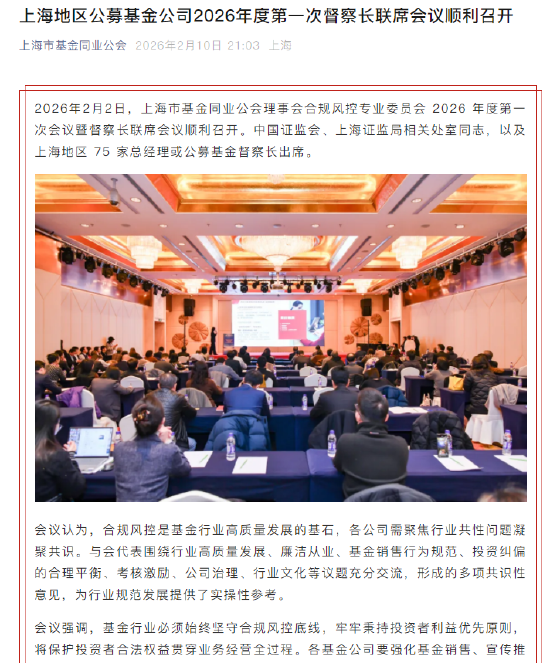
Core Viewpoint - The meeting emphasized the importance of compliance and risk control as the foundation for high-quality development in the fund industry, urging institutions to prioritize investor interests and strengthen internal controls [3][13]. Group 1: Compliance and Risk Control - Compliance and risk control are identified as essential for the high-quality development of the fund industry, with a focus on common issues and consensus building among institutions [3][13]. - Fund companies are encouraged to enhance risk prevention in key areas such as fund sales, promotion, and suitability management, while also conducting thorough risk assessments and self-corrections [4][13]. - The meeting highlighted the need for improved cybersecurity and stable operation of information systems, along with the establishment of effective public opinion monitoring mechanisms [4][13]. Group 2: Business Development - Institutions are advised to leverage their resources and research advantages to cultivate differentiated competitiveness in niche markets, while continuing to optimize product layouts and research systems [4][14]. - The meeting underscored the importance of developing equity funds and enhancing the capital market's functionality [4][14]. - There is a call to advance the construction of a distinctive financial culture in China, emphasizing compliance, integrity, professionalism, and innovation [4][14]. Group 3: Changes Compared to Previous Meetings - The current meeting reflects a shift towards regular and dynamic regulatory practices, with a change in frequency from an annual summary to a first meeting of the year [5][16]. - The leadership of the meeting has transitioned from the Shanghai Securities Regulatory Bureau to a joint effort with the China Securities Regulatory Commission, indicating an elevation of compliance and risk control to a strategic company-level issue [5][16]. - The focus of discussions has evolved from general regulatory measures to addressing emerging risks such as live marketing compliance and fund classification evaluations [5][16][17]. Group 4: Industry Governance and Regulatory Strengthening - The meeting marked a shift from generalized requirements to targeted actions, with a focus on high-quality development and consensus on industry pain points [6][17]. - There is an emphasis on the foundational role of compliance and risk control in the industry, with a call for companies to address common issues collaboratively [6][17]. - Regulatory efforts have intensified, with a mandate for comprehensive self-assessments to achieve early detection and management of risks [6][17]. Group 5: Recognition and Awards - The meeting included a summary and recognition of the 2025 Shanghai Fund Industry Knowledge Competition, awarding honors to outstanding teams and individuals [4][15]. - The Shanghai Fund Industry Association aims to continue acting as a bridge between regulators and the industry, fostering collaboration for a transparent and resilient capital market [4][15]. Group 6: Historical Context - The Shanghai Fund Company Supervisory Directors' Joint Meeting has been held since June 2005, evolving from a self-organized event to an annual activity under the Shanghai Fund Industry Association's Compliance and Risk Control Professional Committee since 2011 [9][20].

75家公募的“督察长会议”,传递了啥信号?
Xin Lang Cai Jing· 2026-02-11 04:00
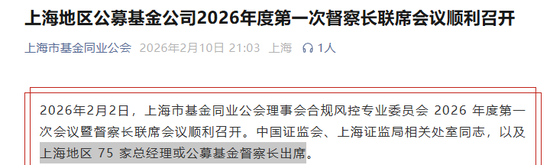
Core Viewpoint - The recent meeting of the Shanghai Fund Industry Association highlighted the importance of compliance and risk management as foundational elements for the high-quality development of the fund industry, with a notable attendance of 75 fund managers or compliance heads, indicating a higher level of engagement compared to previous years [1][3][19]. Group 1: Meeting Overview - The 2026 annual meeting of fund supervisors was attended by 75 fund managers or compliance heads, matching the attendance from the previous meeting in 2025 [1][15]. - The meeting was co-led by the China Securities Regulatory Commission and the Shanghai Securities Regulatory Bureau, marking a shift from previous years [5][17]. - The meeting's specifications were noted to be higher than in previous years, indicating an increased focus on compliance and risk management [7][19]. Group 2: Key Themes and Discussions - The meeting emphasized that compliance and risk management are essential for the high-quality development of the fund industry, with specific focus areas including high-quality development, integrity in operations, and regulatory compliance in fund sales [8][21]. - Key points discussed included the need for fund companies to enhance risk prevention in sales and marketing, conduct self-assessments for risk identification, and improve cybersecurity measures [22]. - The meeting also stressed the importance of monitoring public sentiment and enhancing the industry’s cultural foundation, promoting integrity and innovation [22][21]. Group 3: Industry Context - The fund industry is undergoing significant changes, with expectations for continued evolution as it approaches its 30th anniversary in 2028, drawing parallels to other industries that have transitioned from chaos to regulation [10][25]. - The meeting's outcomes are seen as practical references for the industry’s normative development, suggesting a collective movement towards improved standards and practices [8][21].
联储证券以责任担当诠释金融使命
Cai Fu Zai Xian· 2026-01-26 07:37
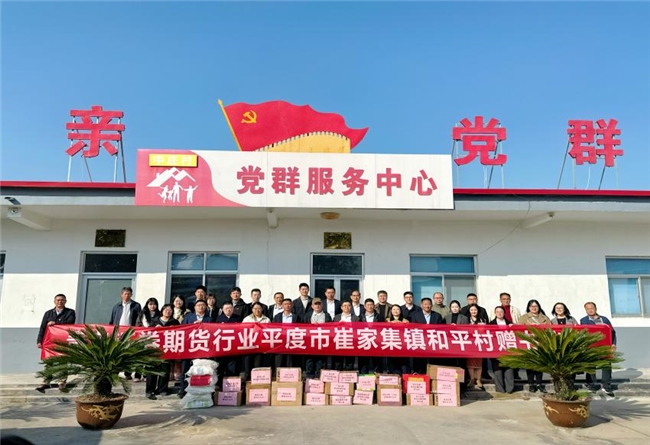
Core Viewpoint - The company actively participates in social responsibility initiatives, exemplified by its recent book donation activity aimed at enriching the cultural life of rural communities and supporting the rural revitalization strategy [1][3]. Group 1: Social Responsibility Initiatives - The company responded to the Qingdao Futures Industry Association's initiative by conducting a book donation event in Pingdu City, specifically in Cuijiaji Town and Ping Village [1]. - The donated books cover various topics, including party-building theory, financial knowledge, agricultural technology, and literary classics, catering to the diverse reading needs of villagers [3]. - This initiative reflects the company's commitment to integrating social responsibility into its corporate culture and aims to enhance the "soft power" that drives rural development [3]. Group 2: Corporate Culture and Governance - The company emphasizes the importance of compliance, integrity, professionalism, and stability in its corporate governance and development processes [3]. - It aims to internalize these cultural values among employees, ensuring that the financial culture is both understood and practiced [3]. - The company plans to continue promoting Chinese financial culture to enhance its cultural soft power and overall competitiveness while contributing to national strategies and high-quality development [3].
申港证券开展企业文化建设系列活动
Zhong Zheng Wang· 2025-08-28 05:39
Core Viewpoint - The company is enhancing patriotic education and corporate culture by organizing activities that promote the understanding of Chinese financial culture and historical responsibility among employees [1][2] Group 1: Corporate Culture and Education - The company organized a theme activity for employees to visit the Shanghai Library Anti-Japanese War Memorial Exhibition and the Sihang Warehouse Anti-Japanese War Memorial Museum to strengthen patriotic education [1] - The company emphasizes the importance of adhering to professional ethics and standards as outlined in the revised "Code of Professional Ethics for Securities Practitioners" released by the China Securities Association [1] - The company is implementing incentive mechanisms and institutional requirements to promote internal corporate culture and ensure high-quality development [1] Group 2: Compliance and Integrity - The company highlights that integrity is the foundation and compliance is the lifeline of the securities industry, essential for the healthy operation of modern securities business [2] - Employees are encouraged to have a keen risk awareness and strictly adhere to risk control systems to identify and mitigate potential risks such as credit, operational, and compliance risks [2] - The company positions its employees as the "frontline" guardians of stable operations and client asset safety [2]