权益类基金

Search documents
渤海证券研究所晨会纪要(2026.03.24)-20260324
BOHAI SECURITIES· 2026-03-24 01:06
Group 1: Fund Research - The equity market indices mostly declined, with the largest drop in the CSI 500, which fell by 5.82% during the week from March 16 to March 20, 2026 [2] - Ant Fund's equity holdings surpassed 1 trillion yuan for the first time, indicating significant growth in public fund assets [2] - A new batch of 15 hard technology-themed funds was approved, reflecting a focus on innovative sectors [2] Group 2: Fund Performance - The average decline for equity funds was 3.30%, with only 8.73% showing positive returns; fixed income plus funds fell by 0.72% with a 14.90% positive return rate [3] - The average position of active equity funds was measured at 71.62%, a decrease of 5.95 percentage points from the previous period [3] - The ETF market experienced a net outflow of 4.05 billion yuan, with stock ETFs seeing the largest outflow of 8.803 billion yuan [3] Group 3: Industry Research - The soft drink industry in China is projected to reach a market size of 1.25 trillion yuan in 2024, accounting for approximately 12.70% of the global soft drink market [5] - The leading category in the domestic soft drink market is packaged drinking water, with a market share of 21.50%, followed by tea beverages [5] - The Tianjin soft drink industry produced 3.3021 million tons in 2025, representing only 1.84% of the national total, but benefits from strong industrial foundations and strategic location [6] Group 4: Brand Development - The revival of the Beijing Beibingyang brand offers valuable lessons for Shanhaiguan, emphasizing brand heritage, product innovation, and diversified channel development [6] - The consumer base is shifting towards younger generations, with health and self-indulgence becoming key demands, indicating a need for soft drink companies to adapt their product offerings [6] - Shanhaiguan Soda, a century-old local brand, aims to expand nationally while leveraging its strong local market presence [6]
基金周报:首家万亿级权益类基金代销机构诞生,15只硬科技基金获批-20260322
Guoxin Securities· 2026-03-22 13:25
- The report does not contain any specific quantitative models or factors related to construction, evaluation, or testing results [5][17][19]
国泰海通|非银:财富管理需求旺盛,头部集中趋势明显——关于2025年下年销售机构公募基金保有量点评
国泰海通证券研究· 2026-03-17 14:08
Core Insights - The total non-cash fund holdings of the top 100 institutions increased by 14.7% to 11.7 trillion yuan, primarily driven by the growth in equity mutual funds [1] - The preference for fixed income plus products is rising, with banks losing market share to brokerages and third-party channels, indicating strong wealth management demand [1] Group 1: Fund Holdings Growth - The non-cash fund holdings of the top 100 sales institutions reached 11.7 trillion yuan in H2 2025, marking a 14.7% increase from H1 2025 [1] - Excluding equity funds, the holdings of other funds (mainly bond funds) amounted to 5.7 trillion yuan, reflecting a 12.67% increase and contributing 43% to the overall growth [1] - Equity fund holdings reached 6.0 trillion yuan, contributing 57% to the increase in non-cash fund holdings, indicating that equity funds are the main growth driver [1] Group 2: Equity Fund Performance - The equity fund holdings of the top 100 institutions grew by 17% to 6 trillion yuan in H2 2025, with index funds accounting for 54% of this growth [2] - The third-party channel showed the largest contribution, increasing by 22% to 1.8 trillion yuan, contributing 38% to the overall growth, with Ant Fund, Tiantian Fund, and Teng'an Fund being the main contributors [2] - The strong market performance in H2 2025, with the Shanghai Composite Index rising by 14.78%, led to increased trading activity, with an average daily transaction volume of 24.57 billion yuan in equity funds [2] Group 3: Market Concentration Trends - The market share of the top 100 wealth management institutions for equity and non-cash funds increased by 0.61% and 1.00% respectively from mid-2025 to the end of 2025, indicating a more pronounced head concentration effect [3] - The market share of banks in equity and non-cash funds decreased by 0.73% and 0.32%, respectively, as wealth management demand shifts towards brokerages and third-party institutions [3] - Fixed income plus products are increasingly favored, suggesting that banks with diverse fixed income products may see their market share decline [3] Group 4: Investment Recommendations - There is an increasing certainty that residents will enhance their allocation to equity assets, suggesting a focus on retail business share growth and potential investments in leading public funds or profitable brokerage firms [4]


关于 2025 年下年销售机构公募基金保有量点评:财富管理需求旺盛,头部集中趋势明显
GUOTAI HAITONG SECURITIES· 2026-03-17 07:40
Investment Rating - The industry investment rating is "Increase" for companies like 招商证券 and 兴业证券, indicating a positive outlook relative to the market index [12]. Core Insights - The demand for wealth management is strong, with a notable trend of concentration among leading institutions. The top 100 institutions saw a 14.7% quarter-on-quarter increase in non-monetary fund holdings, reaching 11.7 trillion yuan, primarily driven by the growth of equity funds [2][4]. - The preference for fixed income plus products is increasing, with banks losing market share to brokerages and third-party channels. This shift is attributed to the growing wealth management demand [2][4]. - The increase in equity fund holdings is mainly from third-party channels, with a 17% quarter-on-quarter growth, where index funds contributed 54% to the total growth of equity funds [4][5]. Summary by Sections Fund Holdings - The top 100 institutions' non-monetary fund holdings reached 11.7 trillion yuan in 2025H2, with equity funds contributing 57% to the growth. The equity fund holdings increased to 6 trillion yuan, while fixed income funds reached 5.7 trillion yuan [4][5]. - The market share of the top 100 wealth management institutions increased by 0.61% for equity funds and 1.00% for non-monetary funds from mid-2025 to the end of 2025 [4]. Company Recommendations - The report recommends关注零售业务份额有望提升, particularly for companies like 兴业证券 and 招商证券, which are expected to benefit from the increasing allocation of equity assets by residents [4][6].






公募代销“一哥”断崖式领先
第一财经· 2026-03-16 14:33
Core Viewpoint - The article discusses the latest rankings of public fund distribution agencies in China, highlighting the significant growth in fund sizes and the competitive landscape among different distribution channels [3][4]. Group 1: Fund Distribution Rankings - The top 100 public fund distribution agencies held a total of 60 trillion yuan in equity fund assets by the end of 2025, with a total non-money fund size of 11.7 trillion yuan and stock index fund assets reaching 2.42 trillion yuan, all showing significant growth [3][5]. - Ant Fund leads in all three metrics, with its equity fund assets increasing from 822.9 billion yuan to 1.02 trillion yuan, becoming the only agency with over 1 trillion yuan in equity fund assets [3][5]. Group 2: Market Dynamics - The public fund market reached a total size of 37.71 trillion yuan by the end of 2025, driven by active trading in the A-share market [5]. - Third-party sales institutions showed rapid growth, with the 16 listed agencies holding a combined equity fund size of 1.8 trillion yuan, a quarter-on-quarter increase of 22.44%, increasing their market share to 29.95% [5][6]. Group 3: Bank Performance - China Merchants Bank ranked second among agencies with over 10% market share, holding 610.5 billion yuan in equity fund assets, driven by its "TREE Long-term Profit Plan" [6]. - Despite the growth of China Merchants Bank, the overall performance of bank channels in the fund distribution market has faced challenges, with declines in equity and non-money fund sizes over three consecutive reporting periods [6][9]. Group 4: Competitive Landscape - The competition among distribution channels remains intense, with securities firms holding a dominant position, controlling half of the stock index fund market with a total size of 1.32 trillion yuan [10]. - The bank channel has begun to increase its efforts in the stock index fund segment, achieving a total distribution size of 357.8 billion yuan, a quarter-on-quarter increase of 34.16% [8][10].

3月A股:步入“两会”行情,以“稳”为主要特征
HUAXI Securities· 2026-03-01 09:42
Market Review - After the Spring Festival, the Wind All A Index saw a significant increase, breaking through the high point of January 26, indicating a reduction in post-holiday cautious sentiment. The financing balance returned to approximately 2.65 trillion yuan, with a net financing inflow of 77.6 billion yuan over the first three trading days after the holiday. Resource products and computing hardware sectors benefited from price increase logic, with steel, non-ferrous metals, and chemical indices rising over 7%. Since February, precious metals and crude oil prices have generally risen due to geopolitical risks and differing expectations regarding Federal Reserve policies. The US dollar index fluctuated around 97, while the offshore RMB continued its appreciation trend, recently surpassing the 6.9 mark [1][2][3]. Market Outlook - As the "Two Sessions" approach, the A-share market is characterized by stability. The escalation of overseas geopolitical conflicts may trigger short-term global risk aversion and inflation trading, with the duration of these conflicts being a key variable affecting the market. Domestically, the upcoming "Two Sessions" will focus on expanding domestic demand and new productive forces, which may become annual priorities. Historical data shows that the market tends to operate steadily during the "Two Sessions," with an increased probability of market gains following the conclusion of the sessions. Key areas of focus include the impact of geopolitical tensions in the Middle East, which may drive short-term global risk aversion and inflation expectations, benefiting sectors like crude oil and non-ferrous metals [2][3]. Focus on "14th Five-Year Plan" Direction - The A-share market will enter the "Two Sessions" period, emphasizing the direction of the "14th Five-Year Plan." Historical analysis from 2019 to 2025 indicates that the market's performance tends to decline during the "Two Sessions," likely due to some funds cashing out during the meetings. However, the performance of the Shanghai Composite Index and Wind All A Index tends to improve in the seven trading days following the sessions. Sectors highlighted during the sessions often continue to perform well throughout the year, such as the power sector after the mention of "carbon neutrality" in 2021 and the AI sector after the introduction of "AI+" in 2024. This year marks the beginning of the "14th Five-Year Plan," and the review of its draft will likely anchor mid-to-long-term industry directions [3][4]. Economic Focus for 2026 - The key tasks for economic work in 2026 include expanding domestic demand and fostering new productive forces. The economic growth target for 31 provinces is set around 5%, reflecting a pragmatic approach of "seeking progress while maintaining stability." The Central Political Bureau emphasized the continuation of a more proactive fiscal policy and moderately loose monetary policy, indicating a supportive and expansionary stance for 2026. The focus on expanding domestic demand and new productive forces is underscored by President Xi Jinping's article outlining eight key tasks, with the first two emphasizing the importance of domestic demand and innovation-driven growth [4][5]. Valuation and Risk Premium - From a valuation perspective, the latest Wind All A price-to-earnings (P/E) ratio, excluding negative values, stands at 18.58 times, which is at the 80th percentile of historical highs since 2010. However, approximately 40% of industries still have valuations below the median since 2010. The latest equity risk premium (ERP) for the CSI 300 is 5.26%, close to the median over the past decade, indicating that A-shares are relatively reasonably valued. In the medium to long term, the current "slow bull" market still has room for further development. Industry allocation should focus on sectors benefiting from inflation expectations, such as oil transportation, non-ferrous metals, and petrochemicals, as well as new productive forces supported by industrial policies, including military, computing, energy storage, and commercial aerospace [5].

公募发行“爆了”!增量资金正疯狂涌向A股
市值风云· 2026-02-27 10:14
Core Insights - The public fund issuance market has seen a significant increase in both the number and scale of new funds established in 2026, with 230 new funds launched and a total issuance scale exceeding 210 billion yuan [1][3]. Group 1: Fund Issuance Trends - The first week of trading in 2026 witnessed a high density and rapid pace of new fund launches, with 18 new funds starting their issuance on the first trading day alone [4][5]. - A total of 36 new funds were planned for issuance during the first trading week from February 24 to 27, 2026, with equity funds dominating the offerings [5][6]. - Among these 36 funds, 14 were actively managed equity funds and 11 were passive stock index funds, accounting for nearly 70% of the total [7]. Group 2: Comparative Analysis - In the first two months of 2026, the cumulative number of new funds reached 246, a significant increase compared to previous years: 177 in 2025, 212 in 2024, and 189 in 2023 [9][11]. - The increase in new fund issuance reflects a growing supply side in the public fund market, with more funds expected to launch in March 2026 [12][11]. Group 3: Fundraising Scale - The total fundraising scale for new funds in 2026 has surpassed 210 billion yuan, compared to less than 150 billion yuan in the same period in 2025, indicating a strong influx of capital into the market [15][18]. - Out of the new funds, 65 had an issuance scale exceeding 1 billion yuan, with 15 funds raising over 3 billion yuan each [17]. Group 4: Market Dynamics - The substantial growth in fundraising is attributed to improved market conditions that have enhanced investor willingness to enter the market, alongside a long-term trend of household savings shifting towards capital markets [18]. - The continuation of this influx of new capital is contingent upon the sustained "profitability effect" in the market, with expectations of a stable upward trend in the equity market for the year [19].
资金结构观察系列之一:“存款到期”一定会带来“存款搬家”吗?
HWABAO SECURITIES· 2026-02-12 08:19
Investment Insights - The report discusses the significant upcoming maturity of approximately 67 trillion yuan in household time deposits in 2026, primarily formed after 2020 due to residents' precautionary savings amid uncertainties, with a notable shift from high interest rates above 3% to a low-rate environment where mainstream renewal rates are below 2% [9][15][27] - The potential reallocation of these funds is a focal point of market discussions, as it could impact the preservation and appreciation of household wealth and influence various financial asset prices [9][27] Fund Flow Directions - The report identifies three main directions for the funds from maturing deposits: 1. Renewal of deposits, which remains a default choice for most savers despite low interest rates, as consumption and housing purchases are not expected to dominate in the short term [2][15] 2. Early mortgage repayment, as the current mortgage rates exceed deposit and low-risk investment returns, leading to a high early repayment rate in RMBS, although this is not the primary direction for the funds [17] 3. Investment in both low-risk assets (such as bank wealth management products, bond funds, and insurance) and risk assets (like equity funds and the stock market), with the latter being the most debated potential direction for "deposit migration" [2][15][17] Asset Performance Influence - The ultimate direction of the maturing deposit funds towards low-risk or risk assets will depend on the actual performance of various asset classes, as funds inherently seek to chase better-performing assets and withdraw from underperforming ones [19][27] - Historical market trends indicate that funds tend to rotate based on asset performance, with recent trends showing simultaneous movements in both bond and stock markets due to significant allocations through "fixed income plus" strategies [19][27] Central Bank Perspective - The report highlights that funds from maturing deposits are likely to flow back into the banking system, albeit in a different form, as they transition from household deposits to non-bank institutional deposits [3][20][26] - By the end of 2025, over 80% of asset management products are expected to be directed towards fixed-income assets, with a significant portion returning to bank deposits, indicating a structural change rather than a mass exodus from the banking system [3][20][26]
节前基金操作现反差:固收“闭门”权益“纳新”
Zheng Quan Ri Bao· 2026-02-11 16:17
Group 1 - The public fund market is experiencing a rare divergence in subscription and redemption patterns as the Spring Festival approaches, with low-risk products like money market and bond funds closing to new investments while some equity funds are still accepting new subscriptions [1] - As of February 11, 64 fund managers announced adjustments to nearly 200 funds, with 150 bond and money market funds, accounting for 75% of the total, implementing subscription limits or suspending subscriptions until after the holiday [1] - The strategy of limiting subscriptions for fixed-income products is a defensive measure to protect existing investors from potential dilution of returns due to large inflows and subsequent outflows during the holiday period [3] Group 2 - In contrast to the tightening of fixed-income products, some equity funds are lifting subscription limits, indicating a more aggressive stance from fund managers regarding the post-holiday liquidity environment and long-term market value [2][3] - Historical data shows a subtle change in the subscription limits for equity funds, with the number of funds imposing large subscription limits decreasing from 614 to 605, and the median limit increasing from 200,000 to 500,000 [2] - The differing subscription strategies between fixed-income and equity products reflect the operational logic and market expectations of these asset classes, guiding investors towards more rational asset allocation [3]
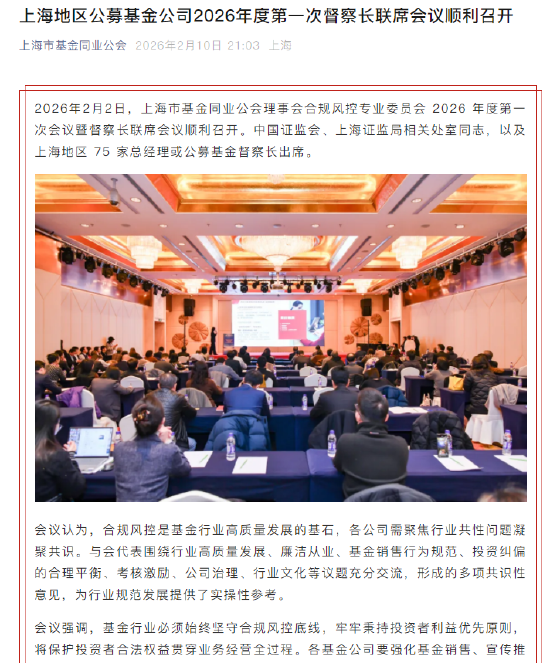
上海公募行业督察长联席会议:坚守合规风控底线,秉持投资者利益优先原则,强化基金销售、宣传等风险防范
Xin Lang Cai Jing· 2026-02-11 11:46
Core Viewpoint - The meeting emphasized that compliance and risk control are fundamental to the high-quality development of the fund industry, urging institutions to focus on common issues and strengthen internal controls to build a robust risk defense [3][8]. Group 1: Compliance and Risk Control - Compliance and risk control are identified as the foundation for high-quality development in the fund industry [3][8]. - Institutions are encouraged to prioritize investor interests and integrate the protection of investors' legal rights throughout their business processes [3][8]. - Fund companies should enhance risk prevention in key areas such as fund sales, promotion, and suitability management, while also improving their compliance and risk control capabilities [3][8]. Group 2: Business Development - Institutions are advised to leverage their resources and research advantages to cultivate differentiated competitiveness in niche areas [4][9]. - There is a call to maintain a focus on equity fund development, optimize product layout and research systems, and enhance the capital market's functionality [4][9]. - The meeting highlighted the importance of advancing a distinctive financial culture that emphasizes compliance, integrity, professionalism, stability, and innovation [4][9]. Group 3: Industry Collaboration - The Shanghai Fund Industry Association aims to act as a bridge between regulatory bodies and the industry, fostering collaboration to build a transparent, open, and resilient capital market [10]. - The association will continue to support the high-quality development of the public fund industry under the guidance of the Shanghai Securities Regulatory Bureau [10].