中国电商出海

Search documents
中国电商出海进入“重资产时代”
美股研究社· 2026-03-17 11:22
Core Viewpoint - The article discusses the evolution of Chinese e-commerce going global, transitioning from a price-driven model to one focused on infrastructure and logistics efficiency [1][3]. Group 1: Transition in E-commerce Strategy - The first phase of Chinese e-commerce overseas was characterized by low prices and direct shipping from China, leveraging cost advantages [5][6]. - As the low-price advantage diminishes, the focus shifts to user experience, efficiency, and service quality [1][6]. - JD.com is taking a different approach by launching its European platform Joybuy, emphasizing logistics and supply chain rather than just pricing [3][7]. Group 2: Logistics and Supply Chain as Competitive Edge - Joybuy employs a heavy asset model, establishing local warehouses and logistics networks in Europe to achieve same-day delivery in certain areas [7][8]. - This logistics efficiency is comparable to or even surpasses local competitors, marking a shift from price competition to infrastructure competition [8][10]. - JD.com’s strategy focuses on supply chain management, allowing for better control over product quality, inventory, and delivery times [10][11]. Group 3: Market Dynamics and Challenges - The European e-commerce market is complex, with a size nearing $800 billion and characterized by diverse languages, cultures, and regulations [13][14]. - Chinese companies are adopting different strategies: low-price platforms like Temu, brand export through platforms like Amazon, and JD.com's supply chain export model [15][16]. - JD.com’s approach requires significant local operational capabilities to navigate compliance, tax, and labor issues [15][17]. Group 4: Future Implications and Investment Perspective - The competition is shifting from a focus on traffic and pricing to logistics and supply chain infrastructure, which is crucial for long-term market share [16][19]. - If JD.com succeeds in Europe, it could validate the heavy asset model and provide a framework for expansion into other developed markets [17][18]. - The ultimate competition may not be about who is cheaper, but who can build a comprehensive logistics and service infrastructure akin to Amazon [18][19].



【极兔速递-W(1519.HK)】全球化成长型物流企业,享中国电商出海红利——首次覆盖报告(付天姿/杨朋沛)
光大证券研究· 2026-03-12 23:05
Core Viewpoint - The article discusses the growth and market positioning of a global logistics service provider that has established a comprehensive express delivery network across 13 countries and regions, including China, Southeast Asia, and Latin America, highlighting its partnerships with major e-commerce platforms like TikTok Shop and Pinduoduo [4]. Southeast Asia: Profitability Base Driven by Scale Effect - The Southeast Asian e-commerce market is experiencing high growth, with total parcel volume expected to reach 15.98 billion in 2024, a year-on-year increase of 25.2%, and a projected compound annual growth rate (CAGR) of 15.2% from 2025 to 2029 [5]. - TikTok Shop is rapidly growing in the Southeast Asian e-commerce market, with gross merchandise volume (GMV) increasing from approximately $4.4 billion in 2022 to about $22.6 billion in 2024, reflecting a CAGR of 127% [5]. - The logistics provider's parcel volume growth in Southeast Asia is closely correlated with TikTok Shop's expansion, with a 57.9% year-on-year increase in parcel volume in the first half of 2025, contributing to a 65.4% year-on-year growth in adjusted EBIT [5]. New Markets: Focusing on Brazil and Mexico - The Latin American e-commerce market presents significant opportunities, with TikTok Shop leading new growth. The region has a lower e-commerce penetration rate compared to Southeast Asia and China, with a fragmented platform landscape [6]. - In the first half of 2025, the logistics provider's parcels in new markets will primarily come from Temu and SHEIN, with TikTok Shop expected to increase its share of parcels processed by the company [6]. - The adjusted EBITDA for new markets is projected to turn profitable in the first half of 2025, with expectations for adjusted EBIT per parcel to reach $0.09 in the second half of 2025 [7]. China: Intense Competition and "Anti-Internal Competition" Boosting Profitability - The long-standing price wars in China's express delivery industry have pressured single parcel revenue, leading to a shift from "price for volume" strategies to a focus on quality improvement and efficiency enhancement as part of a high-quality development path [8].

绿联科技递表港交所;里昂首次给予林清轩“跑赢大市”评级丨港交所早参
Mei Ri Jing Ji Xin Wen· 2026-02-02 17:31
Group 1 - Ugreen Technology has submitted its listing application to the Hong Kong Stock Exchange, with Huatai International as its sole sponsor. The company is a consumer electronics brand focusing on charging, smart office, smart audio-visual, and smart storage products, aiming to become the global leader in the tech consumer electronics market by shipment volume by 2025 [1] - JD Group's European online retail platform, Joybuy, is set to launch in March 2023, leveraging JD's supply chain and logistics capabilities to achieve same-day and next-day delivery in multiple cities across the UK during its trial operation [2] - China Merchants Shekou's contract sales for the year ending December 31, 2025, amounted to approximately RMB 32.308 billion, reflecting a significant year-on-year decrease of 23.91%. The average selling price was approximately RMB 24,918 per square meter [3] Group 2 - Citi has initiated coverage on Lin Qingxuan with an "Outperform" rating, highlighting the company's expansion into the high-end anti-aging and skin-tightening market, which is expected to grow at a compound annual growth rate of 18.9% from 2024 to 2029. The firm forecasts Lin Qingxuan's sales and adjusted net profit to grow at compound annual rates of 42% and 49%, respectively, from 2025 to 2027, with a target price of HKD 128.5 [4]
中国电商出海日本,策略都不灵了?
Hu Xiu· 2025-08-01 01:08
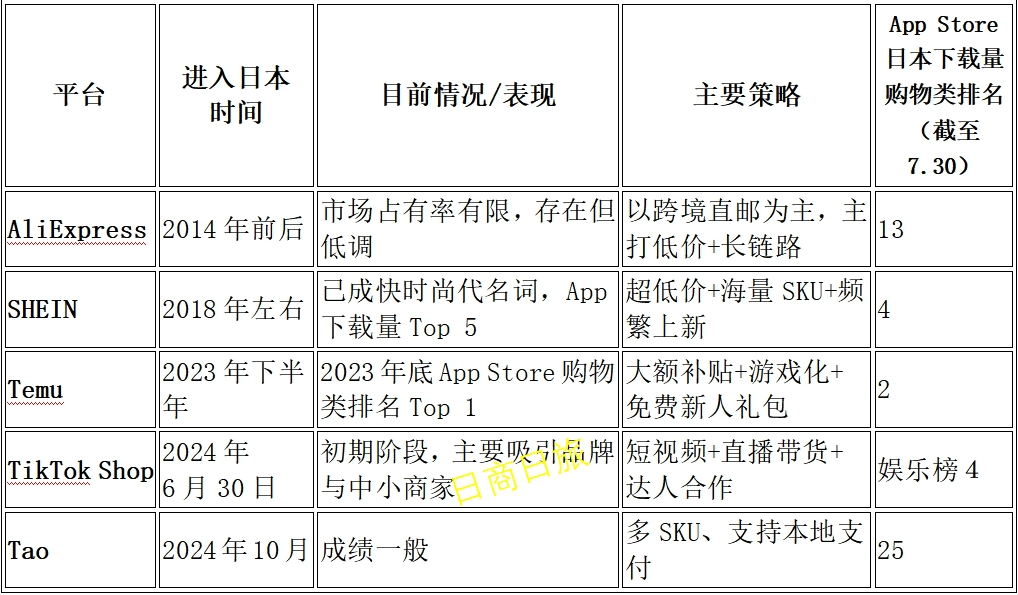
Core Viewpoint - The article discusses the challenges and strategies of Chinese e-commerce companies, particularly Temu and SHEIN, as they expand into the Japanese market, highlighting the differences in consumer behavior and marketing strategies between China and Japan [4][72]. Group 1: Market Conditions - Japan has favorable conditions for e-commerce, including strong payment capabilities, good logistics infrastructure, high internet penetration, and stable demand for clothing, beauty, and daily goods [5][4]. - Despite the strong offline retail presence, there is a solid foundation for e-commerce, with many older consumers having experience with online shopping [5]. Group 2: Company Strategies - Temu, launched in 2022, has rapidly gained traction in Japan, achieving 15.5 million monthly active users by July 2023, largely due to aggressive advertising spending of approximately $2 billion by its parent company, Pinduoduo [12][4]. - SHEIN entered the Japanese market earlier and has become a well-known fast fashion brand, ranking in the top 5 for shopping app downloads on Google Play [13][4]. - Temu's strategy in Japan focuses on low-price subsidies and gamification elements, such as time-limited offers and lotteries, diverging from Pinduoduo's original social group-buying model [24][25]. Group 3: Consumer Behavior - Japanese consumers exhibit a preference for stability and safety in shopping, often conducting extensive research before making purchases, contrasting with the impulsive buying behavior seen in Chinese consumers [57][52]. - The Japanese market is characterized by a high loyalty to brands and a preference for PC-based shopping, with over 50% of e-commerce transactions occurring on desktop computers [53][56]. Group 4: Marketing Techniques - Temu and SHEIN utilize gamification to engage users, employing tactics like limited-time promotions and interactive elements to enhance user experience [30][36]. - Japanese e-commerce typically does not incorporate gamification or urgency in marketing, focusing instead on loyalty programs and straightforward pricing strategies [32][31]. Group 5: Competitive Landscape - The competitive landscape in Japan is challenging for foreign e-commerce players, as local companies have established strong brand loyalty and consumer trust [72][62]. - Temu and SHEIN must navigate cultural differences and consumer expectations, adapting their strategies to align with Japanese shopping habits and preferences [72][74].