主力出货

Search documents
股票经常高开低走意味着什么?我从这三个角度找到了答案
Sou Hu Cai Jing· 2026-02-26 05:37
Core Viewpoint - The phenomenon of "high open and low close" is a common market pattern that indicates a complex battle between bulls and bears, often misleading novice investors who may misinterpret the surface movements of stock prices [1] Group 1: Volume Analysis - High open indicates a short-term bullish signal driven by funds or sentiment, while low close suggests that selling pressure exceeds buying strength, indicating a potential shift in market sentiment [3] - Volume analysis is crucial to distinguish between "washing" and "distribution" actions by the main players. A decrease in volume during a low close after a high open typically indicates a "washing" scenario, where the main players are not genuinely selling but are instead forcing out weak hands [4] - Conversely, a significant increase in volume during a low close suggests a "distribution" scenario, where the main players are taking advantage of the high open to sell off shares, indicating a potential "true decline" [5] Group 2: Price Positioning - The significance of the "high open and low close" pattern varies greatly depending on the price position. In low price areas, it often indicates a washing scenario, while in high price areas, it suggests a distribution scenario [4][5] - In low price regions, if the stock price has not significantly exceeded the main players' cost, it is likely a strategy to accumulate shares before a potential upward movement [4] - In high price regions, where the stock has appreciated over 50%, the likelihood of distribution increases as the main players seek to realize profits [5] Group 3: News Impact - High opens are often driven by news, and the nature of the news directly influences the subsequent low close. If positive news is already priced in, the actual announcement may lead to a sell-off, as seen in cases where companies report significant earnings increases [7][8] - If a high open occurs without clear positive news, it may indicate market sentiment or technical-driven fluctuations, often leading to short-term adjustments [10][11] - Repeated occurrences of this pattern may signal a cooling of market sentiment and a gradual withdrawal of funds from the sector [12] Group 4: Common Misconceptions - A common misconception is that a high open automatically indicates bullish sentiment, while a low close signals panic. It is essential to consider volume and price position for a comprehensive assessment [13] - Another misconception is that a long upper shadow always indicates negative sentiment. In low volume scenarios, it may represent a washing action, while in high volume scenarios, it signals risk [14] - Continuous occurrences of the "high open and low close" pattern suggest an imbalance between bulls and bears, warranting caution and potential reduction in positions [15] Group 5: Conclusion - The key to interpreting the "high open and low close" pattern lies in understanding the interplay of volume, price position, and news context, allowing investors to discern the intentions of main players and navigate market complexities effectively [16][19]


从679暴跌至112,再暴涨翻倍:药捷安康是谁在 “造神”?
Zhi Tong Cai Jing· 2025-10-17 14:30
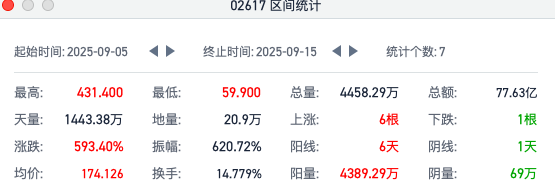
Core Insights - The stock of Yaojie Ankang - B (02617) experienced extreme volatility, with a significant rise followed by a sharp decline, indicating a classic "pump and dump" scenario [1][7][14] Group 1: Price Movement and Trading Volume - From September 5 to September 15, 2025, the stock surged by 593.40% with a trading volume of 44.58 million shares, totaling 7.763 billion [2][3] - The stock reached a peak price of 431.40 and a low of 59.90 during this period, with a trading turnover rate of 14.78% [3] - The subsequent period from September 16 to October 15 saw a drastic decline, with the stock price dropping over 72% from a high of 679.50 [7][8] Group 2: Market Dynamics and Investor Behavior - The initial surge was driven by mainland investors through the Hong Kong Stock Connect, which increased holdings by over 306,000 shares, indicating strong buying interest [4][5] - In contrast, during the decline, the Southbound Stock Connect saw a significant reduction in holdings by 0.6650%, while the Northbound Stock Connect increased by 0.598%, highlighting a divergence in investor sentiment [9][12] - The rebound from October 16 to 17, 2025, saw a 78.85% increase, characterized by a trading volume of 22.76 million shares, indicating a classic "dead cat bounce" [10][11] Group 3: Institutional Actions - Major institutional players like BNP Paribas and Merrill Lynch emerged as new buyers during the rebound, suggesting a shift in market dynamics [10][12] - The actions of domestic funds indicated a lack of confidence in the sustainability of the rebound, as they were net sellers during this period [12][14] - The overall trading behavior suggests that the rebound was primarily driven by short-term speculative trading rather than long-term investment confidence [14]