主权风险

Search documents
巴拿马港口被“接管”后,李嘉诚卖掉英国电网业务,转向非常突然
Sou Hu Cai Jing· 2026-02-27 03:47
Core Viewpoint - The recent forced takeover of port assets by the Panamanian government has prompted the Cheung Kong Group to swiftly sell its core UK electricity grid business, raising concerns about asset security for multinational companies and the restructuring of global investment logic [2][4]. Group 1: Events and Responses - On February 23, the Panamanian government forcibly took control of the Balboa and Cristobal ports, ending a nearly 30-year operating agreement and expelling the management team, leading Cheung Kong to initiate international arbitration [4]. - Shortly after, Cheung Kong's subsidiaries announced the sale of their stake in the UK electricity operator to French energy company Engie for approximately £10.548 billion, totaling over HK$110 billion, marking a complete exit from UK core utility assets [4][6]. Group 2: Asset Characteristics - The UK electricity grid assets served around 8.5 million users and operated approximately 192,000 kilometers of power lines, covering key areas in London and Southeast England, characterized by stable cash flow and predictable returns, traditionally viewed as low-risk core assets [6]. - The decision to sell these assets entirely in cash and equity, without retaining any equity interest, reflects the company's decisive stance and a reassessment of regional risks and asset prospects [6][8]. Group 3: Strategic Implications - The Panama port incident has become a pivotal point for strategic shifts, as the ports, which relied on the Panama Canal's geographical advantages, were expected to hold long-term commercial value until 2047 [8]. - The unilateral takeover disrupted the stability of commercial contracts and long-term investments, highlighting the potential impact of sovereign risk and policy changes on overseas infrastructure assets [8][10]. - The sale of quality electricity grid assets allows for significant cash flow recovery, providing funding for reinvestment in lower-risk areas, strengthening core business, and enhancing shareholder returns [11].






金价破五千黄金稳定币赛道狂飙
Jin Tou Wang· 2026-01-27 04:00
Group 1 - The core viewpoint of the news is that the recent surge in gold prices, surpassing $5000, is seen as a structural shift rather than a short-term spike, driven by inflation hedging, currency devaluation concerns, and renewed sovereign risks [2][5] - Tether Gold (XAUT) is projected to capture approximately 60% of the global gold-backed stablecoin market by the end of 2025, with the market size expected to reach around $4 billion [2] - Tether's gold reserves, as of December 31, 2025, are reported to be 520,089.350 troy ounces, corresponding to a total value of approximately $2.25 billion based on an estimated gold price of $4320 per ounce [2] Group 2 - Tether has seen a significant increase in the issuance of XAUT, with a 38% growth in the last three months, indicating a concentrated demand for gold exposure following the price breakout [3] - The company sold 409,271.64 XAUT in 2025, with a notable increase in sales during the fourth quarter, reflecting a strong market demand for gold-backed tokens [3] - Tether's CEO emphasized that XAUT aims to eliminate uncertainty during times of weakened confidence in the monetary system, with each token backed by physical gold that can be verified on-chain [3][4] Group 3 - The market is witnessing a shift where alternative assets like gold are being accepted by stablecoin issuers, as evidenced by Tether's leading position in the tokenized gold space despite the earlier launch of Paxos' PAX Gold [4] - The demand for tokenized gold is expected to expand further in 2026, as gold prices are anticipated to remain high, with the characteristics of gold-backed stablecoins providing a new infrastructure for investors seeking gold exposure [5] - Technical analysis indicates that the recent gold price surge may face resistance at key levels, with potential for short-term corrections, suggesting a cautious approach to trading strategies [6]
多重利空突袭!欧洲银行股16年来最大反弹面临严峻考验
智通财经网· 2025-09-01 08:57
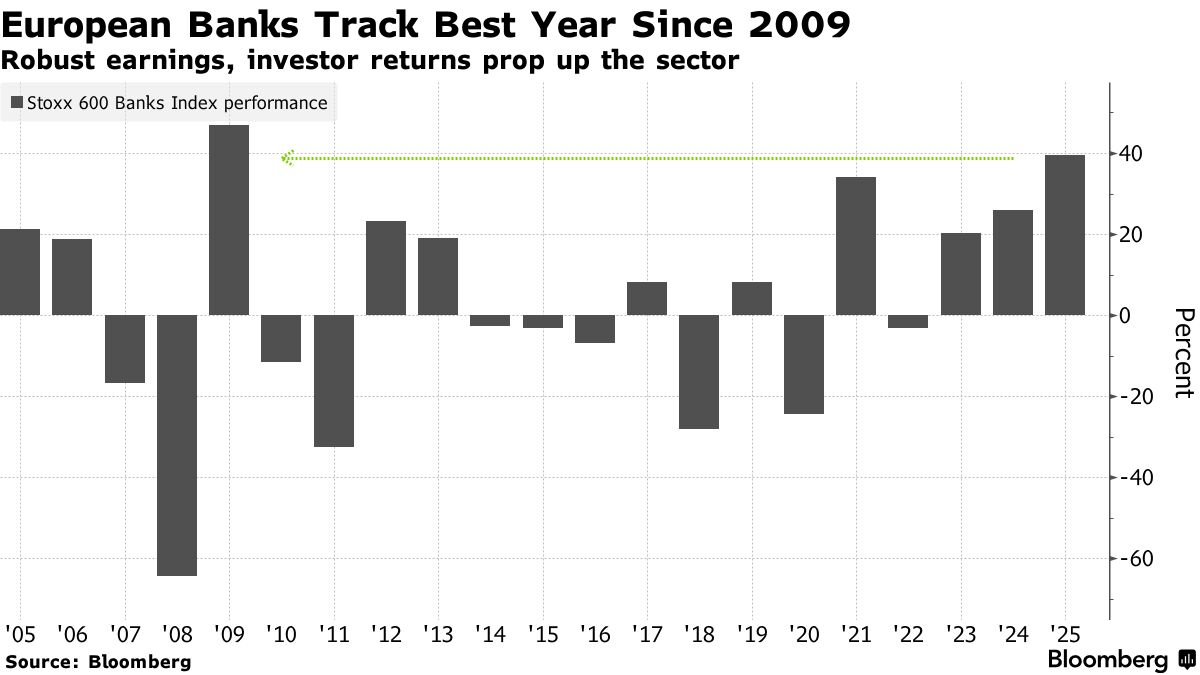
Core Viewpoint - European bank stocks are facing significant challenges amid rising taxes and sovereign risks, with the Stoxx 600 Bank Index experiencing its largest drop in 16 years, down 4.5% last week, due to a series of negative news including political instability in France and renewed calls for windfall taxes in the UK [1] Group 1: Market Reactions - The UK Chancellor is under pressure to raise billions through windfall taxes on banks, reflecting investor concerns about the sector's profitability [1] - Political instability in France, with over 70% of the public opposing a confidence vote for the government, raises doubts about the stability of the banking sector [1] - Major banks such as Deutsche Bank, Sydbank, National Westminster Bank, and Société Générale are particularly affected, as investors question their ability to maintain strong profit outlooks [1] Group 2: Financial Performance - The European banking sector had a strong performance in 2025, with the bank index rising 41% due to impressive earnings and solid investment returns, outperforming other sectors [4] - The MSCI Europe Financial Index constituents exceeded analyst expectations in Q2, with earnings per share growth of 15%, significantly higher than the anticipated 2% [4] Group 3: Analyst Perspectives - Some market participants, including Citigroup and Goldman Sachs, believe that French banks can withstand rising sovereign risks, citing strong capital positions [7] - Optimists argue that despite a third consecutive year of gains for European bank stocks, the rebound is not overheated, as the index remains about 45% below its pre-2007 financial crisis peak [7] - Concerns about a potential deterioration in the global economic outlook persist, with analysts noting that weak economic growth could negatively impact financial stocks historically [10]