
乐业社会

Search documents
工作时间减半?AI驱动下四大乐业场景与产业蓝海
Xin Lang Cai Jing· 2026-02-11 04:17
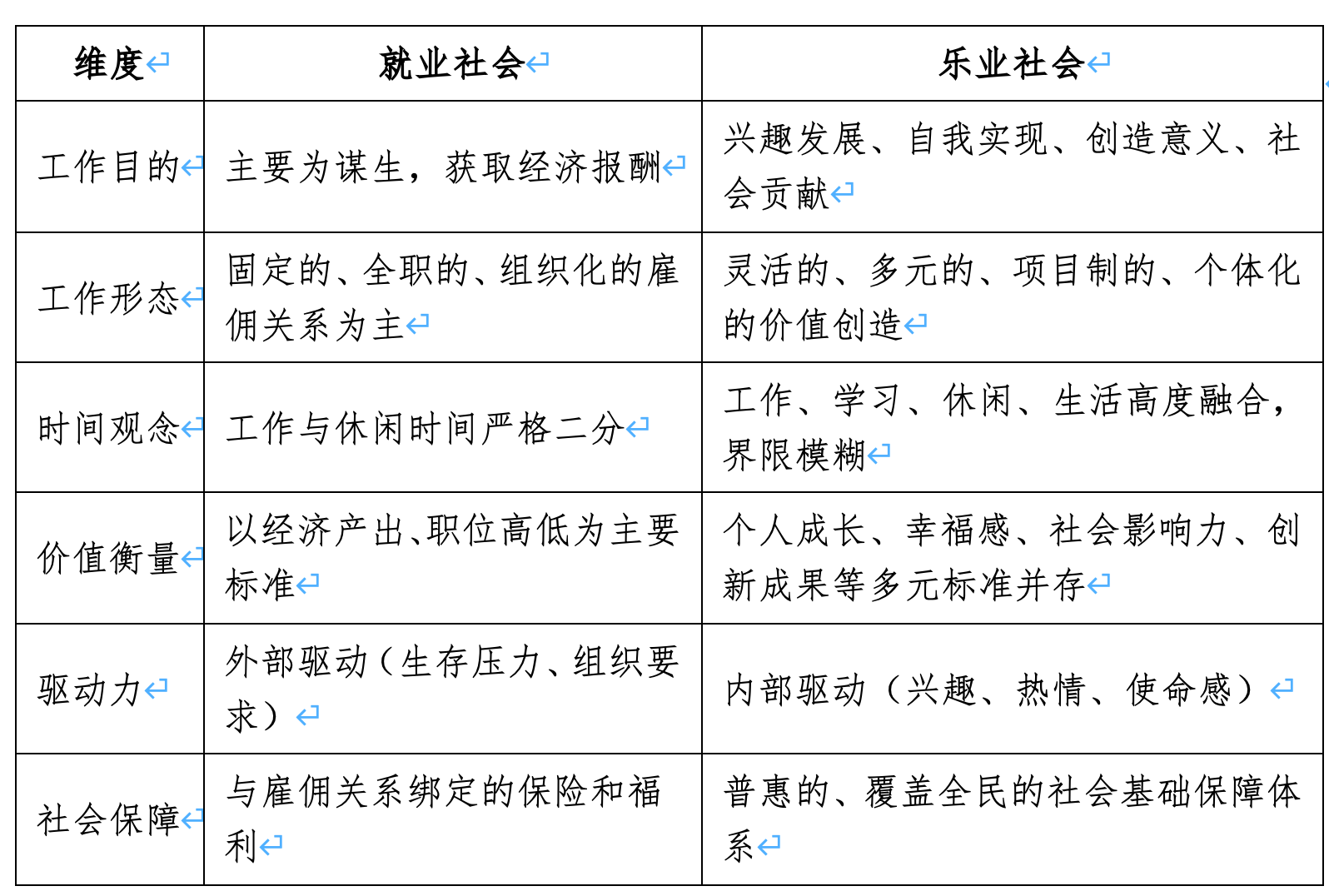
Core Insights - The transition from "employment" to "enjoyment" reflects a profound societal shift driven by AI and technological advancements, redefining work's purpose from mere survival to self-actualization and meaningful contribution [1][3][19] Group 1: Concept of Enjoyment Society - The "Enjoyment Society" emerges in a context of advanced productivity and relative material abundance, allowing individuals to choose their lifestyles and work modes based on personal passion and self-fulfillment [3][4] - The shift towards an "Enjoyment Society" is gradual, with short-term efficiency gains from AI, followed by a mid-term peak in job restructuring, and a long-term stabilization of new employment structures and lifestyles [3][4] Group 2: Life Scenarios in Enjoyment Society - Four core life scenario clusters are identified: self-actualization and interest-driven living, flexible and integrated new work models, quality living and housing security, and new forms of social participation and public services [2][10][12] - The self-actualization cluster includes artistic creation, lifelong learning, and health exploration, emphasizing personal growth and emotional fulfillment [7][8] - The flexible work model cluster highlights the shift from traditional employment to gig economy and remote collaboration, enabling individuals to work while traveling [10] - The quality living cluster focuses on community services and sustainable living, ensuring access to essential services and promoting a high quality of life [11] - The social participation cluster encourages community engagement and social innovation, allowing individuals to contribute their skills for societal benefit [12] Group 3: Industry Opportunities - The transition to an "Enjoyment Society" creates vast commercial opportunities, shifting business logic from merely meeting needs to inspiring passions and enabling creativity [13][19] - The creator economy is a significant sector, providing tools and platforms for individuals to monetize their creative outputs [14] - The lifelong learning industry is evolving towards personalized and immersive experiences, utilizing AI and VR technologies [14] - Health and wellness industries are expanding to include holistic approaches to physical and mental well-being, integrating technology for real-time health management [14] - The travel and cultural immersion sectors are being redefined, focusing on deep experiences and community engagement [15] Group 4: Infrastructure and Support Systems - New collaborative workspaces are emerging, focusing on resource linking and community building rather than traditional office setups [16] - Local life service platforms are integrating various services to provide comprehensive support for quality living [17] - Social participation platforms are facilitating community engagement and resource sharing, promoting a collaborative environment [18] - The realization of the "Enjoyment Society" requires coordinated efforts in policy, technology, and cultural evolution to support diverse values and individual expression [18][19]

“新大航海时代”就业认知变革:以AI为舟驶向“乐业”彼岸
Tai Mei Ti A P P· 2025-12-29 10:22
Core Insights - The article discusses a significant transformation in society driven by AI, likening it to the Age of Exploration, emphasizing a deep restructuring of production logic, individual value, and social structure [1] Group 1: Impact of AI on Employment - Since the advent of ChatGPT, AI has transitioned from laboratories to various sectors, reshaping work methods for individuals [1] - The benefits of this technological revolution are unevenly distributed, with top talents and high-skilled groups gaining opportunities, while middle-skilled jobs face significant threats from automation [1] - Low-income and low-skilled groups are at risk of falling into a vicious cycle of skill disconnection and income decline due to a lack of digital literacy and training resources [1] Group 2: Phases of Labor Market Transformation - The transformation of the labor market due to AI can be divided into three phases: - Short-term (1-5 years): Companies adopt automation and AI tools, leading to a slowdown in low-skilled job recruitment [2] - Mid-term (5-25 years): AI becomes deeply integrated into core business functions, resulting in large-scale restructuring of middle-skilled jobs and a global "job transition wave" [2] - Long-term (25 years and beyond): A stable new employment structure emerges, with a shift in how individual value is measured, focusing on problem-solving and creativity rather than task completion [2] Group 3: Future Employment Structure - By 2050, society is expected to reach a new stage of balance between productivity and production relations, but risks exist during this transition [3] - The concept of "employment" is evolving from a survival contract to a focus on "joyful work," emphasizing personal fulfillment and self-realization in a post-material abundance society [3] Group 4: New Social Structure in a Joyful Work Society - In a joyful work society, the division of labor will be highly differentiated, with a small number of individuals engaged in breakthrough innovations, while most will participate in non-economic activities that promote personal interests and social engagement [4] - This structure aims to liberate individuals from being mere executors of tasks, allowing them to become creators and contributors to culture and society [4] Group 5: Support Mechanisms for Transition - The transition relies on three main supports: - A leap in productivity through AI and robotics, freeing human time for creativity and meaningful pursuits [5] - Optimizing secondary distribution via tax reforms to ensure basic welfare and security for all individuals [6] - Strengthening tertiary distribution by encouraging wealthy individuals to invest in systemic social changes, shifting societal values from wealth accumulation to public value creation [6] - Overall, AI is expected to significantly reduce human working hours, leading to a systemic decline in traditional full-time jobs, necessitating a shift in mindset from survival to development strategies [6]
“新大航海”时代,以AI为舟驶向“乐业”彼岸
Di Yi Cai Jing· 2025-12-28 11:16
Core Insights - The article emphasizes the need for governments, businesses, and individuals to shift from a survival-oriented mindset focused on "employment" to a development-oriented strategy centered on "creating meaningful work" in the context of the AI-driven technological revolution [1][12]. Group 1: Impact of AI on Employment - AI is reshaping employment through a complex interplay of replacement, enhancement, and creation, with generative AI expected to replace up to 30% of work hours in the U.S. by 2030 [3][4]. - The World Economic Forum predicts that between 2025 and 2030, digital tools will eliminate 9 million jobs, while AI and data processing will cut another 9 million positions, with a net loss of 5 million jobs due to robotics and autonomous systems [3]. - High-skill professionals in STEM, management, law, and healthcare are less likely to be replaced by AI and may even see increased opportunities due to enhanced efficiency [5][6]. Group 2: Job Market Dynamics - Middle-skill jobs, such as clerical and customer service roles, are most vulnerable to AI replacement, leading to significant job restructuring [6][7]. - Low-income and low-skill workers are particularly at risk, lacking the resources and skills to adapt to the changes brought by AI, which could lead to a cycle of skill disconnection and income decline [7][8]. Group 3: Phases of Labor Market Transformation - The transformation of the labor market due to AI will occur in three phases: short-term adjustments (1-5 years), mid-term restructuring (5-25 years), and long-term ecological rebalancing (25 years and beyond) [8][9]. - In the short term, efficiency gains will be realized with minimal job loss, while the mid-term will see significant job transformations, with an estimated 30% of jobs undergoing major changes by 2030 [8][9]. Group 4: Vision for a "Joyful Work" Society - The concept of a "joyful work" society is proposed, where work is not merely a means of survival but a source of meaning and fulfillment, supported by a robust productivity base and equitable distribution mechanisms [12][13]. - The future labor structure will be highly differentiated, with a small number of individuals engaged in innovative tasks, while the majority may engage in non-economic pursuits, supported by technological advancements [13][14]. Group 5: Redistribution Mechanisms - Optimizing secondary distribution through tax reforms and establishing an "AI dividend tax" is suggested to ensure that the benefits of technological advancements are shared across society [15][16]. - Strengthening tertiary distribution is also emphasized, encouraging wealthy individuals to contribute to societal welfare, thereby recalibrating social values from wealth accumulation to public contribution [16][17].