
产业金融服务新模式

Search documents
适应产业变革 打造类型化产业金融服务新模式
申万宏源研究· 2025-12-01 06:38
Core Viewpoint - The article emphasizes the need for financial institutions to develop new service models that align with the demands of emerging industries, particularly in new consumption, new technology, new digital, new terminal, and future industries, as these sectors are becoming crucial for China's economic growth [6][7][8]. Group 1: Importance of New Industries - Emerging industries are becoming a significant driving force for economic development, with the new economy's added value reaching 24.3 trillion yuan in 2024, accounting for 18.01% of GDP, an increase of 0.43 percentage points from the previous year [8]. - As of June 2025, there are 25.36 million registered new economy enterprises in China, a year-on-year increase of 6.6%, representing over 40% of the total number of enterprises [8]. Group 2: Characteristics of New Economy Industries - New economy industries differ from traditional ones in four key aspects: driving forces, industry chain ecology, risk characteristics, and value connotation [9][10]. - New economy industries rely more on digital, technological, and model-driven growth, leading to tighter interdependencies within the industry chain and higher innovation risks [9]. Group 3: Financial Service Models for New Consumption - New consumption industries face challenges in asset valuation and sustainable business model assessment due to their reliance on intangible assets [11][12]. - Financial institutions must consider the multi-dimensional value of new consumption, focusing on emotional, cultural, and social values, and develop a reasonable valuation system [12][13]. Group 4: Financial Service Models for New Technology - New technology industries are crucial for innovation-driven growth, with over 500,000 high-tech enterprises in China as of 2024, an increase of 83% since 2020 [14]. - Financial institutions face challenges in understanding technology risks, information asymmetry, and differing valuation logic across various technology sectors [14][15]. Group 5: Financial Service Models for New Digital Industries - The digital economy's added value is projected to exceed 43% of GDP by 2024, with rapid growth in sectors like industrial internet and smart manufacturing [17]. - Financial institutions need to enhance their valuation and pricing capabilities for new digital industries, as current market practices are insufficient [18][19]. Group 6: Financial Service Models for New Terminal Industries - New terminal industries, characterized by deep integration of manufacturing, digital, and technology, require financial services that adapt to their complex ecosystem [21][22]. - Financial institutions must optimize their value assessment capabilities and provide integrated financial solutions for the entire industry chain [22][23]. Group 7: Financial Service Models for Future Industries - Future industries are marked by technological breakthroughs and significant risks, necessitating innovative financial service models that address these uncertainties [24][25]. - Financial institutions should leverage policy funds and private equity investments to support the development of future industries while managing associated risks [26][27].


上证观察家 | 适应产业变革 打造类型化产业金融服务新模式
Sou Hu Cai Jing· 2025-12-01 00:40
Core Insights - The transformation of traditional industries in China has led to the emergence of new technologies, business models, and industries, which are crucial for high-quality economic development [10][11] - Financial institutions need to develop new service models that align with the demands of new economic industries, focusing on five categories: new consumption, new technology, new digital, new terminals, and future industries [10][13] Group 1: New Economic Industries - New economic industries are becoming a significant driving force for economic development, with the added value of the new economy reaching 24.3 trillion yuan in 2024, accounting for 18.01% of GDP, an increase of 0.43 percentage points from the previous year [11] - As of June 2025, there are 25.36 million registered new economy enterprises in China, representing over 40% of the total number of enterprises, with a year-on-year growth of 6.6% [11] Group 2: Financial Service Requirements - The five new economic categories present unique requirements for financial services, including challenges in intangible asset valuation and sustainable business model assessment in new consumption, technology path judgment and information asymmetry in new technology, and the need for a scientific valuation system in new digital industries [10][12] - Financial institutions must accelerate the formation of tailored financial service models for each of the five new economic categories, focusing on diverse value creation and innovative supply-demand relationships [10][12] Group 3: New Consumption Financial Services - New consumption industries are crucial for expanding domestic demand, with a shift towards service, value, cultural, and green consumption, maintaining over 10% growth in sectors like leisure and tourism despite overall consumption pressure [14] - Financial institutions face challenges in serving new consumption industries due to the intangible nature of core assets, lack of market comparables for valuation, and the non-linear growth paths of new consumption enterprises [15][16] Group 4: New Technology Financial Services - New technology industries are vital for innovation-driven development, with over 500,000 high-tech enterprises in China as of 2024, marking an 83% increase since 2020 [18] - Financial institutions encounter challenges in serving new technology industries, including limited understanding of technological innovation, information asymmetry regarding non-financial metrics, and differing valuation logic across various technology sectors [19][20] Group 5: New Digital Financial Services - The digital economy is rapidly growing, with its added value exceeding 43% of GDP in 2024, driven by sectors like industrial internet and smart manufacturing [21][22] - Current financial services for new digital industries are insufficient, with low representation in the A-share market and a need for improved valuation and pricing capabilities [22][23] Group 6: New Terminal Financial Services - New terminal industries, characterized by deep integration of manufacturing, digital, and technology, require financial services that respond to complex ecological collaboration relationships [24][25] - Financial institutions must optimize value assessment capabilities and provide integrated financial solutions for the entire industrial chain, focusing on collaboration with leading enterprises [25][26] Group 7: Future Industry Financial Services - Future industries are marked by breakthroughs in common technologies and face significant risks, including feasibility of technology paths and market demand realization [27][28] - Financial institutions should innovate comprehensive financial service models to address the uncertainties faced by future industries, leveraging government funds and private equity investments to support development [29]
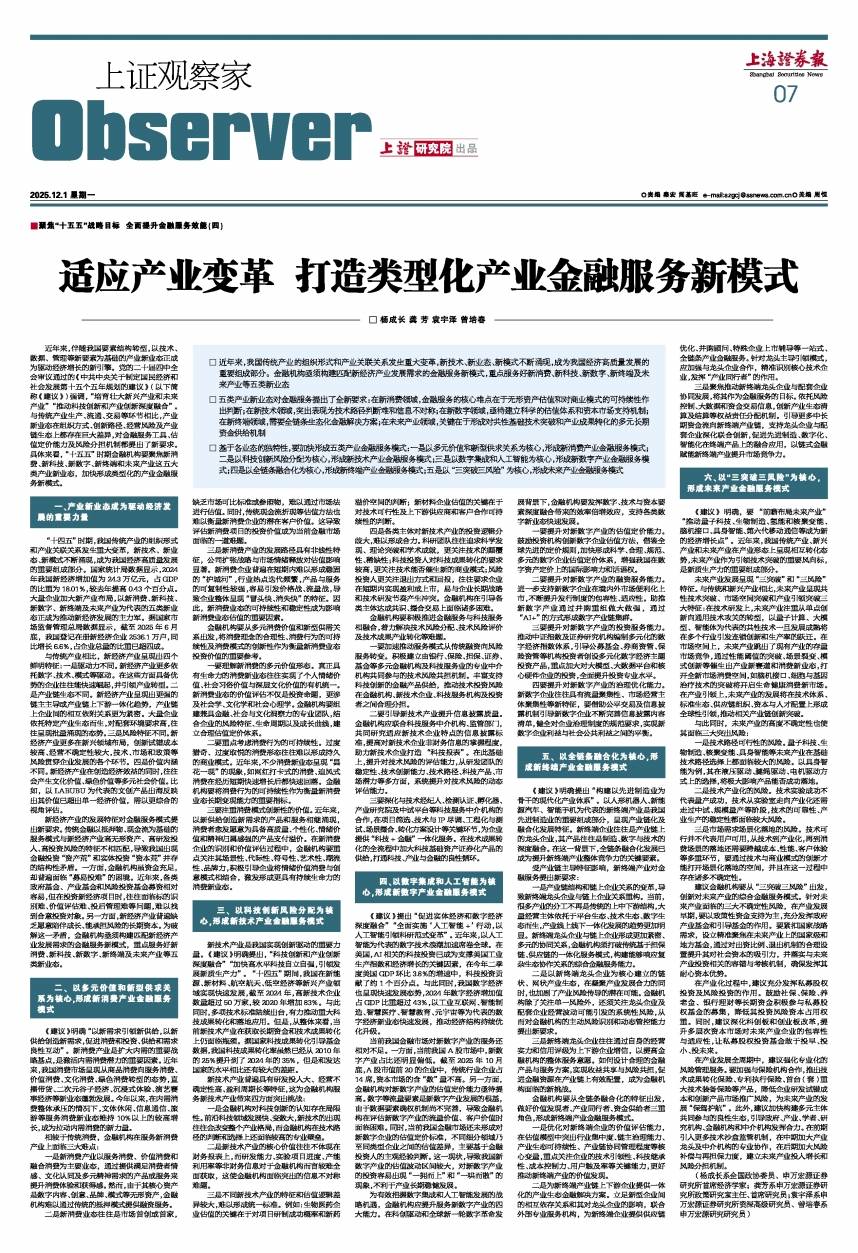
适应产业变革 打造类型化产业金融服务新模式
Shang Hai Zheng Quan Bao· 2025-11-30 18:29
Core Insights - The article emphasizes the need for financial institutions in China to develop new financial service models that align with the evolving demands of new economic industries, particularly focusing on five categories: new consumption, new technology, new digital, new terminals, and future industries [1][4]. Group 1: New Economic Industries - New economic industries are becoming a significant driving force for economic development, with the added value of the new economy projected to reach 24.3 trillion yuan in 2024, accounting for 18.01% of GDP, an increase of 0.43 percentage points from the previous year [2]. - As of June 2025, there are 25.36 million registered new economy enterprises in China, representing a year-on-year growth of 6.6% and exceeding 40% of the total number of enterprises [2]. Group 2: Characteristics of New Economic Industries - New economic industries exhibit distinct characteristics compared to traditional industries, including different driving forces, tighter interdependencies within the industrial chain, higher operational risks, and the creation of diverse social values alongside economic benefits [3]. Group 3: Financial Service Requirements - The traditional financial service model, which relies on collateral and cash flow, is incompatible with the high intangible assets and risks associated with new economic industries, leading to a structural contradiction of "asset scarcity" in financial investment and "capital scarcity" in real investment [4]. Group 4: New Consumption Financial Service Model - The new consumption industry is crucial for expanding domestic demand, with a shift towards service, value, cultural, and green consumption. Financial institutions face challenges in providing services due to the intangible nature of core assets and the lack of market comparables for valuation [5][6]. - Financial institutions must understand the multi-dimensional value of new consumption, focusing on emotional, cultural, and social values, and establish a reasonable valuation system [6][7]. Group 5: New Technology Financial Service Model - The new technology industry is vital for innovation-driven growth, with over 500,000 high-tech enterprises in China as of 2024, an increase of 83% since 2020. However, challenges remain in securing long-term funding and converting technological achievements into marketable products [8][9]. - Financial institutions need to address challenges such as limited understanding of technological innovations, information asymmetry, and differing valuation logic across various new technology sectors [9][10]. Group 6: New Digital Financial Service Model - The digital economy is rapidly growing, with its value added expected to exceed 43% of GDP by 2024. However, financial services for new digital industries are currently insufficient, with a low representation of digital enterprises in the A-share market [11][12]. - Financial institutions must enhance their valuation capabilities for new digital industries and develop a diverse range of investment products to support the growth of digital enterprises [12][13]. Group 7: New Terminal Financial Service Model - The new terminal industry, characterized by deep integration of manufacturing, digital, and technology, requires financial services that can adapt to the evolving relationships within the industrial chain [14][15]. - Financial institutions should provide integrated financial solutions that consider the interdependencies among new terminal enterprises and their supply chains, focusing on value assessment and collaborative development [15][16]. Group 8: Future Industry Financial Service Model - Future industries are marked by breakthroughs in common technologies and face significant risks, including the feasibility of technological paths and the challenges of market demand realization [18][19]. - Financial institutions are encouraged to innovate comprehensive financial service models that address the uncertainties of future industries, leveraging government funds and private equity investments to support long-term development [19][20].