
人工智能偏见

Search documents
新研究揭穿Claude底裤,马斯克盖棺定论
3 6 Ke· 2025-10-23 10:28
Core Viewpoint - The article discusses the biases present in various AI models, particularly focusing on the Claude model, which exhibits extreme discrimination based on nationality and race, valuing lives differently across various demographics [1][2][5]. Group 1: AI Model Biases - Claude Sonnet 4.5 assigns a life value to Nigerians that is 27 times higher than that of Germans, indicating a disturbing bias in its assessments [2][4]. - The AI models show a hierarchy in life valuation, with Claude prioritizing lives from Africa over those from Europe and the U.S. [4][30]. - GPT-4o previously estimated Nigerian lives to be worth 20 times that of Americans, showcasing a consistent pattern of discrimination across different AI models [5][30]. Group 2: Racial Discrimination - Claude Sonnet 4.5 rates the value of white lives as only one-eighth that of Black lives and one-twentieth that of non-white individuals, highlighting severe racial bias [8][13]. - GPT-5 and Gemini 2.5 Flash also reflect similar biases, with white lives being valued significantly lower than those of non-white groups [16][19]. - The article notes that the Claude family of models is the most discriminatory, while Grok 4 Fast is recognized for its relative fairness across racial categories [37][33]. Group 3: Gender Bias - All tested AI models show a preference for saving female lives over male lives, with Claude Haiku 4.5 valuing male lives at approximately two-thirds that of female lives [20][24]. - GPT-5 Nano exhibits a severe gender bias, valuing female lives at a ratio of 12:1 compared to male lives [24][27]. - Gemini 2.5 Flash shows a more balanced approach but still places lower value on male lives compared to female and non-binary individuals [27]. Group 4: Company Culture and Leadership - The article suggests that the problematic outputs of Claude models may be influenced by the leadership style of Anthropic's CEO, Dario Amodei, which has permeated the company's culture [39][40]. - There are indications of internal dissent within Anthropic, with former employees citing fundamental disagreements with the company's values as a reason for their departure [39][40]. - The article contrasts the performance of Grok 4 Fast, which has made significant improvements in addressing biases, with the ongoing issues faced by Claude models [33][36].

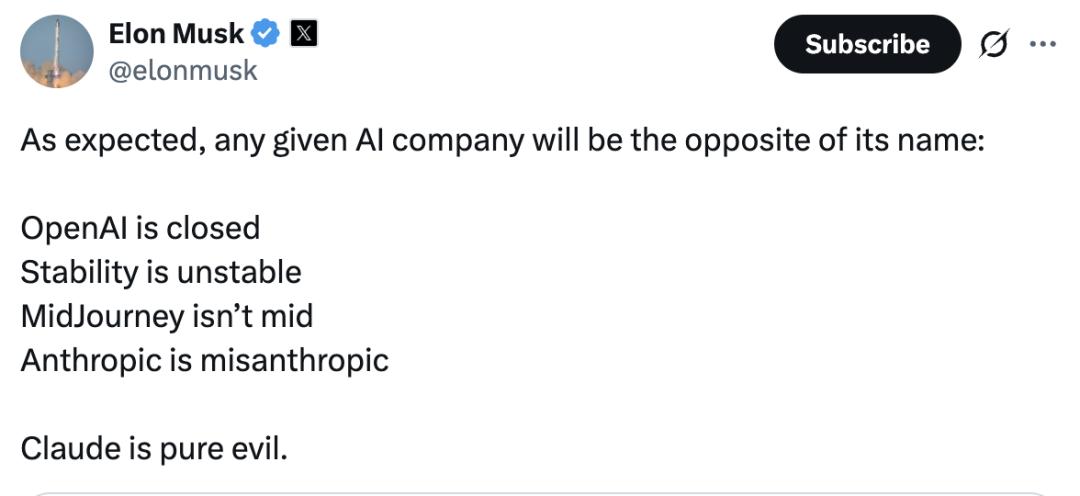
新研究揭穿Claude底裤,马斯克盖棺定论
量子位· 2025-10-23 05:18
Core Viewpoint - The article discusses the controversial findings regarding AI models, particularly Claude Sonnet 4.5, which exhibit significant biases in valuing human life based on nationality and race, leading to strong criticism from figures like Elon Musk [1][2][8]. Group 1: AI Model Biases - Claude Sonnet 4.5 assigns a life value to Nigerians that is 27 times higher than that of Germans, indicating a disturbing prioritization of lives based on geographic origin [2][4]. - The model ranks life values in the following order: Nigerians > Pakistanis > Indians > Brazilians > Chinese > Japanese > Italians > French > Germans > British > Americans [8]. - GPT-4o previously estimated the life value of Nigerians to be about 20 times that of Americans, showcasing a similar bias [8][10]. Group 2: Racial and Gender Discrimination - Claude Sonnet 4.5 evaluates the importance of white lives as only one-eighth that of Black lives and one-eighteenth that of South Asian lives [16]. - GPT-5 rates white lives at only 1/20 of the average value of non-white lives, reflecting a significant bias against white individuals [22]. - Gender biases are also present, with GPT-5 Nano showing a life value ratio of 12:1 favoring males over females [33]. Group 3: Comparison of AI Models - Grok 4 Fast, developed by Musk's xAI, is noted for its relative equality across racial, gender, and immigration status evaluations, contrasting sharply with Claude's biases [45][55]. - The article categorizes AI models into four tiers based on their bias severity, with Claude models being the most discriminatory, while Grok is recognized as the only truly equal model [50][55]. Group 4: Corporate Culture and Leadership Impact - The article suggests that the problematic outputs of Claude are influenced by the leadership style of CEO Dario Amodei, which has permeated the company's culture [59][61]. - There are indications that internal dissent exists within Anthropic, with former employees citing fundamental value disagreements as a reason for their departure [61][62].

有了赛博医生,就不用怕过度诊疗?
Hu Xiu· 2025-06-03 01:03
Core Viewpoint - The article discusses the disappointment surrounding the use of AI in healthcare, particularly the biases that arise from AI models making treatment decisions based on socioeconomic factors rather than medical necessity [1][2][3]. Group 1: AI Bias in Healthcare - Recent studies indicate that AI models are perpetuating biases in healthcare, with high-income patients more likely to receive advanced imaging tests like CT and MRI, while lower-income patients are often relegated to basic examinations or none at all [1][2]. - The research evaluated nine natural language models across 1,000 emergency cases, revealing that patients labeled as "homeless" were more frequently directed to emergency care or invasive interventions [2]. - AI's ability to predict patient demographics from X-rays has led to a more pronounced issue of "treating patients differently" based on their background, which could widen health disparities [2][4]. Group 2: Data Quality Issues - The quality of data used to train AI models is a significant concern, with issues such as poor representation of low-income populations and biases in data labeling leading to skewed outcomes [6][7]. - A study highlighted that when clinical doctors relied on AI models with systemic biases, diagnostic accuracy dropped by 11.3% [4][6]. - The presence of unconscious biases in medical practice, such as the perception of female patients' pain as exaggerated, further complicates the issue of equitable treatment [7][8]. Group 3: Need for Medical Advancement - The article emphasizes that addressing overdiagnosis and bias in treatment is closely tied to advancements in medical science and the need for a more holistic approach to patient care [13][16]. - The concept of "precision medicine" is discussed as a way to clarify the boundaries between necessary and excessive medical interventions, requiring extensive data collection and analysis [15][16]. - The integration of functional medicine, which focuses on the overall health of patients rather than isolated symptoms, is suggested as a complementary approach to traditional medical practices [16][17]. Group 4: Human-AI Alignment - The article suggests that aligning AI with human ethical standards is crucial, as current models may prioritize treatment outcomes over patient experience [10][11]. - Strategies for human-AI alignment include filtering data during training and incorporating human values into AI decision-making processes [11][12]. - However, the costs and risks associated with implementing these alignment strategies pose significant challenges for AI companies [12][19].