人工智能对就业的冲击

Search documents
真实、残酷的AI就业冲击,从一篇精彩的哈佛论文聊起
虎嗅APP· 2025-09-20 14:20
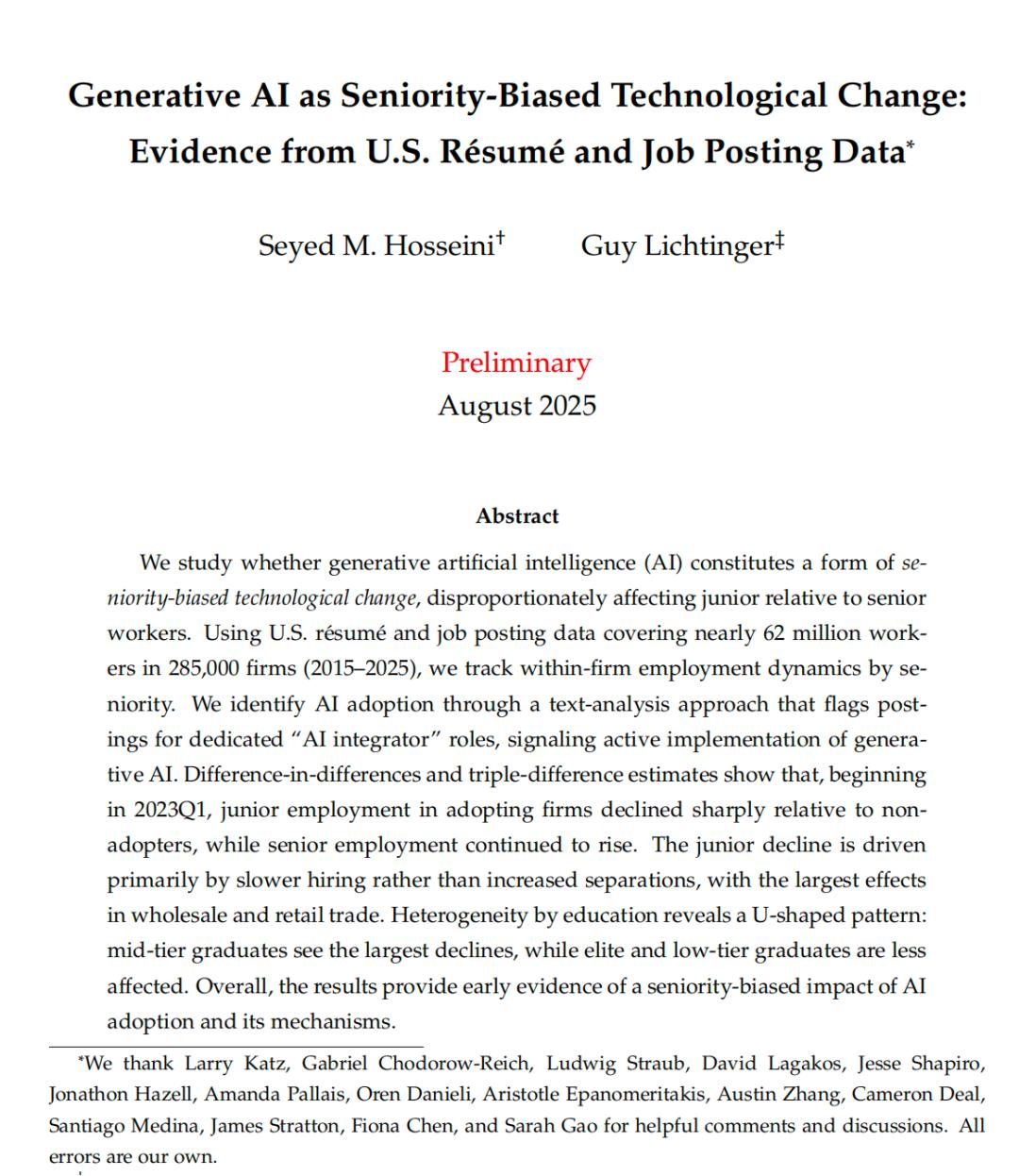
Core Insights - The article discusses the impact of AI on the job market, particularly focusing on how it affects entry-level positions and the employment landscape for young workers [6][7][8]. Group 1: AI's Impact on Employment - A study from Harvard University analyzed the effects of AI on the U.S. job market, revealing a significant decline in entry-level job opportunities since the introduction of AI technologies like ChatGPT [12][14][24]. - The research utilized a comprehensive dataset covering 285,000 companies and 62 million resumes, indicating a clear divergence in employment growth between junior and senior positions from 2015 to 2022 [17][18][19]. - The study found that companies adopting AI technologies saw a dramatic drop in entry-level hiring, with a 7.7% decrease in junior positions compared to non-AI companies after AI adoption [38][42]. Group 2: Mechanisms of Job Reduction - The decline in entry-level positions was primarily due to a halt in hiring rather than increased turnover rates, with AI-using companies hiring an average of 3.7 fewer junior employees per quarter [46][47][48]. - This trend was particularly pronounced in the wholesale and retail sectors, where AI-adopting companies reduced entry-level hiring by nearly 40% [55][56]. Group 3: Educational Background and Job Market Dynamics - The study categorized employees by their university tier, revealing a "U-shaped curve" where graduates from mid-tier universities (Tier 2 and Tier 3) faced the most significant job losses, while those from top-tier (Tier 1) and bottom-tier (Tier 5) universities were less affected [60][64][65]. - Companies preferred hiring top-tier graduates for their problem-solving abilities, while bottom-tier graduates were favored for their lower salary expectations, leaving mid-tier graduates vulnerable to AI-driven job reductions [63][64]. Group 4: Recommendations for Workers - Workers are advised to quickly transition from entry-level roles to more complex tasks that AI cannot easily replace, aiming for a job content where AI cannot substitute more than 50% of their responsibilities [69][74]. - Emphasis is placed on developing unique contextual knowledge and skills that AI cannot replicate, as well as leveraging personal interests to enhance competitiveness in the job market [75][80].


真实、残酷的AI就业冲击——从一篇极其精彩的哈佛论文聊起
3 6 Ke· 2025-09-17 11:18
Core Insights - The article discusses the impact of AI on the job market, particularly focusing on how it affects entry-level positions and the employment landscape for young workers [1][24]. Group 1: Research Findings - A study from Harvard University, conducted by two economics PhD students and supervised by a prominent labor economist, investigates the effects of AI on employment [3][4]. - The research utilizes a comprehensive dataset from Revelio Labs, covering 285,000 companies and 62 million resumes, providing a near-complete view of the U.S. labor market [6][7]. - From 2015 to mid-2022, employment growth for junior and senior positions was parallel, but by mid-2022, junior positions began to stagnate and decline, while senior positions continued to grow [10][12]. Group 2: AI Adoption and Employment Trends - The study identifies a significant drop in entry-level job postings in companies that adopted AI, with a 7.7% decrease in junior positions compared to non-AI adopters after AI's rise [21][23]. - The decline in junior positions is attributed not to increased turnover but to a reduction in hiring, with AI adopters hiring 3.7 fewer junior employees per quarter, equating to a 22% drop in hiring for these roles [27][28]. Group 3: Industry-Specific Impacts - The contraction of entry-level positions is observed across various industries, with the most significant impact in wholesale and retail, where AI adopters reduced junior hiring by nearly 40% [32]. Group 4: Educational Background and Job Security - The study reveals a "U-shaped curve" regarding the impact of AI on employees from different educational backgrounds, with graduates from top-tier universities facing less negative impact, while those from mid-tier universities (Tier 2 and Tier 3) are most adversely affected [34][36]. - The findings suggest that companies prefer to retain top-tier graduates for their problem-solving abilities while finding lower-cost alternatives for graduates from less prestigious institutions [36].