人工智能推理能力

Search documents
国泰海通|计算机:DeepSeek-V3.2系列发布:推理能力对标顶尖闭源,开源生态引领应用落地
国泰海通证券研究· 2025-12-04 12:46
Core Insights - The release of DeepSeek-V3.2 and its enhanced version V3.2-Speciale marks a significant advancement in open-source large models, achieving top-tier performance and practicality, particularly in reasoning capabilities and tool integration [2][3]. Group 1: Performance and Innovation - DeepSeek-V3.2 series has reached a breakthrough in core reasoning capabilities, matching the performance of top closed-source models and significantly outperforming some open-source models focused on long contexts [2]. - The Speciale version has excelled in international competitions, achieving gold medals in events like the International Mathematical Olympiad (IMO) and the International Collegiate Programming Contest (ICPC), where it ranked second among human competitors [2]. - The model innovatively integrates thinking modes with tool invocation, enhancing the agent's generalization and execution capabilities in complex scenarios [3]. Group 2: Technical Advancements - DeepSeek-V3.2 is the first open-source model to systematically incorporate chain-of-thought reasoning into the tool invocation process, utilizing a unique large-scale agent training data synthesis method [3]. - The model has undergone reinforcement learning across over 85,000 complex instructions in more than 1,800 environments, achieving the highest level among open-source models in untrained tool invocation assessments [3]. Group 3: Ecosystem and Market Impact - The comprehensive upgrade of DeepSeek-V3.2's open-source and API services is expected to accelerate technological penetration and drive a transformation in industrial application paradigms [4]. - The open strategy, combining performance and ecosystem openness, significantly lowers the application barriers for enterprises and developers, potentially leading to a large-scale, practical deployment of open-source models [4]. - This approach is anticipated to attract numerous developers to build vertical applications based on DeepSeek, forming a robust open-source application ecosystem centered around it [4].


语音助手的「智商滑铁卢」:当GPT开口说话,准确率从74.8%跌到6.1%
机器之心· 2025-10-17 11:53
Core Insights - The article discusses the significant performance gap between text-based AI models and voice interaction systems, highlighting that voice systems struggle with reasoning tasks compared to their text counterparts [5][29]. Group 1: Research Findings - The VERA study by Duke University and Adobe systematically measured the impact of voice modality on reasoning ability across 12 mainstream voice systems, using 2,931 specially designed test questions [3][5]. - The most striking finding was that OpenAI's GPT family showed a 68.7 percentage point difference in performance between text and voice models, indicating a stark contrast in reasoning capabilities [5][29]. - The best text model, GPT-5, achieved a 74.8% accuracy on math competition questions, while the voice version, GPT-realtime, only managed 6.1% [6][29]. Group 2: Testing Methodology - The research evaluated voice systems on five dimensions: mathematical reasoning, web information synthesis, graduate-level science questions, long dialogue memory, and factual retrieval [10][14]. - A unique "voice-native" transformation process was employed to ensure that the test questions were suitable for voice interaction, including converting numbers to words and symbols to spoken expressions [17][18]. Group 3: Performance Analysis - The average accuracy for text models was approximately 54%, while voice models averaged around 11.3%, resulting in a 42.7 percentage point gap [32]. - The study identified various error types and failure patterns across different architectures, revealing a collective challenge within the industry [28][26]. Group 4: Underlying Issues - The article outlines three main reasons for the performance gap: irreversible streaming commitment, cognitive resource allocation dilemmas, and erroneous chain reactions [21][22][24]. - The architecture of voice systems inherently limits their ability to perform deep reasoning tasks, as they prioritize fluency over accuracy [21][23]. Group 5: Future Directions - The research emphasizes the need for a fundamental rethinking of how deep reasoning can be integrated into real-time dialogue systems, rather than merely connecting text models to text-to-speech systems [37][39]. - Potential breakthroughs could involve asynchronous architecture innovations, intelligent buffering strategies, editable internal states, and parallel processing of complex tasks [41].
OpenAI在ICPC 2025编程赛上满分登顶,Gemini也达到金牌水平
3 6 Ke· 2025-09-18 09:50
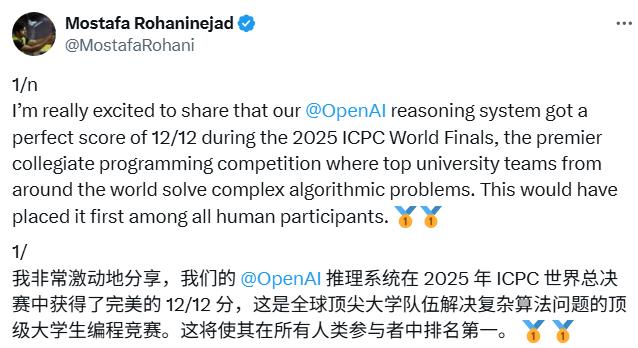
Core Insights - OpenAI and Gemini both achieved gold medal levels at the ICPC 2025, with OpenAI solving all 12 problems in 5 hours, outperforming all human teams [1][6] - Gemini solved 10 out of 12 problems in 677 minutes, ranking second among human teams [3][20] Group 1: Competition Overview - The ICPC World Finals took place on September 4 in Baku, Azerbaijan, featuring top teams from early competition stages [6] - A total of 139 teams participated, with only the top four teams receiving gold medals based on perfect solutions and time efficiency [6] Group 2: Performance Comparison - The top human team, from St. Petersburg State University, solved 11 problems in 1478 minutes, while OpenAI solved all 12 in 300 minutes [5][7] - Gemini's performance included solving 8 problems in 45 minutes and the remaining 2 in the following 3 hours [20] Group 3: AI Capabilities - OpenAI's AI system, comprising a general reasoning model, solved 11 problems accurately on the first attempt, with the final problem requiring 9 attempts [12][7] - Gemini utilized advanced data structures and algorithms to solve problems, demonstrating its capability in complex reasoning tasks [20][28] Group 4: Implications for AI - The success of AI in ICPC highlights its potential to provide innovative solutions and assist in complex reasoning, marking a shift from mere information processing to problem-solving capabilities [35]