
人工智能赋能药物研发

Search documents
英百瑞再获资本青睐,完成近2亿元B轮融资,加码NK细胞治疗赛道
Quan Jing Wang· 2026-02-05 05:21
Core Insights - Yingbairui (Hangzhou) Biopharmaceutical Co., Ltd. successfully completed a nearly 200 million yuan Series B financing, led by Beijing Deep Intelligence Technology Co., Ltd. and supported by notable investors [1][2] - The financing reflects strong market recognition of Yingbairui's core technological capabilities and future development potential, providing robust support for its continued focus on innovative cell therapy [1][2] Financing Details - The Series B financing raised nearly 200 million yuan, which will facilitate Yingbairui's clinical research advancement, large-scale production capacity construction, and commercialization efforts [2] - Deep Intelligence, as the strategic lead investor, aims to leverage its AI-driven drug development advantages to enhance Yingbairui's new drug research decision-making and execution efficiency [2] Company Overview - Yingbairui is a leading company in the global NK cell therapy sector, focusing on cutting-edge tumor immunotherapy and innovative drug development for immune-related diseases, chronic diseases, and CNS diseases [2] - The company has developed a competitive product pipeline based on core technologies such as non-viral vectors and non-gene-modified ACC-NK and tiNK, with several core products already entering clinical stages [2] Future Outlook - The successful financing is expected to accelerate Yingbairui's commercialization process and address unmet clinical treatment needs by providing more safe and effective solutions [2] - With the effective utilization of the newly raised funds, Yingbairui will continue to deepen its focus on innovative cell therapy and core technological breakthroughs [2]
向新而行 | 政策赋能中国创新药的发展新格局
Xin Lang Cai Jing· 2025-12-27 09:15
Core Insights - The Chinese innovative pharmaceutical industry is experiencing significant growth driven by supportive policies that connect R&D breakthroughs, capital vitality, and market demand [3][4]. Group 1: Industry Development - The "New Quality Productivity Research Tour" aims to explore the practical pathways for innovative drugs transitioning from laboratories to global markets, analyzing how policy dividends activate industry potential [3]. - By 2025, the internationalization of China's innovative pharmaceutical industry is expected to accelerate, with the total amount of business development (BD) transactions involving domestic innovative drug companies increasing from $5.06 billion in 2020 to $41.76 billion by August 2025 [4]. Group 2: Policy Support - The Chinese government has introduced comprehensive measures to support the high-quality development of innovative drugs, addressing various aspects such as R&D support, medical insurance access, clinical application, and payment capabilities [5]. - Local policies are also actively addressing industry bottlenecks, with cities like Chongqing and Tianjin implementing specific measures to facilitate the application and production of innovative drugs [5]. Group 3: Market Dynamics - In the first half of 2025, the BD transaction volume for Chinese innovative drug companies surged, with upfront payments reaching 24.1 billion yuan, accounting for 28% of the total financing for domestic companies during the same period [5]. - The industry is shifting from a reliance on domestic sales to a dual-driven model of "domestic sales + external licensing," indicating a transformation in business models [5]. Group 4: Future Outlook - Despite the challenges of high investment, risk, and long cycles in innovative drug development, the integration of artificial intelligence in drug research is emerging as a significant breakthrough [6]. - By 2026, the benefits of policy support are expected to translate into tangible gains for companies, with streamlined approval processes and innovative payment methods facilitating the commercialization of innovative drugs [6].



香港科学园7家企业分享“出海”故事
Nan Fang Du Shi Bao· 2025-12-22 23:14
Group 1 - The 2025 Shenzhen International High-Performance Medical Device and Innovative Pharmaceutical Exhibition aims to create an efficient ecosystem platform for "industry, academia, research, medicine, and finance" while focusing on financial empowerment and overseas expansion as key drivers for industry development [2] - The exhibition featured deep discussions on how finance can empower innovation in the medical device industry, with insights from industry leaders like Lang Tao from China Resources Pharmaceutical Group, who outlined two clear paths: strategic investments in innovative medical device companies and mergers to quickly acquire mature product lines and core technologies [2] - A series of high-profile investment and financing matchmaking activities were held, including the "Breaking the Deadlock · Establishing New" CGT project financing roadshow, which selected eight leading companies in gene editing and cell therapy to engage with investors [3] Group 2 - Jingtai Technology signed a $59.9 billion cooperation order with an overseas pharmaceutical company, marking the largest order in the field of AI-enabled drug development [3] - The "Intelligent Medical, Riding the Waves Overseas" forum focused on the core issues of intelligent and global development in the medical industry, gathering over 80 industry leaders and experts to discuss how AI and digital technologies can empower Chinese medical enterprises for high-quality overseas expansion [4] - The "Breaking the Deadlock · Going Overseas" forum highlighted case studies of seven pioneering companies from the Hong Kong Science Park, emphasizing collaboration and experience sharing to provide replicable pathways for mainland innovative products to enter the global market [4]


AI药物开发平台开放公益使用,应对“被商业忽视的疾病”
Nan Fang Du Shi Bao· 2025-12-15 12:24
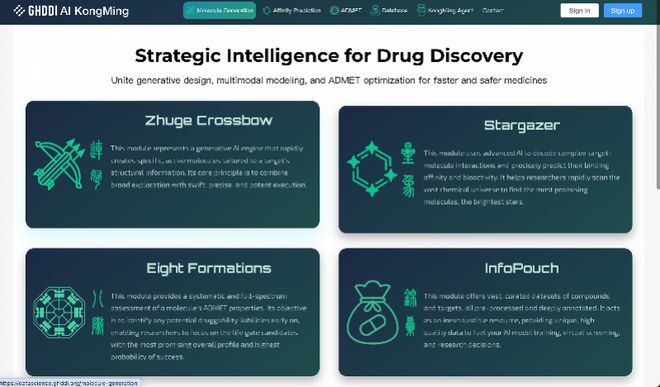
Core Viewpoint - The Global Health Drug Discovery Institute (GHDDI) has launched an AI-driven drug discovery platform named "AI Kongming," which integrates generative AI and multimodal large model technologies to design potential drug candidates for various diseases, particularly those neglected by commercial interests, such as tuberculosis and malaria [1][3]. Group 1: Platform Features - "AI Kongming" covers the entire drug design process from target structure analysis to AI molecule generation and optimization, active screening, and drug-like property evaluation, aiming to break down traditional barriers in drug development [3]. - The platform is currently available for free, particularly for diseases like malaria and tuberculosis, with a molecular library that is also freely accessible [1][7]. - The platform's "Lian Nu" module can generate new molecules based on existing compound data, significantly improving the efficiency of drug design [4][5]. Group 2: Efficiency Improvements - The "Lian Nu" module has demonstrated a 43% increase in the proportion of active molecules after two iterations for viral targets, and for malaria targets, it achieved 17% and 21% active compounds in the first and second rounds, respectively [5]. - The "Xing Xiang" module enhances the speed of candidate molecule screening, allowing for rapid identification of the most promising candidates from a large pool of generated molecules [5]. - The "Ba Zhen" module quickly assesses the safety and drug-like potential of candidate molecules, integrating nearly 70 pharmacokinetic and toxicological properties for rapid evaluation [6]. Group 3: Database and Results - The "Jin Nang" database provides a wealth of novel compound data for tuberculosis and malaria, generating approximately 3,000 molecules for each of about 400 targets, resulting in a library of millions of potential candidates [6]. - In a comparison of traditional high-throughput screening methods, the "Jin Nang" database achieved a hit rate of approximately 38.5% with only 13 synthesized molecules, significantly reducing the development time by six times [6]. Group 4: Challenges and Future Directions - Current challenges in AI-driven drug discovery include data scarcity, as the pharmaceutical field lacks sufficient labeled data for effective AI training, which limits the potential for further advancements [10]. - There is a call for collaboration across scientific communities to enhance data sharing and improve the overall effectiveness of AI in drug discovery [10].
深圳医疗器械产值全国第一 将构建“一廊两区三基地”产业格局
2 1 Shi Ji Jing Ji Bao Dao· 2025-12-10 10:07
Core Viewpoint - Shenzhen is positioning itself as a leading hub for the biopharmaceutical and high-end medical device industries, with significant growth in production value and exports projected through 2024 [1][2]. Group 1: Industry Growth and Development - From 2020 to 2024, the production value of Shenzhen's biopharmaceutical and medical device sectors is expected to increase from 128 billion to 157.6 billion yuan, with an average annual growth rate of 5.3% [1][2]. - Medical device production value is projected to rise from 83.1 billion to 102.8 billion yuan, maintaining the top position in the country [1][2]. - In 2024, the total export value of pharmaceuticals and medical devices is anticipated to reach 41.38 billion yuan, with medical device exports alone accounting for 29.85 billion yuan, also ranking first nationally [1][2]. Group 2: Strategic Initiatives - Shenzhen plans to establish an "industrial development pattern" consisting of "one corridor, two zones, and three bases" to enhance its biopharmaceutical sector [2]. - The "4+4+N" development strategy will focus on four emerging tracks, including cell and gene therapy, and will promote key projects in research and development and international expansion [2]. Group 3: Infrastructure and Ecosystem - The Pingshan District, as a national-level biopharmaceutical industrial base, has developed 13 specialized parks covering over 2.79 million square meters, with an annual compound growth rate of enterprises at 39.8% [2]. - The Guangming District hosts over 900 medical device companies and is developing a comprehensive ecosystem that includes technological innovation, clinical research, and policy support [3]. Group 4: Upcoming Events and Innovations - The Shenzhen International High-Performance Medical Device and Innovative Pharmaceutical Exhibition will take place from December 18 to 20, showcasing advancements in biomanufacturing, AI in pharmaceuticals, and other emerging fields [4][5]. - The exhibition will feature over 300 participating companies, including major international and domestic players, and will highlight new drug developments and clinical trials [5][6].