
13价肺炎球菌多糖结合疫苗

Search documents
两会看疫苗:聚焦“十五五”动态调整,向全生命周期转变
Xiangcai Securities· 2026-03-08 12:51
Investment Rating - The industry investment rating is maintained at "Overweight" [1] Core Insights - The vaccine industry is transitioning from scale expansion to innovation-driven growth, facing short-term pain due to supply-demand imbalance and homogenized competition, but the long-term positive logic remains unchanged, driven by policy, demand, and technology [8][24][27] - Recent discussions during the National People's Congress focused on building a more comprehensive "lifecycle" immunization barrier, indicating potential policy support for expanding the types of vaccines included in the national immunization program [3][4] Summary by Sections Industry Performance - The vaccine sector experienced a decline of 3.81% recently, with a cumulative drop of 14.28% since 2025 [4][10] - The overall pharmaceutical sector also saw a decline, with the medical biology index down by 2.78% [4][10] Company Developments - CanSino's MCV4 and PCV13 vaccines received GMP certification from Malaysia's NPRA, facilitating their registration in Malaysia and other PIC/S member countries [3] - Watson Bio's adsorbed tetanus vaccine has entered Phase III clinical trials, with the first phase completed [3] - Zhifei Biological's insulin injection application has been accepted by the National Medical Products Administration [3] - Kanglaisheng reported a revenue of 1.4452 million yuan for 2025, a year-on-year increase of 63.18%, but still has not achieved commercialization [3] Market Review - The vaccine sector's PE (ttm) is 65.37X, down by 1.47X from the previous period, while the PB (lf) is 1.21X, reflecting a slight decrease [6] - The vaccine industry is characterized by a high proportion of Me-too products, leading to intense competition and price declines [7][24] Investment Recommendations - The vaccine industry is under pressure, with companies encouraged to adjust their pipeline strategies focusing on technological innovation and multi-valent products [7][24] - Long-term attention should be given to companies with strong R&D capabilities and differentiated product lines, with a specific recommendation for CanSino [8][27]
大健康风向标〡中国创新药破局之年,重磅产品重塑全球医药格局
Jing Ji Guan Cha Wang· 2026-02-12 10:00
Core Insights - 2025 marks a milestone year for China's innovative pharmaceuticals, with a significant increase in the number of approved drugs and vaccines, driven by supportive policies, international expansion, and expedited review processes [1][2] Group 1: Drug Approvals and Market Trends - In 2025, China approved 76 innovative drugs, surpassing the 48 approved in 2024, setting a historical record [1] - The number of approved innovative drugs in China exceeded that of the US FDA, which approved 46 new drugs in the same year [1] - China saw the approval of 11 First-in-class drugs, with 4 being independently developed domestically [1] - The total value of licensing transactions for innovative drugs exceeded $130 billion, with over 150 deals made, marking another historical high [1] Group 2: Breakthrough Therapies and Innovations - Among the 76 approved drugs, 17 were recognized as breakthrough therapies, with 13 focused on oncology [2] - Notable drug launches included the first stem cell therapy in China, marking a historic breakthrough in stem cell treatment [2] - The launch of targeted HER2 drugs for non-small cell lung cancer and cholangiocarcinoma signifies a new phase in precision treatment for solid tumors in China [2] Group 3: Disease-Specific Developments - In oncology, 34 new drugs were approved, with breast cancer treatments leading at 9 new drugs, followed by 6 for lung cancer and 8 for hematological malignancies [3] - Two CAR-T cell therapies targeting CD19 were approved, bringing the total number of domestic CAR-T therapies to 7 [3] Group 4: Innovations in Other Therapeutic Areas - In the influenza treatment sector, four new drugs were launched, addressing public health needs during peak flu seasons [4] - The innovative vaccine sector saw significant advancements, including the launch of China's first nine-valent HPV vaccine and a 13-valent pneumococcal conjugate vaccine [5] - The emergence of a serum-free rabies vaccine is expected to fill a market gap, showcasing China's growing capabilities in biopharmaceutical innovation [5]


A股235亿元天价离婚余波未了,康泰生物实控人解除一致行动,减持隐忧凸显
Hua Xia Shi Bao· 2026-02-12 09:39
Core Viewpoint - The recent announcement by Shenzhen Kangtai Biological Products Co., Ltd. regarding the termination of the concerted action agreement between its actual controllers, Du Weimin and Yuan Liping, has reignited concerns over the company's control stability and potential shareholder dilution following their high-profile divorce that split a market value of 23.5 billion yuan [3][5]. Group 1: Shareholder Dynamics - The termination of the concerted action agreement has resulted in Du Weimin's voting rights decreasing from 46.62% to 25.50%, while Yuan Liping now holds 17.07% [5]. - Yuan Liping has committed not to seek control of the company post-termination, aiming to alleviate market concerns regarding control instability [5]. - Since the divorce in 2020, Yuan Liping has reduced her holdings significantly, cashing out nearly 3 billion yuan, raising fears of further dilution of shares following the termination of the agreement [6]. Group 2: Operational Challenges - Kangtai Biological's core business includes the research, production, and sales of human vaccines, with key products such as the 13-valent pneumococcal polysaccharide conjugate vaccine and others [7]. - The company has faced significant operational challenges, including the resignation of a vice president and the termination of a joint venture with AstraZeneca, which was intended to invest approximately 2.76 billion yuan [8][10]. - The decision to terminate the joint venture was influenced by a rapidly changing market environment and increased risks associated with new investments in the vaccine industry [10]. Group 3: Financial Performance - Kangtai Biological's financial outlook is concerning, with a projected net profit for 2025 expected to decline by 63.80% to 75.70%, amounting to between 49 million and 73 million yuan [10]. - The company's performance has been volatile, with net profits peaking at 1.263 billion yuan in 2021, followed by a loss of 133 million yuan in 2022, and a recovery in 2023 and 2024, only to face another significant decline in 2025 [11]. - As of February 11, 2026, the company's stock price has plummeted nearly 90% from 146 yuan per share at the time of the divorce, reflecting a substantial decrease in valuation [11].


疫苗的冷风继续吹
3 6 Ke· 2026-02-10 13:22
Core Viewpoint - The collaboration between Kangtai Biological and AstraZeneca has ended, reflecting the significant challenges and structural issues facing the vaccine industry in China, particularly in light of changing market conditions and increased investment risks [1][2]. Group 1: Collaboration and Market Changes - Kangtai Biological and AstraZeneca established a strategic partnership in March 2025, with a total investment of approximately $400 million, each holding a 50% stake in a joint venture [1]. - On February 6, 2026, Kangtai announced the termination of its collaboration with AstraZeneca due to drastic changes in the market environment and significant downward pressure on the vaccine industry [1]. Group 2: Industry Performance and Financial Struggles - The year 2025 marked a downturn for the Chinese vaccine industry, with major players facing significant financial pressure; Kangtai's net profit is projected to decline by 63.8% to 75.7%, amounting to only 49 million to 73 million yuan [2]. - Zhifei Biological, once a leading company, is expected to report a net loss of 10.698 billion to 13.726 billion yuan for the first time since its listing, far exceeding market expectations [2]. - Watson Bio's revenue is projected to be around 2.4 billion yuan, a 14% decline year-on-year, with net profit dropping by 9% to 22% [2]. Group 3: Clinical Trials and Financial Issues - Kanglao Health has faced severe financial issues, leading to the suspension of clinical trials for its HPV vaccines due to overdue payments and funding shortages [3]. - The company has previously defaulted on a bank loan of 15.21 million yuan, resulting in account freezes, highlighting ongoing financial instability [3]. Group 4: Market Demand and Competitive Pressure - Kangtai's declining performance is attributed to changes in the immunization schedule for the DTP vaccine, which negatively impacted the uptake of its four-component vaccine [4][5]. - The HPV vaccine market has seen a decrease in demand due to economic cycles and increased competition, leading to price wars among numerous entrants [6]. Group 5: Industry Challenges and Future Outlook - The vaccine industry is currently facing significant internal competition and structural challenges following a period of rapid expansion [7]. - The historical weaknesses in China's vaccine industry have led to a situation where many companies are now struggling to maintain profitability amidst increased competition and changing market dynamics [8].
康泰生物与阿斯利康4亿美元合作“触礁”
Bei Jing Shang Bao· 2026-02-08 15:57
Core Viewpoint - The collaboration between Kangtai Biological and AstraZeneca to establish a joint venture in the vaccine sector has been terminated after 10 months due to significant market changes and high investment risks in the vaccine industry [1][4]. Company Summary - Kangtai Biological announced the termination of the joint venture with AstraZeneca, which was initially planned to focus on vaccine development with an estimated total investment of approximately $400 million (about 2.76 billion RMB) [1][3]. - The joint venture was intended to be established in the Beijing Economic and Technological Development Zone, with a registered capital of approximately 345 million RMB (about $50 million), where both companies would hold 50% equity [3]. - Kangtai Biological specializes in the research, production, and sales of human vaccines, with key products including the 13-valent pneumococcal polysaccharide conjugate vaccine and the recombinant hepatitis B vaccine [3]. Industry Summary - The vaccine industry is currently facing significant downward pressure, with many companies, including Kangtai Biological, experiencing a decline in net profits. Kangtai's projected net profit for the previous year is expected to be between 49 million and 73 million RMB, representing a year-on-year decrease of 63.8% to 75.7% [4]. - Factors contributing to the industry's challenges include high research and development costs, complex approval processes, and increased market competition [5]. - Despite the overall industry pressure, Kangtai Biological reported a significant increase in overseas business revenue, which reached 98.83 million RMB, reflecting a year-on-year growth of 859.4% [6].

涉疫苗事项,康泰生物与阿斯利康4亿美元合作项目折戟
Bei Jing Shang Bao· 2026-02-08 11:08
Core Viewpoint - The collaboration between Kangtai Biological and AstraZeneca to establish a joint venture in the vaccine sector has been terminated due to significant market changes and increased risks in the vaccine industry [1][4]. Company Summary - Kangtai Biological announced the termination of the joint venture with AstraZeneca, which was initially planned with a total investment of approximately $400 million (about 2.76 billion yuan) [1][4]. - The joint venture was intended to focus on vaccine development and was to be established in the Beijing Economic and Technological Development Zone, with a registered capital of 345 million yuan (approximately $50 million) [3]. - Kangtai Biological specializes in the research, production, and sales of human vaccines, with key products including the 13-valent pneumococcal polysaccharide conjugate vaccine and the recombinant hepatitis B vaccine [3]. Industry Summary - The vaccine industry is currently facing significant downward pressure, with many companies, including Kangtai Biological, experiencing declining profits. Kangtai's projected net profit for 2025 is expected to decrease by 63.8% to 75.7% compared to the previous year [4][5]. - Factors contributing to the industry's challenges include high research and development costs, complex approval processes, and intensified market competition [5]. - Despite the challenges, Kangtai Biological reported a notable increase in overseas revenue, achieving 98.84 million yuan, which represents a 859.4% increase year-on-year, indicating successful international market expansion [5].
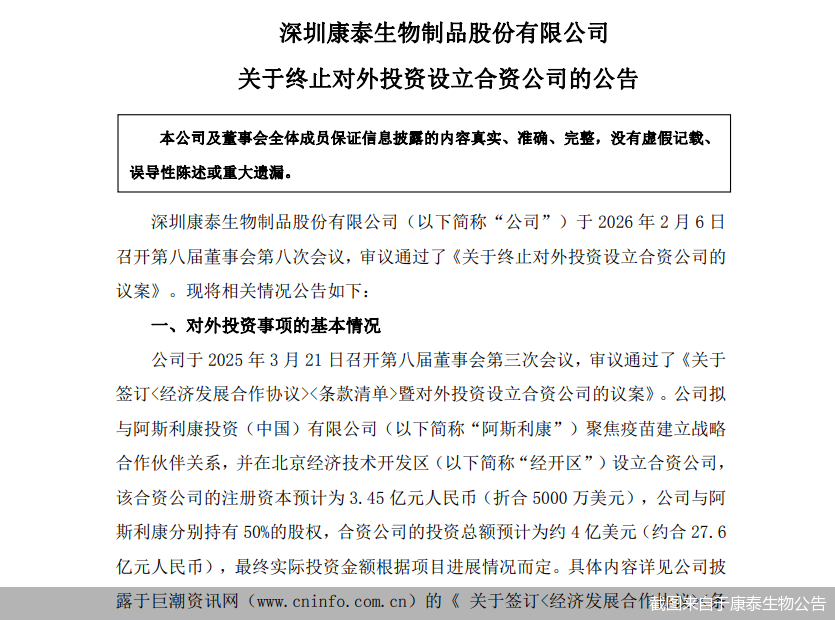
4亿美元疫苗合作告吹,康泰生物终止合资公司设立
Shen Zhen Shang Bao· 2026-02-07 05:59
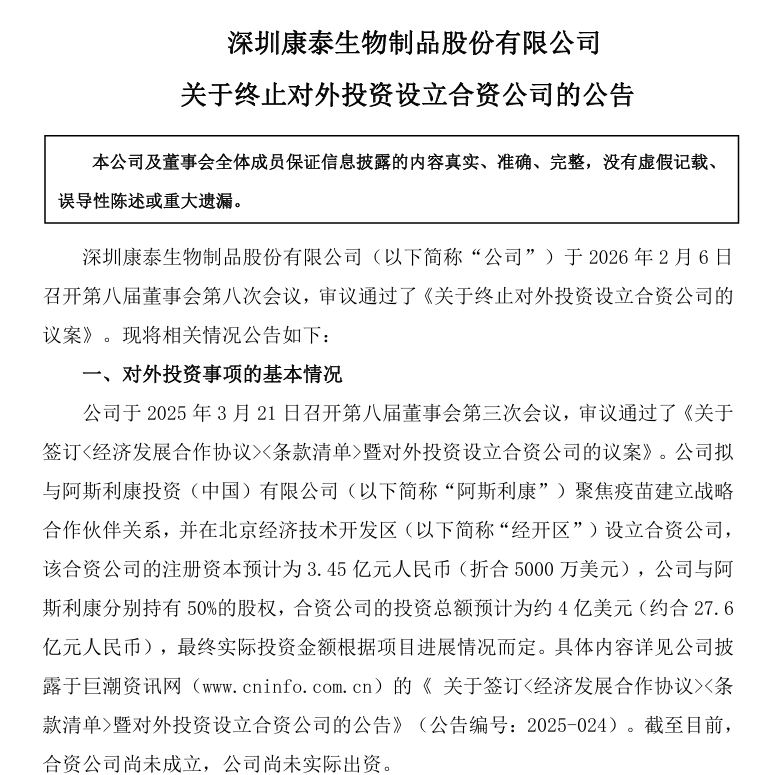
Core Viewpoint - Kangtai Biological (300601) announced the termination of its collaboration with AstraZeneca Investment (China) Co., Ltd. to establish a joint venture in the vaccine sector, stating that this decision will not have a significant adverse impact on the company [1][4]. Group 1: Termination of Joint Venture - The collaboration plan between Kangtai Biological and AstraZeneca began in March 2025, aiming to establish a joint venture in Beijing with a registered capital of approximately 345 million yuan (about 50 million USD) [4]. - The joint venture was intended to focus on vaccine business and both parties were to hold 50% equity, with a total investment of around 400 million USD (approximately 2.76 billion yuan) [4]. - The decision to terminate the collaboration was due to significant changes in the market environment and high investment risks in the vaccine industry, as assessed by both parties [4]. Group 2: Financial Impact and Future Strategy - Kangtai Biological emphasized that since no actual investment had been made, the termination will not significantly affect the company's existing business, financial status, or operational conditions [5]. - The company plans to continue its dual-driven strategy of "internal innovation + external expansion," integrating internal and external resources to enhance its international business layout [5]. - Kangtai Biological's main business includes the research, production, and sales of human vaccines, with key products such as the 13-valent pneumococcal conjugate vaccine and the combined vaccine for whooping cough, diphtheria, and tetanus [5]. Group 3: Recent Financial Performance - On January 29, Kangtai Biological released a performance forecast, expecting a net profit attributable to shareholders for 2025 to be between 49 million and 73 million yuan, representing a decline of 75.70% to 63.80% compared to the previous year [6][7]. - The forecasted net profit after deducting non-recurring gains and losses is expected to be between 51.5 million and 76.5 million yuan, reflecting a decrease of 79.06% to 68.90% year-on-year [6][7]. - The decline in profits is attributed to increased marketing efforts in the domestic market, international strategy implementation, rising operating costs, and increased R&D investments [7].
向新而行 | 政策赋能中国创新药的发展新格局
Xin Lang Cai Jing· 2025-12-27 09:15
Core Insights - The Chinese innovative pharmaceutical industry is experiencing significant growth driven by supportive policies that connect R&D breakthroughs, capital vitality, and market demand [3][4]. Group 1: Industry Development - The "New Quality Productivity Research Tour" aims to explore the practical pathways for innovative drugs transitioning from laboratories to global markets, analyzing how policy dividends activate industry potential [3]. - By 2025, the internationalization of China's innovative pharmaceutical industry is expected to accelerate, with the total amount of business development (BD) transactions involving domestic innovative drug companies increasing from $5.06 billion in 2020 to $41.76 billion by August 2025 [4]. Group 2: Policy Support - The Chinese government has introduced comprehensive measures to support the high-quality development of innovative drugs, addressing various aspects such as R&D support, medical insurance access, clinical application, and payment capabilities [5]. - Local policies are also actively addressing industry bottlenecks, with cities like Chongqing and Tianjin implementing specific measures to facilitate the application and production of innovative drugs [5]. Group 3: Market Dynamics - In the first half of 2025, the BD transaction volume for Chinese innovative drug companies surged, with upfront payments reaching 24.1 billion yuan, accounting for 28% of the total financing for domestic companies during the same period [5]. - The industry is shifting from a reliance on domestic sales to a dual-driven model of "domestic sales + external licensing," indicating a transformation in business models [5]. Group 4: Future Outlook - Despite the challenges of high investment, risk, and long cycles in innovative drug development, the integration of artificial intelligence in drug research is emerging as a significant breakthrough [6]. - By 2026, the benefits of policy support are expected to translate into tangible gains for companies, with streamlined approval processes and innovative payment methods facilitating the commercialization of innovative drugs [6].


(2025.11.24—2025.11.28):骨科手术机器人行业把握:多学科融合与临床需求共振,技术创新驱动研究与产业化加速发展
Huafu Securities· 2025-11-30 09:37
Group 1 - The orthopedic surgical robot industry is characterized by multidisciplinary integration and resonance with clinical needs, driven by technological innovation that accelerates research and industrialization [2][7][10] - Orthopedic surgical robots can create personalized surgical plans preoperatively and guide surgeons during operations, addressing the complexities and high risks associated with traditional orthopedic procedures [2][7] - The demand for orthopedic surgical robots is increasing due to the limitations of traditional methods, such as restricted visibility, significant trauma, high radiation exposure, and increased risk of complications [2][7] Group 2 - Research activity in the field of orthopedic surgical robots has seen a significant increase globally, particularly in the last decade, with China emerging as a major contributor despite starting later [8][9] - From 1993 to 2022, China published the most papers (128) on orthopedic surgical robots, followed by the United States (114), the United Kingdom (68), and Germany (44) [8] - The global surgical robot industry has experienced a notable increase in financing activities, with total funding reaching approximately $8.162 billion over seven years, peaking at $2.798 billion in 2021, a 336% year-on-year increase [9] Group 3 - The domestic surgical robot industry also saw a peak in financing in 2021, with total funding amounting to $1.254 billion, reflecting a 349% year-on-year growth [9] - Recent national policies have emphasized the importance of the surgical robot industry, encouraging domestic medical device companies to innovate and reduce reliance on imported high-end medical equipment [10][13] - The application of joint surgical robots is at a favorable stage due to continuous technological advancements and accumulated clinical experience [10][13]

沃森生物13价肺炎结合疫苗获埃及上市许可
Bei Jing Shang Bao· 2025-11-26 11:44
Core Viewpoint - Watson Bio's subsidiary, Yuxi Watson Biotechnology Co., Ltd., has received marketing authorization for its 13-valent pneumococcal polysaccharide conjugate vaccine from the Egyptian Drug Authority (EDA), marking a significant milestone for the company's international expansion [1]. Group 1: Product Details - The 13-valent pneumococcal polysaccharide conjugate vaccine is primarily intended for infants and children aged 6 weeks to under 5 years, aimed at preventing infections caused by 13 specific serotypes of pneumococcus [1]. - The vaccine includes serotypes 1, 3, 4, 5, 6A, 6B, 7F, 9V, 14, 18C, 19A, 19F, and 23F, which are known to cause infectious diseases [1]. Group 2: Regulatory Milestones - The vaccine was initially approved for sale in China in 2020, and the recent approval in Egypt signifies the company's efforts to expand its market presence internationally [1].