
人民币现金收付

Search documents
人民币现金收付新规今起施行
Yang Shi Xin Wen· 2026-02-01 15:33
Core Viewpoint - The People's Bank of China, along with the National Development and Reform Commission and the Financial Regulatory Bureau, has implemented the "Regulations on Cash Payment and Services in Renminbi" to uphold the legal status of the Renminbi, prevent and rectify the refusal to accept cash, and meet the diverse payment service needs of the public, effective from February 1 [1] Summary by Sections Regulations on Cash Payment Behavior - The regulations establish basic requirements for cash payments based on classification management and universal applicability, including: - Cash payments must be supported in face-to-face services and transactions that can be completed offline, with reasonable change available [2] - Self-service models and locations like parks and schools must clearly indicate payment methods and provide contact information for cash services [2][3] - For fully online transactions, payment methods must be publicly disclosed in advance to respect the public's right to know and choose [3] - If a payment unit entrusts another entity for cash collection, the entrusting party must require acceptance of cash through written agreements [4] - Digital governance and business model innovations must consider public cash usage needs and cannot discriminate against cash payments [4] Requirements for Commercial Banks - Financial institutions must adhere to cash management laws and improve cash service quality to meet public and business needs: - Banks with physical locations must handle cash deposit and withdrawal services for individual clients [5][12] - Banks should ensure the number and layout of cash service points and self-service machines meet the diverse needs of different customer groups [8][15] - Banks must manage the return of Renminbi properly to prevent the circulation of unsuitable currency and mitigate various business risks [8][18] - As entrusted cash collection agents, banks must support cash acceptance [8][21] Handling Cash Payment Issues - In cases of cash payment difficulties, parties should negotiate amicably to resolve disputes and protect their rights legally: - Evidence of refusal to accept cash should be preserved, and complaints can be made through various channels, including consumer protection hotlines [6][22] - The People's Bank of China will coordinate with relevant departments to address complaints promptly [6][22]


图表:2026年2月1日起,一批新规将施行
Xin Hua She· 2026-01-31 02:41
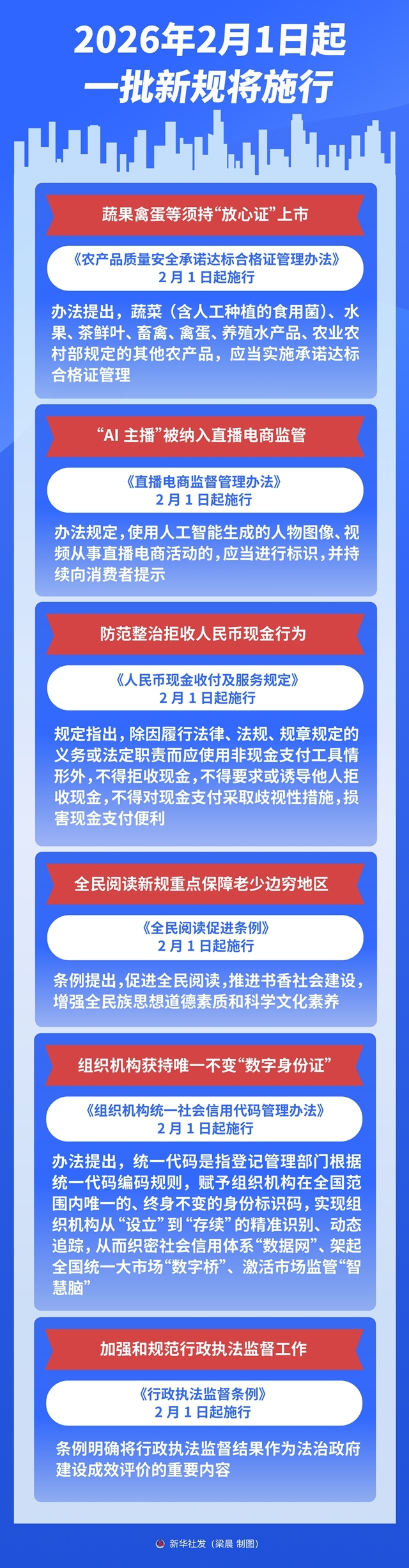
Group 1 - New regulations on agricultural products will require a "Quality Assurance Certificate" for fruits, vegetables, poultry, and other specified products starting February 1, 2026 [1][5] - The new "Live E-commerce Supervision Management Measures" will include regulations for AI-generated avatars in live e-commerce, mandating identification and continuous consumer notifications [1][5] - The "Regulations on Cash Payment and Services" will prohibit the refusal of cash payments, ensuring that cash remains a viable payment option [2][5] Group 2 - The "National Reading Promotion Regulations" aim to enhance reading culture and improve the moral and cultural literacy of the population, with a focus on supporting underprivileged areas [2][3] - The "Unified Social Credit Code Management Measures" will provide organizations with a unique, lifelong identification code to improve the accuracy of organizational identification and enhance the social credit system [3]
事关你我生活 2月新规一起来看
Xin Lang Cai Jing· 2026-01-31 01:55
Group 1: Agricultural Product Management - The "Commitment to Quality Certificate" management for agricultural products, including fruits and vegetables, will be implemented starting February 1. This certificate ensures that the products have not used banned pesticides or veterinary drugs and that the residues of allowed substances are within limits [1] - The management method specifies that vegetables (including cultivated edible fungi), fruits, fresh tea leaves, livestock, poultry, eggs, aquaculture products, and other products designated by the Ministry of Agriculture and Rural Affairs must comply with this certification [1] Group 2: Live E-commerce Regulation - The "Live E-commerce Supervision Management Measures" will also take effect on February 1, incorporating AI-generated content, such as digital anchors, into the regulatory framework. This aims to prevent the misuse of new technologies for generating or spreading false information [2] - The measures require that any AI-generated images or videos used in live e-commerce activities must be clearly labeled and continuously inform consumers [2] Group 3: Cash Payment Regulations - The "Regulations on Cash Payment and Services" will be enforced from February 1, prohibiting the refusal of cash payments except in legally mandated situations. It also forbids encouraging or inducing others to refuse cash [3] - Businesses supporting cash payments must maintain reasonable change availability and ensure conditions for smooth cash transactions [3] Group 4: National Reading Promotion - The "National Reading Promotion Regulations" will be effective from February 1, focusing on enhancing reading accessibility, especially in rural, revolutionary, ethnic, border, and underdeveloped areas [4] - The regulations emphasize support for reading among minors, disabled individuals, and the elderly, including providing suitable reading materials and establishing reading courses [4] Group 5: Unified Social Credit Code - The "Unified Social Credit Code Management Measures" will be implemented on February 1, providing organizations with a unique, permanent identification code for accurate identification and tracking across the country [5] - This initiative aims to strengthen the social credit system and enhance market regulation [5] Group 6: Administrative Law Enforcement Supervision - The "Administrative Law Enforcement Supervision Regulations" will take effect on February 1, emphasizing a balanced approach to supervision, prevention, and correction of administrative law enforcement issues [6] - The regulations will enhance the management of administrative enforcement personnel and monitor for illegal practices such as arbitrary fines and inspections [6]
2月起,这些新规施行
Xin Lang Cai Jing· 2026-01-30 17:41
Group 1: New Regulations in E-commerce and Cash Transactions - The "AI主播" (AI Anchor) will be included in the regulatory framework for live e-commerce starting February 1, 2023, to prevent the use of new technologies for generating or spreading false information [2] - The new regulations on cash transactions will prohibit the refusal of cash payments, except in cases mandated by law, ensuring that cash remains a viable payment option [3] Group 2: Agricultural Product Management - The "Quality Safety Commitment Certificate Management Measures" will be implemented for agricultural products such as vegetables, fruits, and poultry, requiring them to hold a "Quality Assurance Certificate" when marketed [1] Group 3: Promotion of Reading - The "National Reading Promotion Regulations" will focus on enhancing reading accessibility in underdeveloped areas and for vulnerable groups, including children, the elderly, and people with disabilities, starting February 1, 2023 [4] Group 4: Organizational Identification - The "Unified Social Credit Code Management Measures" will provide organizations with a unique, lifelong identification code to improve the accuracy of organizational identification and enhance the social credit system [5] Group 5: Administrative Law Enforcement - The "Administrative Law Enforcement Supervision Regulations" will emphasize the importance of supervision in administrative law enforcement, aiming to improve the quality and effectiveness of administrative actions [6]
2月新规一起来看!
Xin Hua She· 2026-01-30 03:11
Group 1 - The "Agricultural Product Quality Safety Law" will be implemented starting February 1, focusing on ensuring that agricultural products do not use prohibited substances and meet safety standards [3] - The "Live E-commerce Supervision Management Measures" will regulate the live e-commerce industry, particularly concerning the use of artificial intelligence to prevent the generation or dissemination of false information [5] - The "Cash Payment and Collection Regulations" state that cash cannot be refused except under specific legal obligations, aiming to protect cash payment methods [6] Group 2 - The "National Reading Promotion Regulations" aim to enhance national moral and ethical standards through promoting reading, with a focus on marginalized groups and regions [7] - The "Unified Social Credit Code for Organizations" will be implemented to ensure precise identification and dynamic management of organizations across the country [8] - The "Administrative Law Enforcement Supervision Regulations" emphasize the importance of supervision in administrative law enforcement, aiming to prevent and correct violations while enhancing the quality and efficiency of enforcement [9]

央行等三部门发布新规!
Jin Rong Shi Bao· 2025-12-19 11:18
Core Viewpoint - The People's Bank of China, along with other regulatory bodies, has established the "Regulations on Cash Payment and Service" to enhance the cash circulation environment amidst the growing trend of digital payments, ensuring that cash remains a viable payment option for all demographics [1][2]. Group 1: Regulations Overview - The new regulations aim to clarify the cash service obligations of various charging units, business entities, and banking institutions, promoting a collaborative effort to maintain a cash-friendly environment [1][2]. - The regulations emphasize the importance of cash as a fundamental payment tool that supports the real economy and financial stability [1]. Group 2: Principles of the Regulations - The regulations are based on five fundamental principles: financial service for the public, problem-oriented approach, comprehensive measures, collaborative governance, and legal accountability [2]. - The principle of financial service for the public focuses on respecting consumer payment choices and meeting diverse payment needs while encouraging the development of various payment methods [2]. Group 3: Payment Scenarios - The regulations specify that cash payments must be supported in scenarios involving face-to-face services and transactions that can be completed in person, ensuring reasonable cash availability [3]. - For automated services and locations with unified management, businesses must clearly indicate accepted payment methods and provide contact information for cash-related inquiries [3]. Group 4: Banking Sector Requirements - Banking institutions are required to facilitate cash deposit and withdrawal services, ensuring that their network and self-service machines cater to the needs of different customer groups [5]. - Banks must also manage cash collection effectively to prevent the circulation of unfit currency and mitigate various business risks [5].
三部门:经营主体应尊重社会公众对合法支付方式的自主选择权
Zheng Quan Shi Bao Wang· 2025-12-19 09:22
Core Viewpoint - The People's Bank of China, in collaboration with the National Development and Reform Commission and the Financial Regulatory Bureau, has issued regulations to uphold the legal status of the Renminbi and prevent the refusal of cash payments, ensuring a diverse payment service environment for the public [1] Group 1: Regulations on Cash Payments - The newly released regulations emphasize that businesses and service providers must respect the public's right to choose legal payment methods [1] - It is prohibited to refuse cash payments, induce others to refuse cash, or implement discriminatory measures against cash transactions [1] - The regulations aim to create a convenient cash circulation environment amidst the development of various payment methods [1]