
人民生活品质提高

Search documents
国务院副总理丁薛祥:确保2030年前碳达峰目标如期实现
中国有色金属工业协会硅业分会· 2025-11-10 01:49
Core Viewpoint - The article emphasizes the importance of achieving high-quality development and ecological protection during the "14th Five-Year Plan" period, with a focus on green transformation and sustainable development [1][21]. Summary by Sections 1. Strategic Requirements for Achieving Modernization - The "14th Five-Year Plan" period is crucial for laying the foundation for achieving socialist modernization by 2035, with a focus on economic growth, technological innovation, and ecological progress [12][11]. - The article outlines the need to identify strategic opportunities and challenges, emphasizing the importance of adapting to changes in the development environment [13]. 2. Scientific Connotation of Development Goals - High-quality development is essential, with a target for per capita GDP to reach the level of middle-income countries by 2035, focusing on enhancing domestic demand and consumption [15]. - The level of technological self-reliance must significantly improve, with an emphasis on strengthening the national innovation system and enhancing basic research capabilities [16]. - Comprehensive reforms are necessary to improve the socialist market economy, ensuring that market forces play a decisive role in resource allocation [17]. - Social and cultural development must be prioritized, enhancing both material and spiritual wealth, and promoting cultural confidence [19]. - The quality of life for citizens should continuously improve, with a focus on employment, income distribution, and social security systems [20]. - Significant progress in ecological construction is required, with a commitment to achieving peak carbon emissions before 2030 and promoting a green economy [21]. - National security must be reinforced, addressing both traditional and non-traditional security challenges [23]. 3. Implementation of Development Goals - The article stresses the need for a comprehensive understanding of Xi Jinping's thought to guide the modernization process [24]. - Strengthening the centralized leadership of the Communist Party is crucial for achieving development goals [25]. - A fighting spirit is necessary to effectively respond to various risks and challenges [26]. - Practical implementation of the outlined goals is essential, with a focus on actionable plans and collective efforts [26].

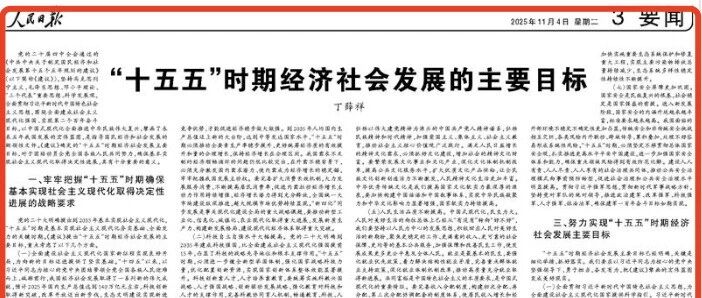
“十五五”时期经济社会发展的主要目标
Ren Min Ri Bao· 2025-11-04 05:05
Group 1 - The core viewpoint of the article emphasizes the strategic requirements for achieving decisive progress in socialist modernization during the "15th Five-Year Plan" period, which is crucial for laying the foundation for future development [1][2] - The "15th Five-Year Plan" aims to ensure a solid start for the new journey of building a modern socialist country, with GDP expected to reach approximately 140 trillion yuan by 2025, alongside advancements in technology, reform, ecological civilization, and public welfare [2][3] - The plan outlines the need for a phased approach to achieve the overall goal of modernization by 2035, with specific targets and strategies for various sectors [3][4] Group 2 - High-quality development is a significant focus, with the goal of increasing per capita GDP to the level of middle-income countries by 2035, emphasizing the importance of domestic demand and consumption [5][6] - The plan highlights the necessity of enhancing self-reliance in technology, aiming to establish China as a technological powerhouse by 2035, with a strong emphasis on education and talent development [6][7] - Comprehensive reforms are essential for modernizing the governance system and enhancing the market economy, with over 300 reform tasks set to be completed by 2029 [8][9] Group 3 - The plan aims to elevate social civilization, promoting both material and spiritual wealth, and enhancing cultural confidence and public cultural services [9][10] - Improving the quality of life for citizens is a priority, focusing on stable employment, equitable income distribution, and a robust social security system [10][11] - Environmental sustainability is a key goal, with initiatives aimed at achieving peak carbon emissions by 2030 and promoting a green economy [11][12] Group 4 - National security is emphasized as a foundation for national rejuvenation, with a focus on enhancing security systems and capabilities to address various risks [13] - The successful implementation of the "15th Five-Year Plan" requires strong leadership from the Communist Party, ensuring alignment with the central government's directives [14][15] - The plan stresses the importance of practical execution and adaptability in achieving the outlined goals, fostering a collective effort from all sectors of society [15]
丁薛祥人民日报撰文
Zhong Guo Ji Jin Bao· 2025-11-04 02:23
Core Points - The article outlines the main goals for China's economic and social development during the "15th Five-Year Plan" period, emphasizing the importance of achieving decisive progress towards socialist modernization by 2035 [2][3] Group 1: Strategic Requirements - The "15th Five-Year Plan" is crucial for laying the foundation for achieving socialist modernization, with a projected GDP of approximately 140 trillion yuan by 2025 [3] - The plan aims to establish a solid foundation for future goals, building on the achievements of the "14th Five-Year Plan" [3] - The development environment is complex, with both opportunities and challenges, necessitating a focus on domestic demand to stabilize economic growth [4] Group 2: Main Goals of Economic and Social Development - High-quality development is prioritized, with a goal for per capita GDP to reach the level of middle-income countries by 2035 [6] - Significant improvements in self-reliance in technology are targeted, with a focus on enhancing the national innovation system and talent cultivation [7] - Comprehensive reforms are to be deepened, particularly in the economic system, to enhance market efficiency and government roles [8] - Social and cultural development is emphasized, aiming to improve both material and spiritual wealth [9] - The quality of life for citizens is to be enhanced, focusing on employment, income, and social security [10][11] - Environmental sustainability is a key focus, with goals for green development and carbon emissions peaking by 2030 [12] - National security measures are to be strengthened to address both traditional and non-traditional risks [13] Group 3: Implementation Strategies - The implementation of the plan requires adherence to Xi Jinping's thought and strong centralized leadership from the Communist Party [14] - A proactive approach to challenges is necessary, emphasizing the importance of struggle and resilience [15] - Detailed action plans are to be developed to ensure the successful execution of the outlined goals [16]
丁薛祥人民日报撰文
中国基金报· 2025-11-04 01:39
Core Viewpoint - The article outlines the main goals for China's economic and social development during the "15th Five-Year Plan" period, emphasizing the importance of achieving decisive progress towards socialist modernization by 2035, while addressing both opportunities and challenges in the current development environment [9][11]. Group 1: Strategic Requirements - The "15th Five-Year Plan" is a critical period for laying the foundation for achieving socialist modernization, with a projected GDP of approximately 140 trillion yuan by 2025, alongside advancements in technology, reform, ecological civilization, and public welfare [12][11]. - The plan aims to establish a solid foundation for future goals, with a focus on strong national construction and the rejuvenation of the nation, requiring precise identification of tasks and strategies in various fields [13]. - The development environment is complex, with both strategic opportunities and risks, necessitating a combination of goal-oriented and problem-oriented approaches to maintain strategic initiative in international competition [13]. Group 2: Main Goals of Economic and Social Development - High-quality development is essential, with a target for per capita GDP to reach the level of middle-income countries by 2035, emphasizing the need to enhance domestic demand and improve consumption mechanisms [15]. - The level of technological self-reliance must significantly increase, with a focus on strengthening national strategic technological capabilities and fostering a robust innovation ecosystem [16][17]. - Comprehensive reforms are necessary to enhance the socialist market economy, improve governance, and expand high-level openness, with a focus on deepening reforms in various sectors [18]. - Social and cultural development must be prioritized, enhancing both material and spiritual wealth, and promoting cultural confidence and core socialist values [19]. - The quality of life for citizens should improve, with a focus on stable employment, equitable income distribution, and enhanced social security systems [20]. - Environmental sustainability is crucial, with a commitment to achieving peak carbon emissions by 2030 and promoting a green economy [21]. - National security must be reinforced, addressing both traditional and non-traditional security challenges to ensure stability and resilience [22]. Group 3: Implementation Strategies - The implementation of the "15th Five-Year Plan" goals requires a comprehensive understanding of Xi Jinping's thought on socialism with Chinese characteristics, serving as a guiding framework for modernization efforts [23]. - Strengthening the centralized leadership of the Communist Party is vital for achieving development goals, ensuring alignment with the Party's directives [23]. - A proactive approach to addressing risks and challenges is necessary, fostering a spirit of struggle and resilience in the face of difficulties [24]. - Effective execution of the plan's objectives is essential, with a focus on practical implementation and mobilizing collective efforts across the nation [24].
丁薛祥发表署名文章
财联社· 2025-11-03 23:59
Core Viewpoint - The article outlines the main goals for China's economic and social development during the "15th Five-Year Plan" period, emphasizing the importance of achieving decisive progress towards socialist modernization by 2035, guided by the principles of socialism with Chinese characteristics [2][3]. Group 1: Strategic Requirements - The "15th Five-Year Plan" is a critical period for laying the foundation for achieving socialist modernization by 2035, with a focus on economic growth, technological innovation, and ecological progress [3]. - The plan aims to provide a solid foundation for future goals, building on the achievements of the "14th Five-Year Plan," with GDP expected to reach approximately 140 trillion yuan by 2025 [3]. - The development environment during this period is complex, with both opportunities and challenges, necessitating a focus on domestic demand to stabilize economic growth [4]. Group 2: Scientific Connotation of Development Goals - High-quality development is essential, with a target for per capita GDP to reach the level of middle-income countries by 2035, emphasizing the need for improved productivity and domestic demand [5][6]. - The plan aims to significantly enhance self-reliance in technology, with a focus on building a strong national innovation system and fostering talent through education [5][7]. - Comprehensive reforms are necessary to improve the socialist market economy, enhance governance, and expand openness, with over 300 reform tasks outlined to be completed by 2029 [5][8]. - Social and cultural development is prioritized, aiming to enhance both material and spiritual wealth, with a focus on cultural confidence and the promotion of core socialist values [5][9]. - The plan emphasizes improving people's quality of life, with a focus on stable employment, equitable income distribution, and a robust social security system [5][10]. - Environmental sustainability is a key goal, with initiatives aimed at achieving peak carbon emissions by 2030 and promoting a green economy [5][11]. - National security is highlighted as a foundational element for development, with a focus on enhancing security capabilities and addressing various risks [5][12]. Group 3: Implementation Strategies - The article stresses the importance of adhering to Xi Jinping's thought on socialism with Chinese characteristics as a guiding principle for achieving development goals [13]. - Strengthening centralized leadership is crucial for ensuring effective implementation of the development objectives [13][14]. - A proactive approach to addressing risks and challenges is necessary, with an emphasis on resilience and determination in overcoming obstacles [14]. - The article calls for a focus on practical implementation, ensuring that the goals outlined in the plan are translated into actionable steps [14].

“十五五”规划建议:提出经济社会发展七方面主要目标
Zhong Guo Xin Wen Wang· 2025-10-28 12:15
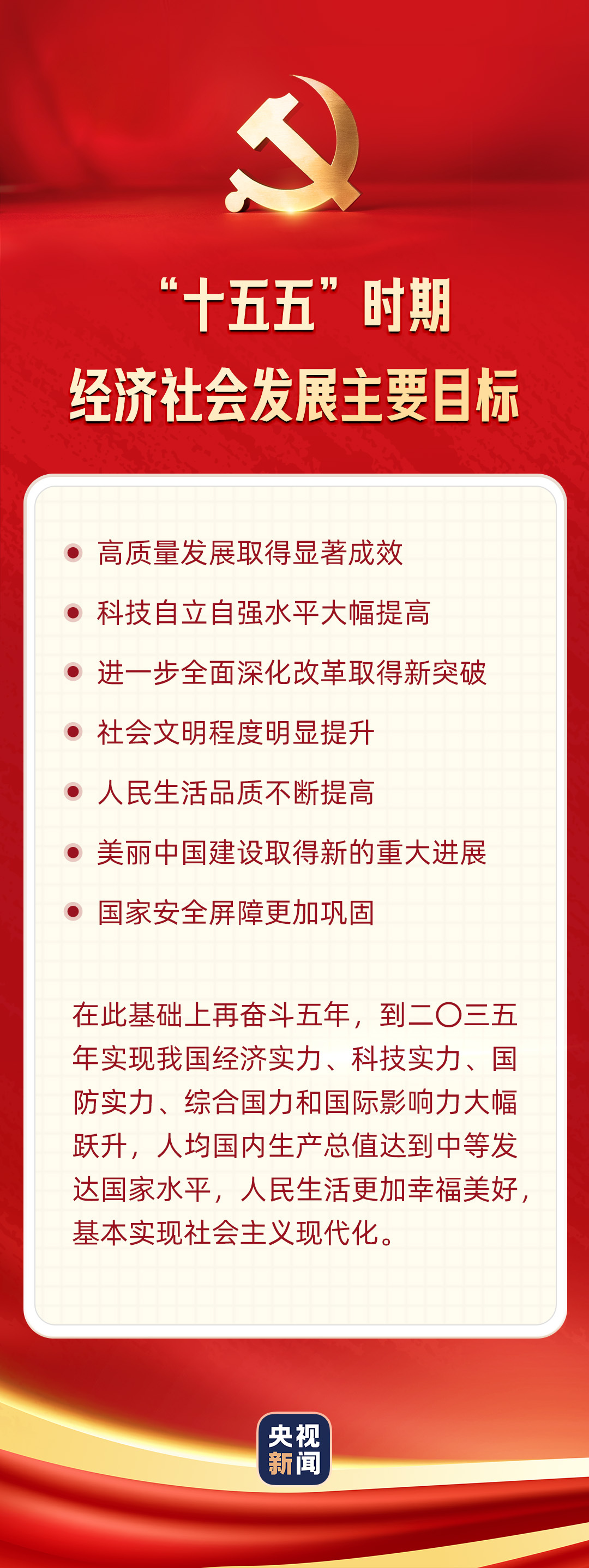
Core Viewpoint - The "15th Five-Year Plan" outlines seven major goals for economic and social development, emphasizing the importance of this period in achieving socialist modernization [1][2]. Group 1: Economic Development Goals - Significant achievements in high-quality development, with economic growth maintained within a reasonable range and an increase in total factor productivity [2] - The role of domestic demand in driving economic growth is expected to strengthen, with major progress in new industrialization, information technology, urbanization, and agricultural modernization [2] - The construction of a unified national market is advancing, showcasing the advantages of a super-large-scale market [2] Group 2: Technological Advancements - A substantial increase in self-reliance and strength in technology, with improvements in the national innovation system and enhanced capabilities in basic research and original innovation [2] - Rapid breakthroughs in key core technologies in critical areas, with a growing number of leading fields [2] Group 3: Reform and Governance - New breakthroughs in comprehensive deepening of reforms, with modernization of the national governance system and governance capabilities [3] - Improvement in the socialist market economy system and high-level opening-up mechanisms [3] Group 4: Social and Cultural Development - Noticeable enhancement in social civilization, with a stronger cultural confidence and widespread practice of socialist core values [3] - Increased richness in the spiritual and cultural life of the people, along with enhanced national cohesion and cultural influence [3] Group 5: Quality of Life Improvements - Continuous improvement in the quality of life, with progress in high-quality employment and synchronization of income growth with economic growth [3] - Optimization of the distribution structure and expansion of the middle-income group [3] Group 6: Environmental Sustainability - Major progress in building a beautiful China, with a basic formation of green production and lifestyle [3] - Achievement of carbon peak targets and establishment of a clean, low-carbon, safe, and efficient new energy system [3] Group 7: National Security - Strengthening of the national security system and capabilities, with effective prevention and resolution of risks in key areas [3] - Improvement in social governance and public safety governance levels [3] Future Outlook - By 2035, significant advancements in China's economic, technological, defense, and comprehensive national strength are anticipated, with GDP per capita reaching levels of moderately developed countries [4]
中共中央新闻发布会丨《建议》明确“十五五”时期经济社会发展主要目标
Yang Shi Xin Wen Ke Hu Duan· 2025-10-24 10:43
Core Points - The article discusses the key objectives for China's economic and social development during the 14th Five-Year Plan period, as outlined by the Central Committee [1] - The goals include significant achievements in high-quality development, advancements in self-reliant technology, and breakthroughs in comprehensive reforms [1][6] - The plan emphasizes improvements in social civilization, quality of life, progress in building a beautiful China, and strengthening national security [1][7] Summary by Categories - **High-Quality Development**: The plan aims for notable results in high-quality economic development [1] - **Technological Self-Reliance**: There is a focus on significantly enhancing the level of technological self-reliance and strength [1][6] - **Reform Breakthroughs**: The initiative seeks to achieve new breakthroughs in comprehensive deepening of reforms [1] - **Social Civilization**: The goal includes a marked improvement in the level of social civilization [1] - **Quality of Life**: Continuous enhancement of people's quality of life is a priority [1] - **Beautiful China**: The construction of a beautiful China is expected to make new significant progress [1][7] - **National Security**: The plan aims to further consolidate the national security barrier [1][7]
增强必胜信心 赢得战略主动
Xin Hua She· 2025-10-24 00:36
Core Viewpoint - The 20th Central Committee's Fourth Plenary Session has approved the proposal for the 15th Five-Year Plan, outlining China's development blueprint for the next five years, emphasizing the commitment to advancing Chinese-style modernization and achieving socialist modernization [1] Group 1: High-Quality Development - High-quality development is the primary task for building a modern socialist country, with significant achievements expected during the 15th Five-Year Plan [2] - The plan aims to guide scientific deployment across various fields, promoting higher quality, efficiency, equity, sustainability, and safety in development [2][3] Group 2: Modern Industrial System - A modern industrial system is crucial for promoting high-quality economic development, focusing on intelligent, green, and integrated directions [3] - The plan emphasizes optimizing traditional industries, nurturing emerging industries, and enhancing service sectors and infrastructure [3] Group 3: Domestic Market Support - Strong domestic market support is essential for high-quality development, with a focus on improving people's livelihoods and stimulating consumption [4] - The plan aims to release demand in various sectors through proactive macroeconomic policies, making domestic demand a primary driver of economic growth [4] Group 4: Technological Self-Reliance - The level of technological self-reliance and strength is set to significantly increase, with a focus on scientific and technological innovation as a pathway to modernization [5][6] - The plan includes strengthening original innovation and key core technology breakthroughs, integrating technology with education and talent development [7] Group 5: Comprehensive Reform - Comprehensive reform is identified as a fundamental driver for advancing Chinese-style modernization, with a focus on enhancing the socialist market economy [8] - The plan includes specific measures to improve macroeconomic governance and remove deep-seated institutional barriers [8][9] Group 6: High-Level Opening Up - The plan calls for expanding high-level opening up to create a win-win cooperation landscape, promoting trade innovation and investment cooperation [10] - It emphasizes the importance of a market-oriented, law-based, and international business environment to enhance global resource allocation capabilities [10] Group 7: Cultural Development - The session highlights the importance of cultural development, aiming for a significant improvement in social civilization levels [11] - The plan includes promoting cultural innovation and enhancing the influence of Chinese civilization [11] Group 8: Improving People's Livelihoods - The plan emphasizes the need to improve and guarantee people's livelihoods, aiming for common prosperity and addressing urgent social issues [13][14] - Specific measures include promoting quality employment, improving the income distribution system, and enhancing public services [14] Group 9: Ecological Progress - The plan sets a goal for significant progress in building a beautiful China, focusing on green transformation and ecological civilization [15][16] - It includes measures for pollution prevention and ecological system optimization to support high-quality development [17] Group 10: National Security - The plan underscores the importance of national security as a foundation for national rejuvenation, integrating security with social governance [19][20] - It aims to modernize the national security system and enhance public safety governance [19]
续写经济快速发展和社会长期稳定两大奇迹新篇章
Si Chuan Ri Bao· 2025-10-23 22:02
Core Points - The "15th Five-Year Plan" period is crucial for achieving basic socialist modernization and will focus on high-quality development and technological self-reliance [5][6][7] - The recent Fourth Plenary Session of the 20th Central Committee emphasized the importance of unity under Xi Jinping's leadership to tackle challenges and promote national rejuvenation [1][2][4] - The economic achievements during the "14th Five-Year Plan" period include crossing significant GDP milestones and contributing approximately 30% to global economic growth [2][3] Economic Development - Sichuan's economy has seen significant growth, surpassing 5 trillion and 6 trillion yuan, moving from 6th to 5th in national rankings [3] - The average income in certain villages has nearly doubled compared to 2020, indicating improved living standards [3] - The province's industrial sectors, such as the power battery industry, have also reported substantial growth, with outputs exceeding 100 billion yuan for two consecutive years [3] Strategic Goals - The "15th Five-Year Plan" outlines key objectives including enhancing economic quality, deepening reforms, and improving social welfare [5][6] - Specific measures include focusing on the real economy, boosting innovation, and expanding domestic markets [6][7] - The plan aims to create a modern industrial system and promote green transformation across various sectors [6][7] Implementation and Local Initiatives - Local governments and enterprises are committed to implementing the directives from the Fourth Plenary Session, focusing on practical actions to achieve high-quality development [8][9] - Projects such as the Chengdu-Deyang railway are being expedited to enhance regional integration and connectivity [9] - Efforts to optimize the business environment are underway, with initiatives aimed at improving service integration and supporting local economies [9][10]