代表人诉讼

Search documents
最高法:支持投资者保护机构对已退市上市公司提起普通代表人诉讼
Mei Ri Jing Ji Xin Wen· 2026-02-24 02:53
Core Viewpoint - The Supreme People's Court is actively promoting special representative litigation for debt disputes to support investor protection, particularly against listed companies and their controlling shareholders or intermediaries [1] Group 1: Legal Framework - The majority of cases in the capital market involve defendants such as controlling shareholders of listed companies, securities firms, and accounting firms [1] - The court supports the initiation of ordinary representative lawsuits by investor protection organizations against multiple ST companies, *ST companies, and delisted companies [1] Group 2: Investor Protection - The measures aim to provide more convenient and lower-cost remedies for investors seeking to protect their rights [1]
6家企业将退市!代表人诉讼步入常态化,年内投资者可索赔证券标的超250家
Zheng Quan Shi Bao Wang· 2025-12-24 05:00
Core Viewpoint - The regulatory environment in the capital market is increasingly stringent, with a "zero tolerance" approach towards financial fraud and information disclosure violations, leading to significant implications for companies and investors [1][4][10]. Group 1: Regulatory Actions and Company Penalties - Kexin Information (300730) received an administrative penalty notice from the China Securities Regulatory Commission (CSRC) for violations, which may lead to further lawsuits from affected investors [1]. - ST Huilun (300460) and ST Jiaao (603822) also faced penalties for information disclosure violations, with fines of 3 million yuan and 5.5 million yuan respectively, highlighting the ongoing scrutiny of companies' financial practices [5]. - The CSRC's intensified enforcement actions reflect a broader trend of holding companies accountable for financial misconduct, with over 250 companies currently facing potential investor lawsuits due to clear violations [3][5]. Group 2: Investor Rights and Legal Framework - Investors have the right to seek compensation for securities violations, as outlined in China's Securities Law, which includes provisions for insider trading, market manipulation, and false statements [6]. - As of December 23, 2025, there are 256 companies eligible for investor claims, with 50 having already won or settled cases, indicating a growing trend in investor activism [6][7]. - The legal framework allows investors to initiate lawsuits even if the company has not yet received an administrative penalty, emphasizing the importance of timely legal action [6]. Group 3: Trends in Investor Litigation - The number of investor lawsuits and the amounts claimed are on the rise, with significant cases involving thousands of investors and claims exceeding 4 billion yuan in some instances [8][9]. - The introduction of representative litigation has lowered the cost for investors, making it easier for large groups to pursue claims collectively [9]. - Legal complexities are increasing, with disputes now often involving nuanced issues such as the materiality of false statements and the allocation of responsibility among various parties, including controlling shareholders and intermediaries [9][10]. Group 4: Recommendations for Improvement - There is a need for optimization in the investor rights protection process, including clearer timelines for case handling and improved mechanisms to prevent delays in litigation [11]. - The establishment of detailed standards for initiating public interest lawsuits and addressing misinformation in the market is recommended to enhance investor protection [12].

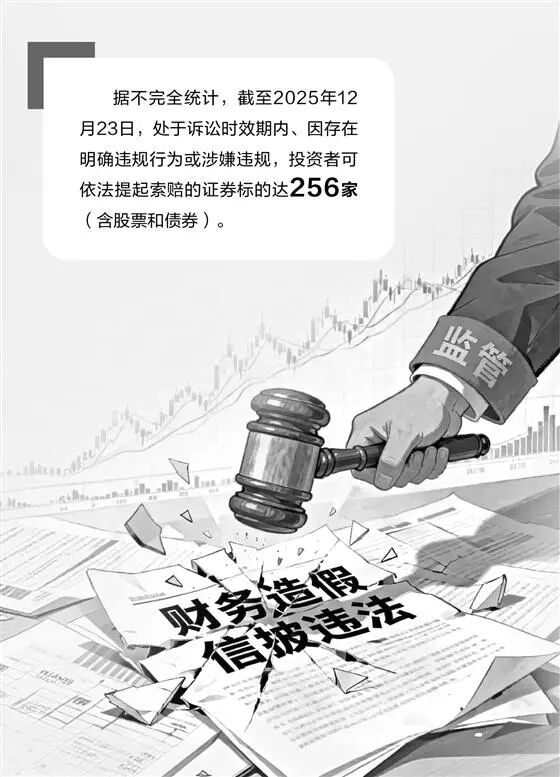
年内投资者可索赔证券标的超250家
Zheng Quan Shi Bao· 2025-12-24 00:37
Core Viewpoint - The normalization of representative lawsuits has led to over 250 companies facing potential securities claims from investors, highlighting the increasing regulatory scrutiny and investor protection efforts in the capital market [1][2][3]. Group 1: Regulatory Environment - The China Securities Regulatory Commission (CSRC) has intensified enforcement against financial fraud and information disclosure violations, signaling a "zero tolerance" approach to such behaviors [1]. - As of December 23, 2025, there are 256 securities (including stocks and bonds) that investors can claim against due to clear violations [1][4]. Group 2: Investor Rights and Legal Framework - Investors have clear rights to compensation under China's Securities Law, which holds responsible parties accountable for insider trading, market manipulation, and false statements [4]. - The statute of limitations for civil claims related to these violations is three years, and investors can initiate lawsuits even if the company has not yet received administrative penalties [4][5]. Group 3: Case Examples and Trends - Recent cases involving ST Huilun and ST Jiaao illustrate the types of violations leading to administrative penalties, including failure to disclose fund usage and inaccuracies in financial reporting [3][4]. - The trend of representative lawsuits is becoming more common, with significant participation from investors, as seen in cases like Jin Tong Ling and *ST Meishang, which involved thousands of investors [7][8]. Group 4: Challenges and Recommendations - Despite progress, there are still areas needing improvement in the investor rights protection process, such as the efficiency of case handling and the clarity of legal standards [10][12]. - Legal experts suggest that regulatory bodies and judicial authorities should collaborate to establish clear timelines for case processing and address issues like "case suppression" [10][12].
代表人诉讼步入常态化 年内投资者可索赔证券标的超250家
Zheng Quan Shi Bao· 2025-12-23 18:44
Core Viewpoint - The regulatory environment in China's capital market is increasingly stringent, with a focus on punishing financial fraud and information disclosure violations, leading to a significant rise in investor lawsuits against companies for securities fraud [1][3][6]. Group 1: Regulatory Actions and Company Violations - Companies such as ST Hui Lun and ST Jia Ao have received administrative penalty notices for violations related to information disclosure, with fines of 3 million yuan and 5.5 million yuan respectively [2]. - The China Securities Regulatory Commission (CSRC) has intensified its enforcement actions, indicating a "zero tolerance" policy towards financial misconduct [1][6]. - As of December 23, 2025, there are 256 companies (including stocks and bonds) that investors can sue for securities fraud, with 50 companies already having won or settled claims [3][4]. Group 2: Investor Rights and Legal Framework - Investors have clear rights to compensation under China's Securities Law, which holds responsible parties accountable for insider trading, market manipulation, and false statements [3]. - The statute of limitations for filing claims is three years, and investors are encouraged to act quickly, even if the company has not yet received an administrative penalty [3][4]. - The legal landscape is evolving, with a notable increase in the number of representative lawsuits and the complexity of cases, reflecting a shift towards more robust investor protection [6][7]. Group 3: Trends in Investor Litigation - The number of investor lawsuits and the amounts claimed are on the rise, with cases involving thousands of investors becoming common [6]. - The introduction of representative lawsuits has significantly reduced the cost of litigation for investors, allowing for broader participation in claims [6][7]. - Recent cases have seen claims exceeding 4 billion yuan, with some cases potentially reaching over 10 billion yuan, indicating a growing trend in the scale of investor claims [6]. Group 4: Challenges and Recommendations - Despite improvements in investor rights protection, there are still procedural inefficiencies, such as delays in case processing and a lack of clarity in legal standards [8][9]. - Legal experts suggest that regulatory bodies and judicial authorities need to collaborate to streamline the litigation process and establish clear timelines for case handling [8]. - There is a call for more detailed judicial interpretations to address the complexities of securities fraud cases, which would help clarify the legal landscape for investors [9].
ST旭电证券虚假陈述案进展情况说明
Xin Lang Cai Jing· 2025-12-09 12:05
Core Viewpoint - The China Securities Investor Service Center supports 11 investors in a lawsuit against ST Xudong for false statements, which has been accepted by the Shijiazhuang Intermediate People's Court [1][2]. Group 1: Lawsuit Details - The Shijiazhuang Intermediate People's Court issued a public announcement on December 9, 2025, regarding the representative lawsuit, detailing the scope of rights holders, registration period, and registration methods [1][2]. - The rights holders are defined as investors who purchased Dongxu Optoelectronics stock (original stock code: 000413) through public bidding from February 15, 2016, to July 5, 2024, and still held the stock at the close of trading on July 5, 2024, with similar claims [1][2]. Group 2: Registration Process - Eligible investors must register their claims by January 8, 2026, through the Shijiazhuang Intermediate People's Court's securities dispute litigation intelligent review platform [1][2]. - The court's consultation phone number is provided for inquiries [1][2]. Group 3: Ongoing Support - The China Securities Investor Service Center will continue to fulfill its responsibilities in supporting the lawsuit and will provide updates on the litigation progress through various platforms [2][3].

头部券商发声!投资者索赔损失
券商中国· 2025-12-04 12:33
Core Viewpoint - The article discusses a legal case involving CITIC Securities and its subsidiary, CITIC Securities South China, related to investor lawsuits against Dongxu Optoelectronics for alleged false statements leading to investment losses. The case is being processed under a representative litigation procedure, and the potential financial impact on CITIC Securities is deemed minimal. Group 1: Legal Proceedings - CITIC Securities South China received a civil ruling from the Hebei High Court confirming the case will proceed under a representative litigation procedure [2] - The lawsuit involves 11 investors suing Dongxu Optoelectronics and other related parties for a total claim of 1.8282 million yuan due to alleged false statements [5] - The plaintiffs argue that Dongxu Optoelectronics, which has been delisted, made false disclosures in its annual reports from 2015 to 2022, leading to their financial losses [7] Group 2: Allegations Against Dongxu Optoelectronics - Dongxu Optoelectronics is accused of having false records and significant omissions in its annual reports, as well as fraudulent issuance of stocks during a non-public offering in 2017 [9] - The company failed to disclose its 2023 annual report within the legal timeframe, which has raised further concerns among investors [9] - The total amount raised from the fraudulent stock issuance was 7.565 billion yuan, which was based on misleading financial data [9]