代际更替

Search documents
时代更替浪潮下:从陈景河荣退看企业家的传承与新生 | 涛涛布诀285
Sou Hu Cai Jing· 2026-01-14 10:15
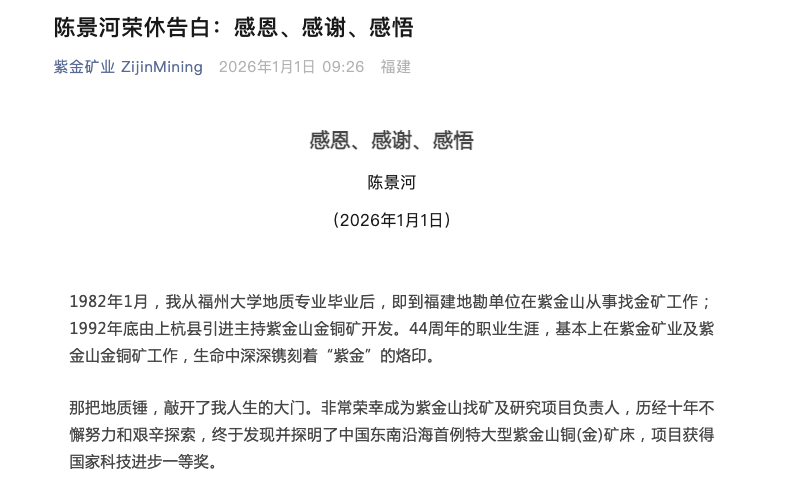
Core Insights - The retirement of Chen Jinghe, founder of Zijin Mining, marks the end of a significant era in the mining industry, reflecting generational changes among Chinese entrepreneurs and the ongoing industrial evolution [1][3]. Group 1: Chen Jinghe's Achievements - Born in 1955, Chen transformed a small county enterprise into a global leader in the mining sector, with the "Zijin system" comprising three listed companies valued at over 1.4 trillion yuan [3]. - Despite holding less than 1% of shares, Chen prioritized the company's future, expressing pride in the mining industry while acknowledging missed opportunities and management shortcomings [3]. Group 2: Zijin Mining's Strategic Moves - Zijin Mining has made significant acquisitions, including 100% ownership of the Arinac copper-gold mine in Peru and 95% of the Rosebel gold mine in Suriname, among others [5][6]. - The company has outlined a three-year plan (2023-2025) and a long-term goal for 2030, focusing on climate change initiatives, aiming for peak carbon emissions by 2029 and carbon neutrality by 2050 [5]. Group 3: Industry Evolution and Future Prospects - The transition from traditional industries to technology and innovation is evident, with new entrepreneurs emerging in the tech sector, such as the "Hangzhou Six Little Dragons," who are making strides in robotics and brain-machine interfaces [16][20]. - The ongoing generational shift in entrepreneurship highlights the need for traditional companies to embrace technology to ensure continuity and relevance in a rapidly changing market [20][21].


韩国4月出生人口同比增幅创34年来最高
财联社· 2025-06-27 05:54
Group 1 - In April, South Korea's newborn population reached 20,717, marking an 8.7% year-on-year increase, the highest monthly growth since April 1991 [1] - The total fertility rate in South Korea rose to 0.79 in April, an increase of 0.06 compared to the previous year, although it remains significantly below the replacement level of 2.1 [1] - The rise in birth rates is attributed to an increase in marriage rates, a growing population of women in their early 30s, and various government policies aimed at promoting childbirth [1][2] Group 2 - The number of marriages in April increased by 4.9% year-on-year, reaching 18,921 couples, marking the 13th consecutive month of growth [2] - The population of women aged 30 to 34 has grown from 1.51 million in 2020 to 1.65 million in May this year, contributing to higher marriage and birth rates [2] - Despite the positive trends, experts express skepticism about the sustainability of these increases due to structural issues such as high housing costs, intense educational competition, and changing attitudes towards marriage and family among the younger generation [2][3] Group 3 - The South Korean government has implemented measures such as a monthly childcare allowance of 300,000 KRW (approximately 1,740 RMB) for parents of children under one year old and increased parental leave [2] - A recent UN report categorizes South Korea as a "super low fertility" country, estimating only a 0.1% chance of restoring the total fertility rate to a level that can achieve generational replacement within the next 30 years [2] - Economic challenges related to population issues are prompting both the government and major companies to take action to reverse the declining birth rate trend [2]