
作品信息网络传播权

Search documents
小红书遭TVB旗下公司起诉,公司暂无回应
Xin Lang Ke Ji· 2025-09-03 08:33
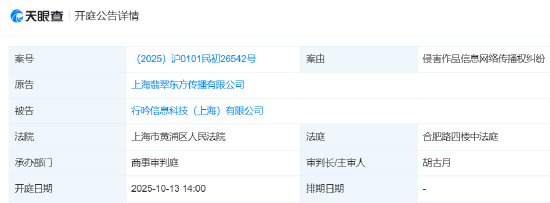
Core Points - Recently, 行吟信息科技 (Shanghai) Co., Ltd., the operator of 小红书, was sued by 上海翡翠东方传播有限公司 for infringement of online dissemination rights of works, with the case scheduled for hearing on October 13, 2025 [1][2] - 行吟信息科技 (Shanghai) Co., Ltd. was established in 2013 and is primarily engaged in professional technical services, with a registered capital of 1 million RMB [2] - The company completed its E round of financing in 2024 and was listed as an executed party by the Shanghai Huangpu District People's Court in June 2025 [2][3] Legal Proceedings - The case number for the lawsuit is (2025)沪0101民初26542号, and it will be heard at the Huangpu District People's Court in Shanghai [1][2] - The presiding judge for the case is 胡古月, and the court session will take place in the fourth-floor courtroom on Hefei Road [2] Company Status - 行吟信息科技 (Shanghai) Co., Ltd. was listed as an executed party with an execution target of 0 RMB, indicating potential financial or operational challenges [3]

付费委托他人制作的宣传片被诉侵权
Ren Min Wang· 2025-07-09 01:02
Core Viewpoint - The court ruled that the chemical company is not liable for damages due to the use of a third-party video segment in its promotional material, as it acted without intent to infringe and took prompt action to remove the content upon notification [2][4]. Group 1: Case Background - A chemical company was sued for using a 3-second clip from a copyrighted work in a promotional video, leading to a claim for 50,000 yuan in damages [1]. - The promotional video was created by a third-party media company, and the chemical company had paid 137,000 yuan for its production [1]. Group 2: Court's Findings - The court found that the chemical company did not have subjective intent to infringe and had exercised reasonable care in commissioning the video [2][4]. - The court acknowledged that while the chemical company infringed on the copyright, it was not liable for damages due to the legitimate source defense, as it had acted responsibly and promptly removed the infringing content [2][4]. Group 3: Legal Implications - The ruling highlighted the application of the legitimate source defense in copyright cases, indicating that if a party can demonstrate they exercised reasonable care and had no intent to infringe, they may not be held liable for damages [4]. - The court did not require the chemical company to issue a public apology, considering its lack of malicious intent and prompt action to cease the infringement [2].