
传媒影视

Search documents
英大证券晨会纪要-20260213
British Securities· 2026-02-13 01:49
Group 1 - The report indicates a generally optimistic outlook for the A-share market before and after the Spring Festival, suggesting that long-term investors should hold stocks while short-term traders should adjust their positions based on risk preferences [2][10] - The report highlights that the market is currently in a slow bull phase, with expectations of improved liquidity and policy support after the holiday, which could create new investment opportunities [3][11] - Key sectors showing strength include electric grid equipment, liquid cooling, and semiconductors, while media and consumer sectors are experiencing adjustments, indicating a phase of stock selection and market competition [9][12] Group 2 - The semiconductor sector is identified as a long-term investment opportunity, with a projected growth of 10.10% in 2023, driven by digital transformation and geopolitical factors [8] - The report emphasizes the importance of focusing on stocks with strong performance and growth expectations within the semiconductor sector, while advising caution against high-flying stocks lacking fundamental support [8][11] - The report notes that the market's trading volume has been around 2 trillion yuan, reflecting a cautious sentiment among investors, which suggests that a careful approach to investment is necessary [3][6]
资金流向,新变化!
Zhong Guo Zheng Quan Bao· 2026-01-16 13:06
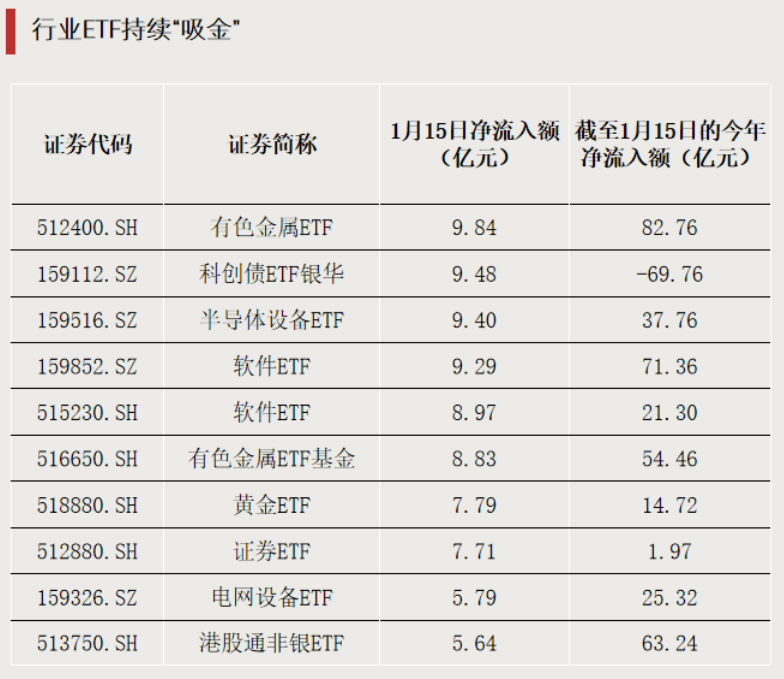
Group 1: ETF Market Overview - On January 16, the overall ETF market experienced a decline, with semiconductor-themed ETFs showing strong performance, as several products rose against the trend and entered the top ten gainers of the day [1][4] - The total trading volume of ETFs exceeded 750 billion yuan, setting a historical record, with 23 ETFs having a single-day trading volume exceeding 10 billion yuan [2][12] - The ETF market saw a significant net outflow of over 68 billion yuan, marking the highest single-day outflow of the year, with a clear divergence in fund flows [3][8] Group 2: Sector Performance - Semiconductor-themed ETFs surged, with seven out of the top ten gainers focusing on the semiconductor sector, particularly tracking the Shanghai Stock Exchange's semiconductor materials and equipment index [4][5] - The leading semiconductor ETF, Penghua (589020), rose by 8.74% on the day and has accumulated a year-to-date increase of 29.93%, making it the highest-performing ETF in the same period [4] - Conversely, media and entertainment-themed ETFs experienced a notable decline, with the top six losers all dropping over 4%, and some trading at a discount [6][7] Group 3: Fund Flow Dynamics - The net outflow from the ETF market was primarily driven by stock-type ETFs, which saw a net outflow of over 67 billion yuan, while industry ETFs continued to attract capital [8][9] - Among the top ten net inflows, several industry ETFs focused on non-ferrous metals, semiconductor equipment, software, gold, and securities [8] - The non-ferrous metals ETF (512400) led with a net inflow of 9.84 billion yuan, with a year-to-date net inflow exceeding 8 billion yuan, ranking second in the market [9] Group 4: Future Industry Insights - The investment outlook for the AI industry chain is high, with expectations of significant growth driven by AI, supply chain restructuring, and structural inflation [10] - The storage industry is anticipated to perform well in 2026, driven by AI-induced supply-demand imbalances, with increasing demand for advanced storage solutions [10]

A股行情持续,哪些ETF强势吸金
Sou Hu Cai Jing· 2026-01-12 12:05
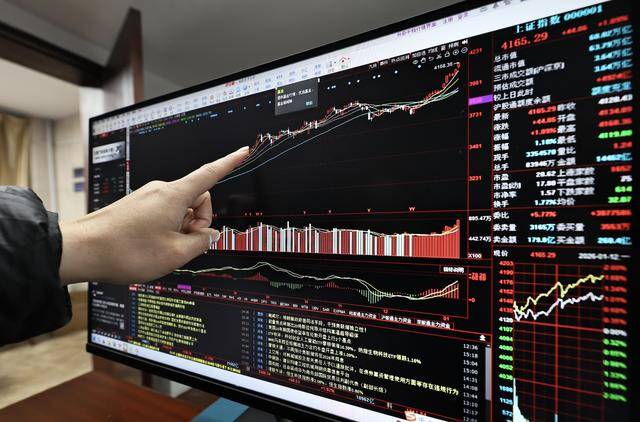
Core Viewpoint - The A-share market continues its strong performance at the beginning of the year, with significant trading volumes and a notable increase in various sectors, particularly in commercial aerospace and technology-related ETFs [3][6][10]. Market Performance - As of January 12, the Shanghai Composite Index surpassed 4165 points, with a total trading volume exceeding 3.64 trillion yuan, marking a historical high. The Shanghai index rose by 1.09%, while the Shenzhen Component and ChiNext indices increased by 1.75% and 1.82%, respectively [3]. - Over 4100 stocks in the market saw gains, with 202 stocks hitting the daily limit up [3]. Sector Analysis - The cultural media, military electronics, and IT services sectors all experienced gains exceeding 7%, while real estate, insurance, agricultural chemicals, and oil processing sectors faced declines [3]. - The commercial aerospace sector remains hot, with related ETFs experiencing significant surges. Multiple satellite industry ETFs saw daily gains of over 9% [3][6]. ETF Market Dynamics - A total of 1875 ETFs were analyzed, with 1487 showing increases, indicating a positive market sentiment. Notably, 50 ETFs had daily gains exceeding 9% [6]. - The Morgan Stanley CSI AI ETF led the gains with a 16.59% increase, while other technology-related ETFs also performed strongly [6][7]. Fund Flows - There is a clear divergence in fund flows, with fixed-income ETFs experiencing significant redemptions, particularly in the sci-tech bond category, which accounted for over 60% of the outflows [8]. - Conversely, equity ETFs saw substantial inflows, with satellite communication-related ETFs attracting over 80 billion yuan [9]. Investment Outlook - Analysts suggest that the commercial aerospace sector, despite high valuations, has significant long-term growth potential. The industry is expected to see accelerated development, with dynamic P/E ratios projected to decrease significantly by 2026 and 2027 [12]. - Investment strategies should focus on cyclical sectors, technology innovation, and areas benefiting from domestic demand and consumption recovery, such as entertainment and social services [11].
一份指南:关于“高低切”
Guotou Securities· 2025-11-13 03:05
Group 1 - The report outlines the "A-share high-low cut index" as a tool to track the pricing patterns in the A-share market, indicating that an increase in the index suggests a rise in the differentiation of returns among industries, while a peak followed by a decline indicates the emergence of high-low cut phenomena [1][2] - The report notes that typically, the A-share market experiences 2-3 significant high-low cut pricing cycles within a year, each lasting approximately 2-3 months. When the index exceeds the upper range (around 60%), it often signals an overheated high-position sector, while a drop to the lower range (around 30%) suggests the end of a low-position rebound or the brewing of a new differentiation cycle [1][3] - The report explains that high-low differentiation in the A-share market is driven by chip differentiation and fundamental divergence, particularly when there is a significant influx of capital and stark growth differences between high and low sectors [2][3] Group 2 - The report discusses the relationship between the high-low cut index and market structure, indicating that when the index peaks and declines, it often signals a recovery in low-position sectors, but the clarity of style switching depends on the logic signals from low-position sectors [3][4] - The report highlights that the high-low cut index often correlates with the overall market index, particularly when the index peaks and declines, which can signal a transition from a bull to a bear market [3][4] - The report emphasizes that since late October, the outperformance of overseas and low-position cyclical sectors has begun to manifest, with the report suggesting that true style switching will occur when liquidity transitions to a fundamental-driven market [4][5] Group 3 - The report provides a historical review of high-low cut phenomena, detailing significant transitions in market styles from 2017 to 2025, including shifts from cyclical sectors to consumer and technology sectors, and from high-dividend defensive sectors to low-position rebounds [6][10] - The report notes that the high-low cut phenomenon in 2023 was characterized by a shift from technology-driven sectors to low-position cyclical sectors, driven by policy catalysts in the real estate market [19][22] - The report indicates that the most recent high-low cut in October 2025 reflects a transition from high-position technology sectors to low-position cyclical resources, influenced by macroeconomic factors and policy expectations [27][28]
最新纲领
Datayes· 2025-10-23 12:09
Core Viewpoint - The article discusses the key outcomes and strategic directions from the Fourth Plenary Session of the 20th Central Committee of the Communist Party of China, emphasizing high-quality development, technological self-reliance, and the establishment of a robust domestic market. Economic and Social Development Goals - The main goals for the 15th Five-Year Plan include significant achievements in high-quality development, substantial improvements in technological self-reliance, deepening reforms, enhancing social civilization, improving people's living standards, advancing ecological progress, and strengthening national security [3]. Key Tasks for the Next Five Years - The article outlines twelve major tasks, including: - Building a modern industrial system focused on strengthening the real economy and maintaining a reasonable proportion of manufacturing [7]. - Accelerating technological self-reliance to lead new productive forces and seize technological high ground [7]. - Establishing a strong domestic market by expanding domestic demand and removing barriers to a unified national market [7]. - Promoting high-level socialist market economic system to stimulate the vitality of various business entities [7]. - Expanding high-level opening-up to create win-win cooperation [7]. - Advancing agricultural modernization and rural revitalization [7]. - Promoting regional coordinated development and optimizing economic layout [7]. - Fostering socialist culture and enhancing cultural strength [7]. - Advancing common prosperity by addressing urgent livelihood issues, particularly in real estate and population development [7]. - Building a beautiful China through comprehensive green transformation [7]. - Modernizing national security systems and capabilities [7]. - Promoting high-quality defense and military modernization [7]. Short-term Work Focus - The focus is on stabilizing growth and preventing risks, with an emphasis on maintaining employment, ensuring social stability, and addressing urgent public concerns [5][7]. Domestic Market and Consumption - The article stresses the importance of building a strong domestic market and enhancing consumption, with a strategic focus on expanding domestic demand and ensuring a positive interaction between supply and demand [16]. International Context - The article notes the increasing complexity and uncertainty in the international environment, highlighting China's transition to a high-quality development stage and its institutional advantages [8]. Industry Performance - The article mentions various sectors experiencing significant growth, such as coal, energy metals, and cultural industries, while also noting the challenges faced by sectors like electronics and real estate [11][12][33]. Company Performance Highlights - Several companies reported substantial revenue and profit growth, indicating a positive trend in specific industries, such as renewable energy and pharmaceuticals [19][20]. Investment Opportunities - The article suggests potential investment opportunities in sectors aligned with the strategic goals outlined in the 15th Five-Year Plan, particularly in technology, manufacturing, and green industries [7][19].
本轮慢牛行情的节奏与后续演绎路径
2025-08-20 14:49
Summary of Conference Call Records Industry or Company Involved - The discussion primarily revolves around the A-share market and various sectors including beauty care, electronics, non-banking financials, and consumer goods. Core Points and Arguments 1. **Market Characteristics**: The current A-share market is characterized by structural prosperity, with a significant recovery in specific sectors such as beauty care, electronics, non-banking financials, and non-ferrous metals, despite an overall modest profit recovery. The mid-year earnings forecast shows a 27.51% increase, a slight year-on-year decline of 1.21% [3][4] 2. **External and Internal Uncertainties**: Short-term capital inflow is limited due to external factors like restricted foreign investment and macroeconomic uncertainties, which dampen overall economic expectations [3][4] 3. **Market Sentiment**: Investor sentiment has surged, with the sentiment index exceeding 90, indicating a state of euphoria that may lead to a rapid increase in stock prices as short positions are covered [5][8] 4. **Trading Patterns**: The market exhibits a "three up, two down" pattern, with stronger performance in the first half of the week compared to the latter half, necessitating caution regarding potential pullbacks [3][6] 5. **Potential for Market Correction**: Overheated market conditions, indicated by a five-day average turnover rate exceeding 2%, could lead to corrections back to the 20-day moving average, and rates above 3% may result in deeper adjustments towards the 60-day line [6][8] 6. **Future Market Outlook**: The mid-term outlook remains optimistic for the A-share market, provided that the pace of increases is controlled to avoid significant corrections. Attention should be paid to external factors such as U.S. Federal Reserve interest rate expectations and the performance of U.S. tech stocks [8][14] 7. **Sector Rotation and Investment Opportunities**: Emphasis on sector rotation is crucial, with a focus on strong trends in AI, humanoid robots, and semiconductor sectors, as well as opportunities in the beauty industry within the new consumption space [9][10][11] 8. **Dividend Sectors**: Apart from traditional banking, sectors such as insurance, petrochemicals, food and beverage, and white goods are highlighted for their high dividend yields and stable returns, with the liquor sector showing potential for investment as pessimistic expectations have been largely priced in [2][13] 9. **Risks and Strategies**: The market may face minor pullback risks in the short term, but maintaining a slow bull market rhythm can facilitate continued upward movement. Attention should be given to the performance of U.S. tech stocks, as their downturn could impact domestic tech sectors [14][15] Other Important but Possibly Overlooked Content 1. **Market Dynamics**: The discussion notes that the recent upward acceleration in the market is influenced by external factors such as the easing of the Russia-Ukraine conflict and rising expectations for interest rate cuts by the Federal Reserve, which have positively impacted global and A-share markets [4][5] 2. **Sector-Specific Trends**: The call emphasizes the importance of identifying low-position sector rotation opportunities, particularly in the new consumption space, which has begun to show signs of recovery despite previous underperformance [10][11] 3. **Regulatory Environment**: The ongoing discussions among regulatory bodies regarding the photovoltaic industry and battery components indicate that the "anti-involution" theme, while currently less popular, may still have potential for future development [12]
付费委托他人制作的宣传片被诉侵权
Ren Min Wang· 2025-07-09 01:02
Core Viewpoint - The court ruled that the chemical company is not liable for damages due to the use of a third-party video segment in its promotional material, as it acted without intent to infringe and took prompt action to remove the content upon notification [2][4]. Group 1: Case Background - A chemical company was sued for using a 3-second clip from a copyrighted work in a promotional video, leading to a claim for 50,000 yuan in damages [1]. - The promotional video was created by a third-party media company, and the chemical company had paid 137,000 yuan for its production [1]. Group 2: Court's Findings - The court found that the chemical company did not have subjective intent to infringe and had exercised reasonable care in commissioning the video [2][4]. - The court acknowledged that while the chemical company infringed on the copyright, it was not liable for damages due to the legitimate source defense, as it had acted responsibly and promptly removed the infringing content [2][4]. Group 3: Legal Implications - The ruling highlighted the application of the legitimate source defense in copyright cases, indicating that if a party can demonstrate they exercised reasonable care and had no intent to infringe, they may not be held liable for damages [4]. - The court did not require the chemical company to issue a public apology, considering its lack of malicious intent and prompt action to cease the infringement [2].