保险销售误导

Search documents
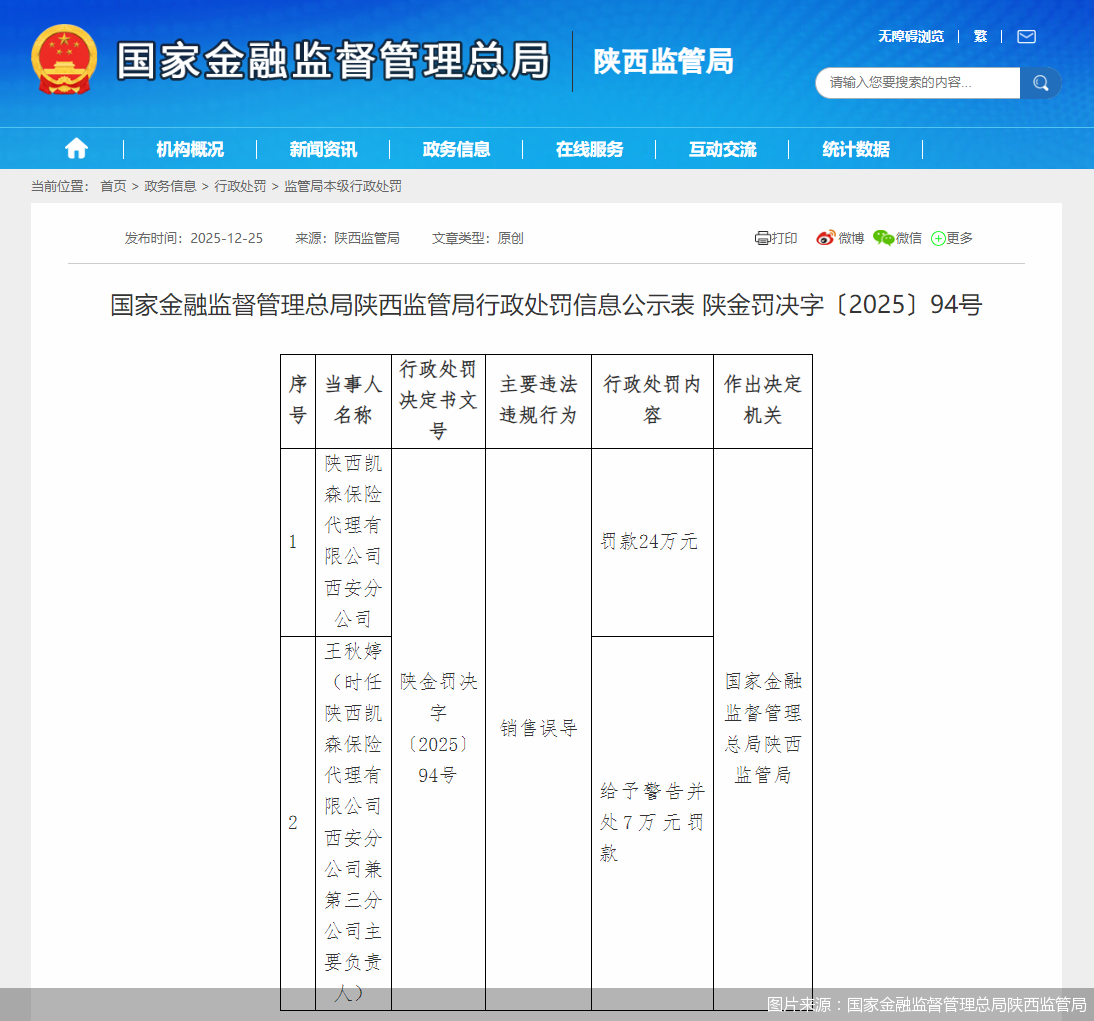
因销售误导,陕西凯森保险代理西安分公司合计被罚31万元
Bei Jing Shang Bao· 2025-12-25 12:31
Group 1 - The National Financial Supervision Administration of Shaanxi issued an administrative penalty against Shaanxi Kaisen Insurance Agency Co., Ltd. Xi'an Branch for misleading sales practices, resulting in a fine of 240,000 yuan [1] - The main responsible person, Wang Qiuting, received a warning and was fined 70,000 yuan for her role in the violations [1]

分红落差大、看到拿不到!早期分红险如今收益令人“失望”,该怎么办?
Mei Ri Jing Ji Xin Wen· 2025-11-12 13:57
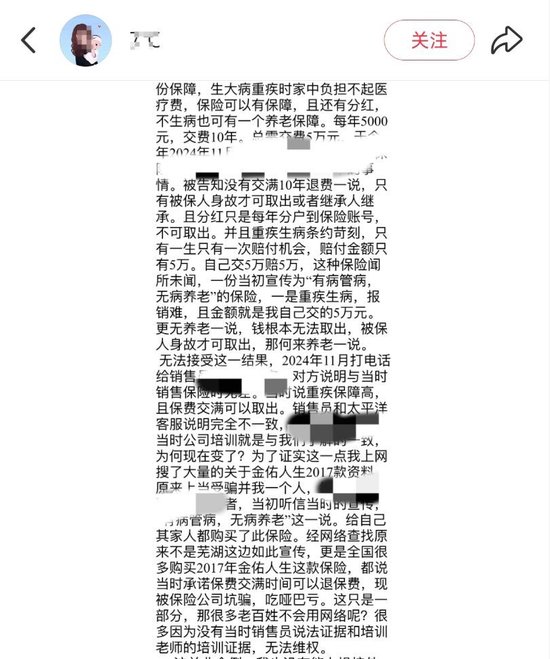
Core Viewpoint - The article highlights consumer dissatisfaction with insurance products, particularly regarding discrepancies between promised benefits and actual returns, leading to feelings of being misled by sales representatives [1][5]. Group 1: Consumer Experiences - A consumer named Wang reported that the insurance product she purchased, which was marketed as providing both health coverage and retirement benefits, did not deliver as promised, leading to a sense of betrayal [2][4]. - Many consumers, including Wang and another individual named Zhang, expressed frustration over the low actual returns compared to what was initially promised by sales agents, indicating a widespread issue in the insurance market [4][5]. Group 2: Insurance Product Characteristics - The article explains that the dividends from insurance products are derived from the insurance company's operational performance, including mortality rates, expense ratios, and investment returns, which can lead to unstable and unpredictable payouts [5][6]. - It is noted that promotional materials often present hypothetical returns that may not reflect actual performance, and in poor financial years, dividends could be zero [5][6]. Group 3: Sales Practices and Misleading Information - The article discusses the prevalence of misleading sales practices in the insurance industry, where agents may exaggerate benefits or obscure critical information to boost sales [7][8]. - Despite regulatory efforts to curb misleading sales tactics, such practices persist, contributing to consumer complaints and dissatisfaction [7][8]. Group 4: Legal and Consumer Protection - Legal experts suggest that consumers should thoroughly read and understand insurance contracts, retain evidence of sales communications, and seek professional advice to protect their rights [9][10]. - In cases of perceived misrepresentation, consumers are advised to document evidence and consider legal action to recover premiums paid, emphasizing the importance of a complete evidence chain for successful claims [10].
代理退保“毒丸”调查(下):高度工业化的黑灰产
Bei Jing Shang Bao· 2025-10-21 06:36
Core Viewpoint - The rise of the "agent refund" industry, which operates in a gray area, has intensified despite warnings from insurance companies. This industry exploits consumer anxiety by presenting itself as a "rights defender" while leading consumers to face significant financial losses and highlighting regulatory challenges within the insurance sector [1][3]. Development Stages - The "agent refund" phenomenon has evolved through three stages since its inception. The first stage began in 2020, driven by economic pressures and the flow of information through short video platforms, which allowed for widespread dissemination of refund information. The second stage saw a shift to fraudulent charging as insurance companies began to notice an increase in refund claims, leading to a decline in the effectiveness of traditional complaint channels. The third stage, which emerged in 2024, is characterized by a surge in legal service institutions entering the refund space, focusing on monetizing traffic rather than providing genuine services [3][4]. Industry Dynamics - The internet has facilitated the growth of the agent refund industry by connecting consumers with service providers. Larger refund agencies typically employ teams of around 50-60 salespeople who engage with clients and guide them through the refund process. Most agencies rely on organic traffic generated through the publication of related videos to attract clients [4][5]. Sales and Transparency Issues - The root cause of the agent refund industry's growth lies in the lack of transparency during the sales process. Many insurance agents either intentionally mislead clients or lack a proper understanding of the products they sell. Misleading presentations during sales meetings contribute to consumer confusion and dissatisfaction [6][8]. Consumer Experiences - Numerous consumer accounts reveal severe issues with insurance contracts, including instances of fraud and misleading sales tactics. One extreme case involved a consumer accumulating nearly 5 million yuan in loans due to deceptive practices by an insurance agent, raising concerns about the complicity of insurance companies in such frauds [7][9]. Regulatory Challenges - The persistence of the agent refund industry highlights significant regulatory challenges. Factors contributing to this issue include the focus on scale by insurance companies, leading to unhealthy competition, and the information asymmetry between consumers and agents. Additionally, the difficulty consumers face in pursuing claims exacerbates the problem [8][10]. Impact on Consumers - The agent refund industry poses multiple risks to consumers, including financial losses and the potential inability to secure adequate insurance coverage after canceling policies. A typical case involved a consumer losing a significant refund amount due to reliance on an agent refund service, ultimately resulting in a net loss [9][10]. Recommendations for Improvement - To address the issues surrounding agent refunds, collaboration among insurance companies, consumers, and regulators is essential. Companies should enhance customer service and communication channels, while regulators need to clarify the boundaries between legitimate complaints and fraudulent activities. Additionally, improving consumer education regarding insurance products can help mitigate impulsive refund decisions [12][13].

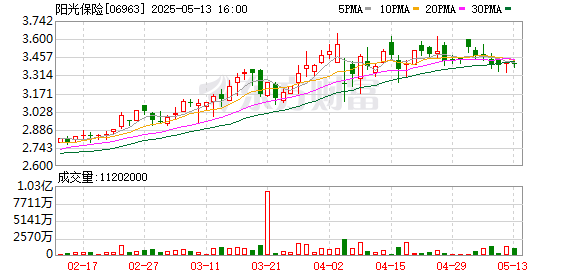
“20年后退本金”承诺落空?阳光保险遭投诉,律师提醒风险
Nan Fang Du Shi Bao· 2025-05-13 09:57
Core Viewpoint - The article highlights a consumer complaint regarding a discrepancy between the promises made by an insurance agent and the actual terms of the insurance contract, raising concerns about sales practices in the insurance industry [4]. Company Overview - Sunshine Insurance Group Co., Ltd. was established in 2005 and is one of China's top 500 enterprises, focusing on life and property insurance [3]. - In 2024, Sunshine Insurance Group reported total premium income of 128.38 billion yuan, an increase of 8.0% year-on-year, with Sunshine Life achieving premium income of 80.45 billion yuan, up 7.8% [3]. Product Specifics - The "Sunshine Life Zhenxin 2019 Lifetime Major Illness" insurance product is a lifelong critical illness insurance that includes death benefits and was awarded in 2019 as a noteworthy health insurance product [3]. - Concerns have arisen regarding whether this type of critical illness insurance allows for the return of the principal after 20 years, with industry experts suggesting that such a return is unlikely unless the product includes a "whole life" component [3][5]. Consumer Experience - A consumer named Mr. Wang was misled by an insurance agent who promised a return of the principal after 20 years, which was later contradicted by the insurance company's explanation that only the cash value of the policy could be refunded [2][4]. - The article notes that many consumers, like Mr. Wang, often trust agents and neglect to read the contract details, leading to misunderstandings and disputes [5]. Industry Insights - Data from the National Financial Supervision Administration indicates that in the first three quarters of 2024, complaints about policy cancellations accounted for 48.3% of personal insurance complaints, while sales-related complaints made up 31.1% [5]. - The complexity of insurance products often makes it difficult for ordinary consumers to fully understand the terms, highlighting the need for better training and management of insurance agents to prevent misleading statements [5]. Legal Guidance - In cases where there is a discrepancy between an agent's verbal promises and the written contract, legal experts recommend that consumers file complaints with the insurance regulatory authority for third-party verification and potential mediation [6].