
信用评价体系

Search documents
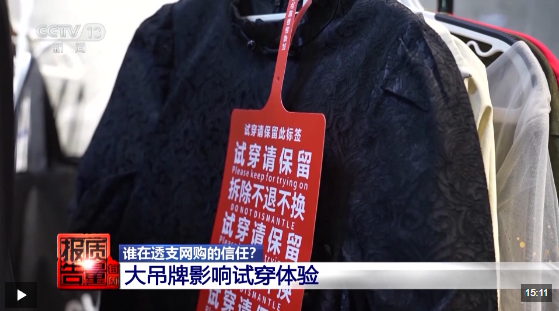
每周质量报告丨上防盗扣、挂大吊牌 谁在透支网购的信任?
Xin Lang Cai Jing· 2026-01-11 11:00
Core Viewpoint - The rise of online shopping has led to increased use of large tags and anti-theft devices on clothing, reflecting merchants' concerns over high return rates and potential losses from returned items that cannot be resold [1][8]. Group 1: Merchant Experiences - Merchants like Zhou Yuanxia and Wang Meng have adopted large tags and anti-theft devices to prevent returns of worn or damaged clothing, which is particularly problematic for items like Hanfu and Tang suits that have higher return rates [4][6]. - Wang Meng noted that while the use of large tags increases costs and reduces sales, it effectively mitigates losses from returns [6]. - E-commerce operators like Yan Qinqin have shifted focus from promoting products to managing returns, facing challenges with customers attempting to return items beyond the allowed return period [10][12]. Group 2: Consumer Impact - Consumers have expressed frustration with large tags that obstruct the view of clothing details, impacting their shopping experience and leading to potential returns due to sizing issues [17][19]. - Many consumers believe that only a small number of individuals engage in malicious return practices, suggesting that the majority are honest buyers affected by the stringent return policies [19][20]. Group 3: Industry Challenges - The overall return rate for women's clothing online hovers around 50% to 60%, with some sectors like live-streaming e-commerce exceeding 80%, leading to increased operational costs for merchants [28][30]. - The costs associated with returns, including logistics and product damage, can significantly erode profit margins, making it crucial for merchants to manage return policies effectively [30][32]. - Experts suggest that e-commerce platforms need to enhance their ability to identify and manage return behaviors to protect both consumer rights and merchant interests [32][34]. Group 4: Solutions and Recommendations - Experts recommend that platforms utilize big data to create a credit evaluation system that can help identify trustworthy consumers and flag suspicious return behaviors [34][36]. - There is a call for technological solutions to improve the tracking of consumer behavior and establish a credit rating system for return actions, which could help maintain trust in the market [36].

王子新材:建立完善的信用评价体系与账期政策
Sou Hu Cai Jing· 2025-11-07 08:32
Core Viewpoint - Wangzi New Materials (002735) has established a comprehensive credit evaluation system and payment terms based on various factors such as customer business scale, credit status, and historical cooperation [1] Group 1 - The company emphasizes the importance of risk assessment in business cooperation and accounts receivable management to protect the interests of the company and its shareholders [1] - Wangzi New Materials is committed to ensuring the achievement of future operational goals through effective credit policies [1]

为市场经济毛细血管注入更多制度活水
Sou Hu Cai Jing· 2025-09-11 00:05
Core Viewpoint - The implementation of the national standard for individual business credit evaluation aims to enhance credit financing for individual businesses by establishing a standardized evaluation system that incorporates various dimensions such as tax compliance, social security contributions, and digital operations [1][2][3] Group 1: Standard Implementation and Impact - The new standard addresses the long-standing issue of the lack of a credit assessment system for individual businesses, which has hindered their access to financing due to their small scale and insufficient collateral [1][2] - By transforming daily operational data into quantifiable credit assets, the standard allows for a shift from traditional collateral-based lending to a model that values reputation and stable business records [1][2] - The establishment of a standardized credit information sharing channel will significantly reduce investigation costs for financial institutions and facilitate the market circulation of credit elements [2][3] Group 2: Broader Economic Implications - The credit evaluation system is expected to generate institutional benefits beyond financial services, enabling timely risk detection and supporting the identification of high-potential businesses [2][3] - The integration of credit accumulation with policies aimed at transforming individual businesses into enterprises will help overcome institutional barriers during their upgrade process [2][3] - The standard's implementation is strategically significant for China's economic transformation, as it aims to release the vitality of microeconomic entities and reduce transaction costs [3][4] Group 3: Long-term Effects and Future Considerations - A favorable credit environment is anticipated to attract more resources to individual businesses, creating a virtuous cycle of improved credit leading to easier financing and faster development [4] - The enhancement of the credit system is expected to foster a stronger spirit of contract within society, thereby lowering transaction costs and improving economic efficiency [4] - Continuous efforts are needed to address practical challenges such as data collection standardization and the protection of individual business rights, ensuring the effective application of the new credit evaluation system [3][4]
桐庐全县推广全生命周期增值服务改革
Mei Ri Shang Bao· 2025-07-22 22:22
Core Viewpoint - Tonglu County has initiated a comprehensive "mass entrepreneurship" service reform, providing full lifecycle support to entrepreneurs, which has led to significant engagement and facilitation of business registrations and transitions [1][2]. Group 1: Service Implementation - The county has processed 1,238 service requests and issued 807 business licenses, facilitating the transformation of 77 businesses into enterprises and 41 small businesses into regulated entities [1]. - A "nanny-style" service approach has been adopted, moving over 1,000 approval and regulatory tasks to the pre-service stage, thereby streamlining the process for entrepreneurs [2]. - The market regulation department has focused on five specific functional areas, including intellectual property and medical devices, to provide tailored service plans [2]. Group 2: Follow-up and Monitoring - A unique follow-up system has been established, where staff members respond to business requests within 30 minutes and schedule on-site services, ensuring continuous lifecycle support [3]. - The county's supervisory bodies conduct embedded monitoring of service quality and response times, ensuring high efficiency and satisfaction in service delivery [3]. - A compliance guide has been created to address common issues faced by businesses, and a plan has been set to reduce regulatory checks by 31.81% by 2025 [3]. Group 3: Empowerment and Growth - A credit evaluation system has been implemented, providing new businesses with a credit rating and benefits such as reduced inspection frequency and financing support [4]. - The county is also innovating in intellectual property services, offering comprehensive support from patent exploration to pre-authorization [4].