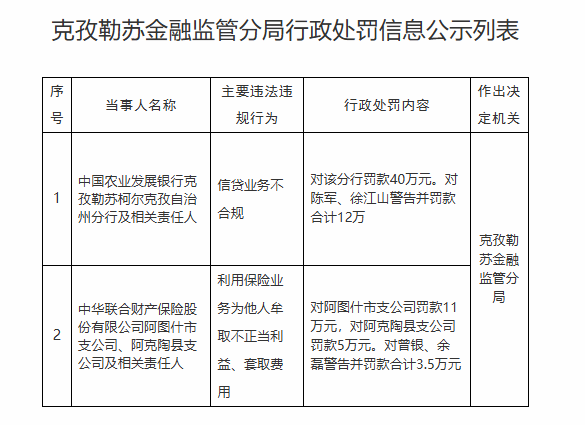
信贷业务违规

Search documents
银行业被罚超26亿元 上百人被“终身禁业”
Jin Rong Shi Bao· 2026-01-23 01:32
Core Insights - In 2025, financial regulatory authorities issued a total of 2,588 fines to banking institutions, amounting to 2.641 billion yuan, marking a significant increase from 2024 [1][2] - The regulatory approach has shifted from punishing institutions to holding individual employees accountable, with over 3,000 banking personnel penalized [1][9] - The trend of "strict regulation, strong accountability, and zero tolerance" has become normalized, focusing on quality and effectiveness rather than broad coverage [1][2] Regulatory Trends - The number of large fines (over 1 million yuan) issued to banking institutions increased significantly, with 455 such fines in 2025, including 31 fines exceeding 10 million yuan [2][3] - The majority of penalties were concentrated in the second half of 2025, with a notable spike in fines towards the end of the year [3][4] - The largest single fine in 2025 reached 97.9 million yuan, attributed to poor management practices across various banking operations [3] Types of Violations - Major areas of violations included credit business, anti-money laundering, and internal control systems, with nearly half of the large fines related to credit business infractions [6][8] - Internet loan business violations emerged as a significant concern, with several banks penalized for inadequate risk management during rapid business expansion [7][8] - Anti-money laundering fines surged to 1,381 in 2025, a 185.92% increase from 2024, reflecting heightened regulatory scrutiny [8] Individual Accountability - The "double penalty" system has led to a substantial increase in fines against individual banking personnel, with 3,933 personal fines issued in 2025 [9][10] - Over 100 banking employees received lifetime bans from the industry, a notable rise compared to previous years [10][11] - The regulatory focus on individual accountability aims to enhance compliance awareness and risk management within financial institutions [11] Future Outlook - The trend of stringent regulation and risk prevention is expected to continue into 2026, with a shift towards behavior-based assessments rather than merely financial metrics [12] - Compliance capabilities are anticipated to become essential for the survival of banks, with a focus on proactive governance and integration into business processes [12] - Regulatory attention will likely center on corporate governance, data security, consumer rights protection, and compliance with green and inclusive finance policies [12]
中华联合财险2家支公司被罚 利用保险业务套取费用等
Zhong Guo Jing Ji Wang· 2026-01-01 06:58
Group 1 - The article reports on administrative penalties imposed by the Kizilsu Financial Regulatory Bureau on various financial institutions for violations of regulations [1] - China Agricultural Development Bank's Kizilsu branch was fined 400,000 yuan for non-compliance in credit operations, with two individuals receiving warnings and fines totaling 120,000 yuan [1] - China United Property Insurance Company faced penalties for using insurance business to gain improper benefits, with fines of 110,000 yuan for the Atushi branch and 50,000 yuan for the Akto branch, along with warnings and fines totaling 35,000 yuan for two individuals [1]

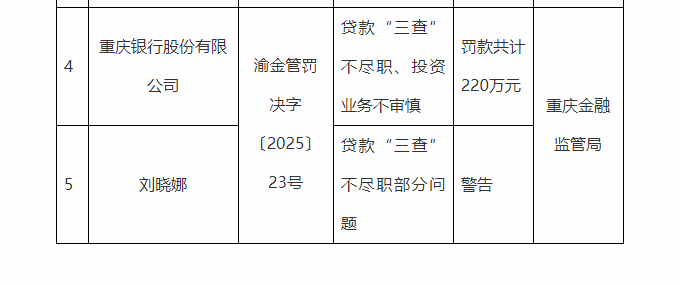
重庆银行,被罚220万
Zhong Guo Ji Jin Bao· 2025-10-23 04:52
Group 1 - Chongqing Bank was fined 2.2 million yuan due to multiple violations in credit business, including negligence in the "three checks" process and imprudent investment practices [1][2] - The bank's related personnel, Liu Xiaona, received a warning for issues related to the "three checks" negligence [1][2] - Chongqing Bank was established in 1996 and became the first local state-owned commercial bank listed on the Hong Kong Stock Exchange in November 2013, later listing on the Shanghai Stock Exchange in February 2021 [2] Group 2 - As of the end of July, Chongqing Bank's total assets reached 1,008.7 billion yuan, an increase of 152.1 billion yuan, representing a growth rate of 17.76% compared to the previous year [2] - In the first half of 2025, Chongqing Bank reported operating income of 7.659 billion yuan, a year-on-year increase of 7.00%, and a net profit attributable to shareholders of 3.19 billion yuan, up 5.39% year-on-year [3] - The bank's net interest margin stood at 1.39%, while net income from fees and commissions decreased by 28.62% to 365 million yuan, accounting for only 4.76% of total operating income [3]
前三季银行业被罚超16亿,股份行占三成!违规重灾区有哪些
Nan Fang Du Shi Bao· 2025-10-09 10:20
Core Insights - The banking industry in China has faced significant regulatory penalties in 2023, with a total of 16.64 billion yuan in fines, marking a 14.71% increase compared to the same period last year [2][5][6]. Summary by Category Regulatory Penalties Overview - In the first three quarters of 2023, the banking sector received 4,583 regulatory fines, with September alone accounting for 4.37 billion yuan, which is 26.26% of the total fines for the year [2][5]. - The total fines for the banking industry have surpassed 16 billion yuan, indicating a growing trend in regulatory scrutiny [2]. Breakdown by Bank Type - Joint-stock banks have been the most penalized, with fines totaling 4.97 billion yuan, representing 30% of the total fines. They received 271 fines, with an average penalty of 1.85 million yuan [5][6]. - Agricultural commercial banks were fined 4 billion yuan, with 552 penalties issued and an average fine of 728,700 yuan [6]. - State-owned banks faced fines of 2.74 billion yuan, with 406 penalties and an average fine of 682,300 yuan [6]. - City commercial banks received fines totaling 1.88 billion yuan, with 169 penalties and an average fine of 1.13 million yuan [6]. Foreign and Policy Banks - Foreign banks had a high average penalty of 1.76 million yuan, with 13 fines issued. Notably, Yuanta Bank was fined 14.85 million yuan for regulatory violations [7]. - Policy banks received 52 fines with an average penalty of 1.46 million yuan [7]. Common Violations - The most frequent violations were related to credit business, with 349 fines issued for inadequate loan checks, accounting for 20% of all penalties [9]. - There were 54 fines related to inaccurate classification of credit assets, which can obscure the true risk faced by banks [9][10]. - Violations in anti-money laundering practices were also common, with 16% of penalties related to failure to properly identify customer identities [10].

又有11家机构被罚1.6亿
Zhong Guo Jing Ying Bao· 2025-09-13 05:04
Core Insights - The National Financial Regulatory Administration has issued significant fines to various financial institutions, totaling approximately 260 million yuan since September, with a focus on violations in the credit sector [1][2][3] - The increase in penalties reflects a heightened regulatory scrutiny on banks, particularly regarding their credit management practices and compliance with regulations [3][4] Regulatory Actions - In September, 11 institutions were fined around 163 million yuan for various violations, including improper management of loans and non-compliance in data reporting [2] - The total fines for credit-related violations in the banking sector have exceeded several hundred million yuan this year, indicating a trend of increasing regulatory enforcement [1][2] Compliance Challenges - Banks are facing significant challenges in compliance and risk management, particularly in the areas of loan monitoring and data reporting [2][3] - The rise in penalties is attributed to the failure of banks to conduct thorough pre-loan investigations and post-loan management, leading to issues such as misclassification of assets and concealment of non-performing loans [2][3] Risk Management Issues - The pressure to maintain performance metrics has led some banks to engage in practices that obscure the true quality of their loan portfolios, such as concealing non-performing loans [5][6] - Analysts highlight that the current economic slowdown has exacerbated asset quality pressures, prompting banks to adopt non-compliant methods to mask deteriorating loan performance [3][5] Recommendations for Improvement - Experts suggest that banks need to enhance their internal governance and risk management frameworks, including optimizing performance assessments and strengthening risk culture [6] - There is a call for improved regulatory oversight and accountability, as well as the development of a more effective market for the disposal of non-performing assets [6]
国家开发银行一分行受罚!今年已被罚6次,多涉信贷业务违规
Nan Fang Du Shi Bao· 2025-08-25 06:53
Core Viewpoint - The China Development Bank (CDB) Yunnan Branch has been fined multiple times this year for non-compliance in loan management and capital control, indicating ongoing regulatory scrutiny and compliance issues within the bank [2][3][5]. Regulatory Penalties - The CDB Yunnan Branch was fined 2 million yuan for imprudent loan management and capital control, marking the sixth penalty this year [2][3]. - CDB has faced a total of approximately 19.59 million yuan in fines this year, with six penalties issued, three of which were significant, exceeding one million yuan [3][4]. - Previous penalties include 1.3 million yuan for the Chongqing Branch in January and 1.6 million yuan for the Jilin Branch in February for various compliance failures [3][4]. Financial Performance - As of the end of last year, CDB reported total assets of 18.62 trillion yuan and a loan balance of 14.69 trillion yuan, reflecting a year-on-year growth of 3.12% [7]. - The bank's revenue for last year was 172.996 billion yuan, a decline of 17.49%, while net profit increased by 1.77% to 88.96 billion yuan [7]. - The bank's non-performing loan ratio was 0.37%, a decrease of 0.21 percentage points from the previous year, while the loan provision ratio increased to 4.80% [7]. Compliance and Risk Management - CDB has initiated a three-year action plan (2024-2027) to enhance internal control and compliance, with a focus on improving credit management and compliance operations [7][8]. - The bank has acknowledged the need to address various risk areas, including credit risk and overseas business risk, as highlighted by recent internal and external inspections [8].
渤海银行一分行信贷违规被罚60万元!一个月内连收3张罚单
Nan Fang Du Shi Bao· 2025-07-07 07:52
Core Viewpoint - Bohai Bank's Hefei branch has been fined for violations in credit operations, highlighting ongoing compliance issues within the bank [2][3][5] Group 1: Regulatory Actions - The Hefei branch of Bohai Bank was fined 600,000 yuan for improper loan disbursement practices and inadequate due diligence in personal business loans [3] - This marks the third penalty for Bohai Bank in the past month, with a total of six fines amounting to 3.09 million yuan in 2023 [2][4] - Other branches, including those in Ningbo and Changsha, have also faced penalties for various regulatory violations, totaling fines of 62,000 yuan and 67,000 yuan respectively [4] Group 2: Management and Compliance Challenges - Four individuals from the Hefei branch have been warned due to their involvement in the violations, indicating a need for improved management oversight [3] - Despite achieving revenue growth of 4.20% and a net profit increase of 1.99% in Q1 2023, the bank faces significant challenges in maintaining compliance and risk management [4][5] - The bank's management has emphasized the importance of compliance and risk control in their strategic meetings, yet the recent penalties raise questions about the effectiveness of these initiatives [5]