
信贷需求回暖

Search documents
报告派研读:2025-2026年中国香港银行业深度报告
Sou Hu Cai Jing· 2026-02-03 04:37
Group 1 - The core viewpoint of the article is that the Hong Kong banking industry is entering a new phase of structural repair and cyclical adjustment, with signs of credit demand recovery and overall resilience in profitability despite pressure on net interest margins [1][22]. Group 2 - Credit issuance has turned positive, entering a moderate expansion phase, driven by the recovery of the Hong Kong economy, particularly in exports, consumption, and active capital markets [2][3]. - As of November 2025, loans in the Hong Kong banking sector increased by 1.2% year-on-year, a 4.0 percentage point improvement from the end of 2024, continuing a positive growth trend since May [4]. - Retail loans grew at a rate of 3.2%, outperforming corporate loans which grew at 0.7%, becoming a key driver of overall credit growth [5]. - Non-housing retail loans, including credit cards and consumer loans, increased by 6.5%, supported by a 3.5% rise in private consumption [5]. - Corporate credit recovery is primarily driven by two sectors: active capital market transactions boosting financial sector loan demand, with a year-on-year growth of 13.7% in financial sector loans, and a moderate recovery in manufacturing, with an 8.4% increase in manufacturing loans [5][6]. Group 3 - Net interest margins are under downward pressure but show strong resilience, with the HIBOR rate declining by 150 basis points to 3.08% by the end of 2025 due to the Federal Reserve's rate cuts [8]. - As of the end of Q3 2025, the industry’s net interest margin was 1.47%, a year-on-year decrease of 3 basis points, but the decline is less severe compared to 2024 [9]. - The decrease in the yield on interest-earning assets (-1.28 percentage points) was greater than the decline in the cost of interest-bearing liabilities (-0.89 percentage points), impacting the net interest margin [10]. Group 4 - Asset quality is stabilizing, with the overall non-performing loan ratio in the Hong Kong banking sector at 1.98%, a slight year-on-year decrease of 1 basis point [12]. - The non-performing loan ratio for loans to mainland China decreased significantly by 80 basis points to 1.99%, indicating risk mitigation in key areas [12]. - The capital adequacy ratio stands at 20.1%, with a provision coverage ratio around 250%, providing a solid buffer against potential risks [14]. Group 5 - Although profitability is under short-term pressure, the long-term fundamentals remain robust, with mainstream banks experiencing a narrowing revenue decline and a positive growth rate in net interest income driven by scale expansion [16]. - Non-interest income has increased to 50% of total income, becoming a significant growth driver, with wealth management and intermediary business income rising by 20% year-on-year [17]. - Cost management has shown effectiveness, with business management expenses growing at 1%, leading to a decrease in the cost-to-income ratio for several banks [18]. - Despite a 70% year-on-year increase in credit impairment provisions, primarily due to fluctuations in the real estate market, the future outlook for impairment pressure is expected to ease as the housing market stabilizes [19][20].

信贷需求回暖,关注海外降息进程
Ping An Securities· 2026-01-29 08:10
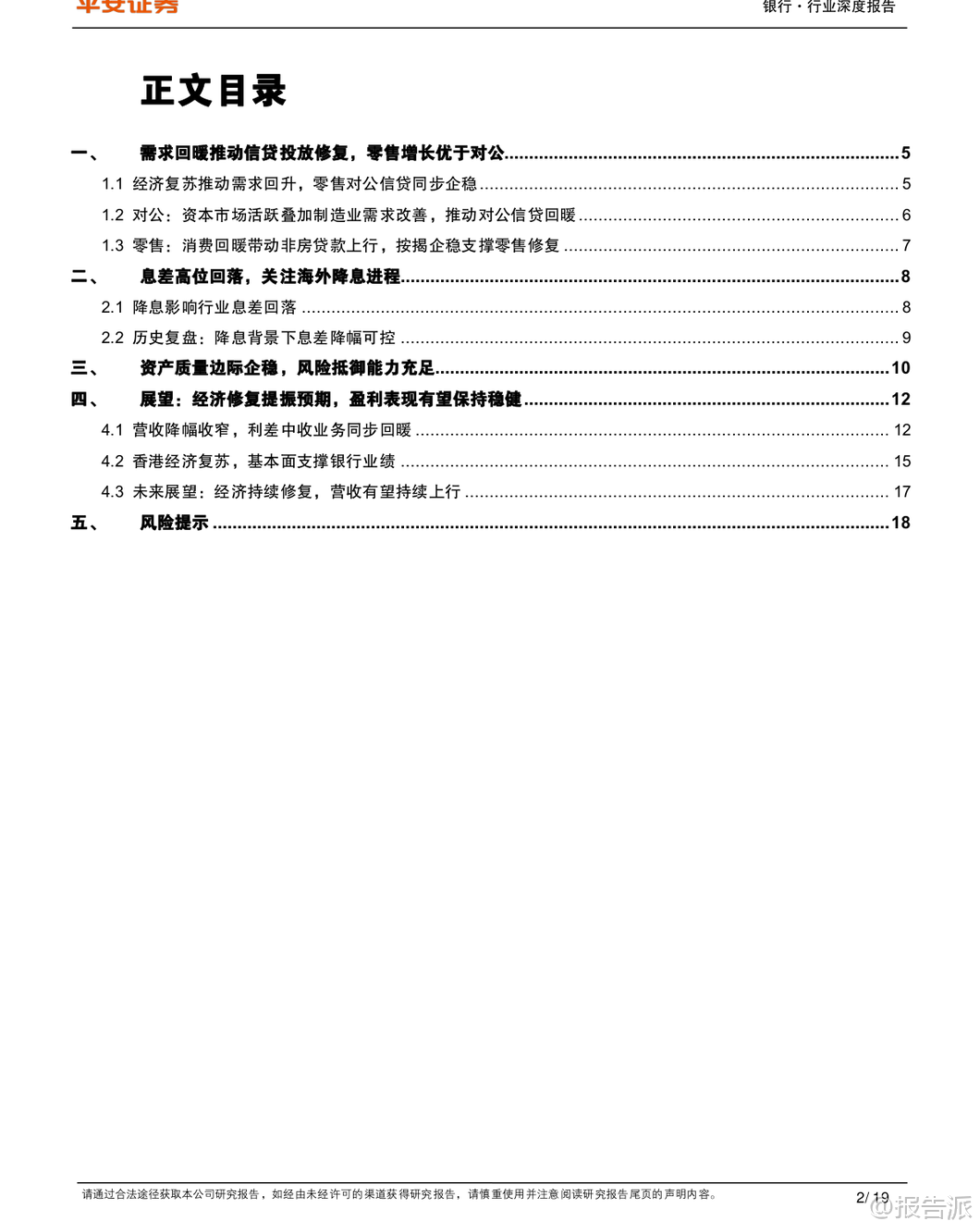
Investment Rating - The report maintains a "Strong Outperform" rating for the Hong Kong banking industry [1] Core Insights - Credit demand is recovering, leading to a gradual restoration of loan growth, with retail loans growing faster than corporate loans. As of November 2025, the loan growth rate in Hong Kong's banking sector was 1.2%, up 4.0 percentage points from the end of 2024, continuing a positive growth trend for five consecutive months [4][8] - The net interest margin is under pressure due to the impact of overseas interest rate cuts, particularly from the Federal Reserve. As of Q3 2025, the net interest margin for Hong Kong's banking sector was 1.47%, down 3 basis points year-on-year, but the decline was less severe compared to the previous year [4][22] - Asset quality is stabilizing, with the overall non-performing loan (NPL) ratio at 1.98% as of Q3 2025, showing a slight year-on-year improvement. The capital adequacy ratios remain robust, indicating strong risk resilience [4][32] - The economic recovery is expected to support stable profitability in the banking sector, despite ongoing pressure from interest rate cuts. The recovery in the real estate market and overall economic conditions are anticipated to bolster demand and asset quality [4][41] Summary by Sections 1. Credit Demand Recovery - The economic recovery in Hong Kong has led to a rebound in credit demand, with retail loan growth outpacing corporate loans. In Q3 2025, retail loans grew by 3.2% year-on-year, while corporate loans grew by 0.7%, reflecting a significant increase from the end of 2024 [8][11] - Corporate loans have benefited from an active capital market and improved manufacturing demand, with financial sector loans increasing by 13.7% year-on-year [13][15] - Retail loans, particularly non-housing loans, have seen a notable increase, with a growth rate of 6.5% year-on-year as of Q3 2025 [20] 2. Interest Margin Trends - The banking sector's net interest margin is experiencing downward pressure due to the Federal Reserve's interest rate cuts, with a net interest margin of 1.47% as of Q3 2025 [22][23] - The decline in net interest margin is primarily driven by a decrease in the yield on interest-earning assets, which fell by 1.28 percentage points to 4.02% [25] - Historical analysis indicates that the decline in net interest margin during previous rate-cut cycles has been manageable, suggesting a similar trend may continue [27][28] 3. Asset Quality Stability - The overall NPL ratio for the banking sector has stabilized at 1.98%, with improvements noted in specific sectors such as mainland loans and credit cards [32][35] - The capital adequacy ratios remain high, with the core Tier 1 capital ratio at 20.1%, indicating a strong buffer against potential risks [37] - The recovery in the economy has enhanced repayment capabilities, contributing to the stabilization of asset quality metrics [38] 4. Future Outlook - The report anticipates that the economic recovery will support stable profitability in the banking sector, despite the challenges posed by interest rate cuts [41] - The ongoing recovery in the real estate market is expected to positively impact demand and asset quality, providing a foundation for growth in the banking sector [41][42]