债市投研框架修正

Search documents
经典重温 | 债市的“盲点”?(申万宏观·赵伟团队)
申万宏源宏观· 2025-09-25 05:14
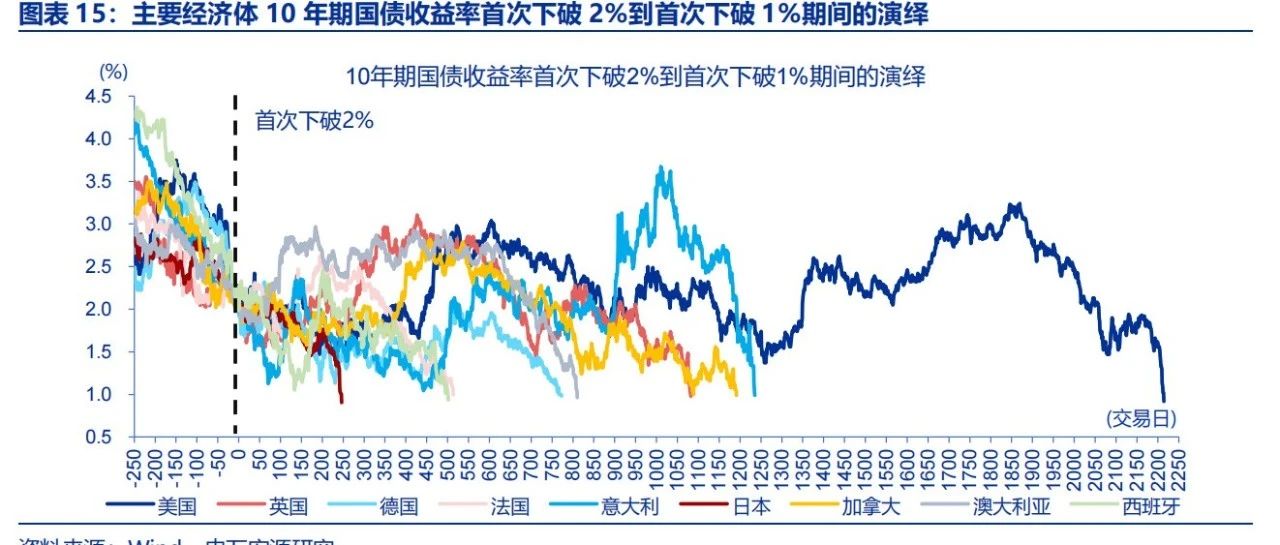
Core Viewpoint - The bond market has entered a phase of adjustment after a prolonged bull market, with increasing market divergence and potential investment blind spots identified for 2025 [2][9]. Recent Changes in the Bond Market - The bond market has shown rapid interest rate declines and a flattening yield curve since the beginning of 2023, with the 10Y government bond yield dropping by 94 basis points and the 1Y yield by 53 basis points [3][10]. - The economic backdrop includes a GDP growth rate decrease from 6.5% to 5.4% and a decline in MLF rates from 2.75% to 2.00% [3][19]. - Significant adjustments have occurred in the bond market, with the 10Y government bond yield rising from 1.60% to 1.83% between January 6 and March 14, 2024 [3][26]. Investment Blind Spots in the Bond Market - Historical data suggests that once long-term interest rates fall below 2%, the market often enters a multi-year consolidation phase, with the average time taken for rates to drop from 3% to 2% being 2 years and from 2% to 1% being 4 years [4][37]. - The market has exhibited extreme positioning since 2022, with the yield spread between the 10Y government bond and the overall A-share dividend yield breaking historical norms, even turning negative at -0.9% in January 2025 [4][65]. Framework Adjustments for the Bond Market - The policy environment has solidified since the "924" policy, with a clearer GDP target of around 5% and a focus on dynamic adjustments [5][69]. - Asset allocation has begun to rebalance, with significant shifts in fund positioning observed, such as a mixed fund stock holding ratio of 70.5%, which is at a low percentile compared to the past three years [5][84]. - The current yield of 1.83% for the 10Y government bond remains significantly lower than the 3.35% dividend yield of high-dividend stocks, indicating a potential return to more normalized market conditions [5][90].


深度专题 | 债市的“盲点”?——兼论长债利率从“2%”到“1%”的距离
赵伟宏观探索· 2025-03-18 01:07
Core Viewpoint - The article discusses the recent adjustments in the bond market following a prolonged bull market, highlighting potential blind spots in investment strategies and suggesting a revised research framework for 2025 [2][9]. Recent Changes in the Bond Market - The bond market has experienced a significant adjustment after a long bull run, with notable changes in market sentiment and increased divergence among investors [3][4]. - Key characteristics of the bond market in 2023 include a rapid decline in interest rates, with the 10-year government bond yield dropping by 94 basis points (bp) since January, while the 1-year yield decreased by 53 bp [3][10]. - The economic backdrop includes a projected GDP growth decline from 6.5% to 5.4% between Q2 2023 and Q4 2024, alongside a decrease in the MLF rate from 2.75% to 2.00% [3][12]. Investment Blind Spots - The bond market may have entered a period of volatility, particularly as long-term interest rates fall below 2%, which historically leads to several years of oscillation [4][16]. - The extreme market positioning since 2022 has led to a significant deviation from historical norms, with the yield spread between the 10-year government bond and the overall A-share dividend yield reaching a negative value of -0.9% by January 2025 [5][26]. Revised Framework for Bond Market Research - The article emphasizes the need for a "rebalancing" approach in asset allocation, as recent policy signals and economic indicators suggest a shift in market dynamics [6][27]. - As of March 14, 2025, mixed funds have a stock holding ratio of 70.5%, indicating a relatively low position compared to historical data, while the 10-year government bond yield remains significantly below the high-dividend stock index yield of 3.35% [6][30]. - The article suggests that the current state of the bond market may lead to a prolonged period of volatility, necessitating a strategic focus on asset allocation [6][35].