光纤—无线融合通信

Search documents
6G通信有了“全能选手”
Huan Qiu Wang Zi Xun· 2026-02-27 01:12
Core Concept - A team of Chinese scientists has successfully developed a new concept of "fiber-wireless integrated communication," achieving seamless integration between fiber and wireless communication systems, addressing a long-standing issue in the telecommunications field [1] Group 1: Technological Breakthrough - The core component of the new system is a super-broadband optoelectronic integrated chip with a bandwidth exceeding 250 GHz, capable of processing massive data simultaneously, akin to transforming a country road into a multi-lane superhighway [2] - The system has set three world records: a modulator bandwidth of over 250 GHz, data transmission of 512 Gbit per second through a single fiber, and wireless transmission reaching 400 Gbit per second, marking the fastest speeds globally [2] Group 2: Application and Performance - The system can support real-time transmission of 86 channels of 8K video, demonstrating a bandwidth increase by an order of magnitude compared to 5G standards, showcasing its capability for high user concurrency [2] - The technology is expected to facilitate the efficient development and utilization of terahertz spectrum resources in the upcoming 6G era [2] Group 3: AI Integration and Future Prospects - The system incorporates AI for channel equalization, utilizing a neural network-based digital signal processing algorithm that allows the system to adapt to various channel environments, ensuring stable signal transmission [3] - All key technologies and fabrication processes are based on a domestically produced integrated optical platform, reducing reliance on foreign advanced microelectronics, and aiding China's semiconductor chip industry [3] - Future goals include increasing system integration to eliminate discrete components, potentially allowing an entire 6G base station's functionality to be integrated into a chip the size of a fingernail [3]
光通信全线大涨!6G突破叠加AI算力狂飙,产业进入加速期
Hua Er Jie Jian Wen· 2026-02-24 09:05
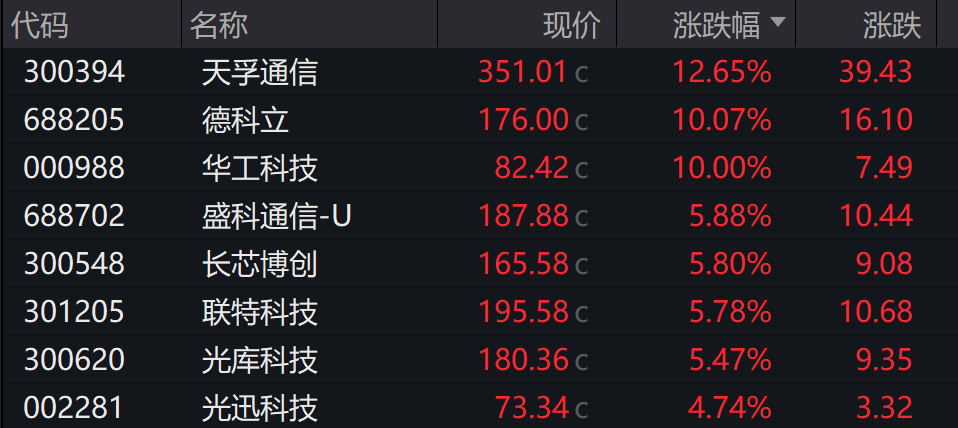
Core Viewpoint - The global optical communication industry is entering a rapid growth phase driven by the iteration of AI large models and breakthroughs in next-generation communication technologies, with significant demand for underlying computing power and the commercialization of Co-Packaged Optics (CPO) technology [1] Group 1: Market Performance - On February 24, A-share optical communication concept stocks collectively surged, with the sector overall increasing by over 3%, and several stocks, including Farsens and Huagong Technology, hitting the daily limit or rising over 10% [1][2] - Notable stock performances included Tianfu Communication up by 12.65% to 351.01 CNY, and Huagong Technology rising by 10% to 82.42 CNY [2] Group 2: Industry Demand and Supply - The demand for optical modules is surging due to the explosive growth in computing power driven by AI applications, with major tech companies like ByteDance, Alibaba, and Google intensifying their model updates [4] - Leading companies in the optical communication sector, such as Huagong Technology and Changfei Fiber, have their production lines operating at full capacity, with orders extending to the fourth quarter of 2026 [4][6] Group 3: Technological Breakthroughs - Chinese research teams have achieved a significant milestone by integrating fiber and wireless communication systems, breaking three world records in data transmission rates [6] - The new system features a modulator bandwidth exceeding 250 GHz and a single fiber data transmission rate of 512 Gbps, showcasing the potential for large-scale deployment in 6G base stations [6] Group 4: CPO Technology Evolution - The optical communication industry is transitioning from traditional pluggable modules to Co-Packaged Optics (CPO), which offers significant improvements in density, performance, and energy efficiency [7] - CPO technology is expected to reduce system-level power consumption by over 50% and enhance bandwidth density, supporting rates above 224G [7][18] - Major tech companies like NVIDIA and Intel are accelerating the commercialization of CPO technology, indicating a strong market shift towards high-bandwidth interconnects [13][18]