超宽带光电融合集成芯片

Search documents
6G通信有了“全能选手”
Huan Qiu Wang Zi Xun· 2026-02-27 01:12
Core Concept - A team of Chinese scientists has successfully developed a new concept of "fiber-wireless integrated communication," achieving seamless integration between fiber and wireless communication systems, addressing a long-standing issue in the telecommunications field [1] Group 1: Technological Breakthrough - The core component of the new system is a super-broadband optoelectronic integrated chip with a bandwidth exceeding 250 GHz, capable of processing massive data simultaneously, akin to transforming a country road into a multi-lane superhighway [2] - The system has set three world records: a modulator bandwidth of over 250 GHz, data transmission of 512 Gbit per second through a single fiber, and wireless transmission reaching 400 Gbit per second, marking the fastest speeds globally [2] Group 2: Application and Performance - The system can support real-time transmission of 86 channels of 8K video, demonstrating a bandwidth increase by an order of magnitude compared to 5G standards, showcasing its capability for high user concurrency [2] - The technology is expected to facilitate the efficient development and utilization of terahertz spectrum resources in the upcoming 6G era [2] Group 3: AI Integration and Future Prospects - The system incorporates AI for channel equalization, utilizing a neural network-based digital signal processing algorithm that allows the system to adapt to various channel environments, ensuring stable signal transmission [3] - All key technologies and fabrication processes are based on a domestically produced integrated optical platform, reducing reliance on foreign advanced microelectronics, and aiding China's semiconductor chip industry [3] - Future goals include increasing system integration to eliminate discrete components, potentially allowing an entire 6G base station's functionality to be integrated into a chip the size of a fingernail [3]
我国率先实现光纤和无线通信系统无缝融合
Guan Cha Zhe Wang· 2026-02-26 07:17
Core Insights - The research paper titled "Integrated photonics enabling ultra-wideband fibre–wireless communication" was published in the prestigious journal Nature, marking a significant advancement in the fields of next-generation wireless communication (6G) and optical communication [1] - The study introduces the concept of integrated "fibre-wireless fusion communication," achieving seamless integration between fiber and wireless communication systems for the first time globally [1][3] - The developed system supports record-breaking data transmission rates across all major telecom scenarios, including fiber, wireless, and hybrid links, enabling a unified system for cross-scenario reuse [1][3] Group 1 - The research team achieved over 250GHz ultra-large bandwidth for optoelectronic/electro-optic conversion devices, setting records with thin-film lithium niobate modulators and indium phosphide detectors [3] - The fiber-wireless integrated fusion system demonstrated a record single-channel transmission of 256Gbaud (512Gbps) for fiber communication and 400Gbps for terahertz wireless communication, showcasing the capability to transmit 86 channels of 8K HD video in real-time [3][8] - This breakthrough is expected to reshape telecom system architecture and lay the foundation for achieving an all-optical interconnection vision, promoting rapid development in this field in China [3][10] Group 2 - The rapid development of AI technology has created a demand for higher density and performance computing power, which is crucial for future AI competitiveness [4] - The integration of fiber and wireless communication addresses the bandwidth gap that has hindered unified system design, enabling high-speed and compatible end-to-end transmission on the same infrastructure [4][6] - The research team proposed a new digital signal processing algorithm based on neural networks, significantly enhancing the system's adaptability to nonlinear impairments and overcoming challenges faced by traditional equalization algorithms [6][8] Group 3 - The system supports over 512Gbps for single-channel fiber communication and over 400Gbps for optical terahertz communication, establishing a new benchmark in all-optical communication [8] - The proposed ultra-wideband integrated photonic devices and AI equalization algorithms are applicable to both wired and wireless communication, bridging the gap between these two fields at the physical layer [8][10] - The system demonstrates excellent performance in energy consumption, cost, and scalability, with promising applications in 6G base stations and wireless data centers [10]


电子行业周报:苹果即将推出新机,关注消费电子投资机会-20250911
Yong Xing Zheng Quan· 2025-09-11 09:21
Investment Rating - The industry investment rating is "Maintain Overweight" for the electronics sector [7]. Core Insights - The AI computing power supply chain is expected to drive future growth, with the advanced packaging market continuing to expand. Yole Group forecasts that total revenue for backend equipment will reach approximately $6.9 billion in 2025 and grow to $9.2 billion by 2030, representing a compound annual growth rate (CAGR) of 5.8% [17][37]. - The introduction of the iPhone 17 series is anticipated to lead a transformation in the consumer electronics product line, with a projected 3.5% increase in shipments compared to the iPhone 16 series [19][36]. - The development of a disruptive silicon carbide (SiC) AR waveguide by West Lake University and Mude Micro-Nano Technology Co., Ltd. is expected to create investment opportunities in the end-side technology sector [18][36]. - The concept of a "universal optoelectronic integrated wireless transceiver engine" proposed by Peking University is set to empower the 6G industry, indicating strong potential for domestic supply chain opportunities [20][21]. Summary by Sections 1. Core Insights and Investment Recommendations - The AI computing power supply chain is expected to grow significantly, with investment opportunities in areas such as computing power, advanced packaging, PCB, and liquid cooling [17][22]. - The upcoming launch of the iPhone 17 series is expected to rejuvenate the consumer electronics sector, with investment opportunities in the related supply chain [19][22]. - The introduction of the SiC AR waveguide technology is anticipated to create new investment opportunities in the end-side technology sector [18][22]. - The advancements in domestic supply chains, particularly in the context of 6G technology, are viewed positively [20][22]. 2. Market Review - The A-share Shenwan Electronics Index fell by 4.57% during the week of September 1-5, underperforming the CSI 300 Index by 3.76 percentage points [23][26]. - Among the sub-sectors, the semiconductor sector experienced the largest decline at 6.55%, while electronic chemicals II showed the least decline at 1.46% [26][29]. 3. Industry News - The iPhone 17 series is projected to see a 3.5% increase in shipments compared to the previous series, indicating a positive market response [19][36]. - The new SiC AR waveguide technology is expected to significantly enhance the capabilities of AR devices, marking a breakthrough in the industry [18][36]. - The development of a high-performance optoelectronic integrated chip by Peking University is set to revolutionize wireless communication technologies [20][21].

【太平洋科技-每日观点&资讯】(2025-09-01)
远峰电子· 2025-08-31 11:14
Market Performance - The main board led the gains with notable increases in stocks such as Guoan Co. (+10.07%), Tongfu Microelectronics (+10.01%), and Jianghai Co. (+10.01%) [1] - The ChiNext board saw significant growth with Tongda Sea (+20.01%) and Jiebang Technology (+20.00%) leading the way [1] - The Sci-Tech Innovation board was led by Aerospace Hongtu (+17.94%) and Kaipu Cloud (+16.52%) [1] - Active sub-industries included SW Printed Circuit Boards (+3.54%) and SW Integrated Circuit Packaging and Testing (+1.73%) [1] Domestic News - A research team from Peking University and Hong Kong City University proposed a concept for a "Universal Photonic Fusion Wireless Transceiver Engine," successfully developing a chip for high-speed wireless communication with a coverage range exceeding 110 GHz [1] - TSMC is set to begin construction of a new 1.4nm advanced process wafer plant in Taiwan, with an estimated total investment of NT$1.2 trillion to NT$1.5 trillion (approximately $39.2 billion to $49 billion) [1] - GalaxyCore launched a high-performance 5MP image sensor GC5605 designed for AI PC applications, enhancing video quality for scenarios like video conferencing [1] - Tailin Micro announced plans to acquire 100% of Shanghai Panqi Microelectronics to expand its low-power IoT wireless connection platform [1] Company Announcements - Howey Group reported a total revenue of 13.956 billion yuan for H1 2025, a year-on-year increase of 15.42%, with a net profit of 2.028 billion yuan, up 48.34% [2] - Dingjie Smart reported total revenue of 1.045 billion yuan for H1 2025, a 4.08% increase, with a net profit of 45 million yuan, up 6.09% [2] - Lingyi Technology reported total revenue of 23.625 billion yuan for H1 2025, a 23.35% increase, with a net profit of 930 million yuan, up 35.94% [2] - Kaisheng Technology reported total revenue of 2.765 billion yuan for H1 2025, a 24.7% increase, with a net profit of 52 million yuan, up 23.7% [2] Overseas News - Dell Technologies reported $5.6 billion in AI server orders for Q2, a significant drop from $12.1 billion in the previous quarter, with AI server shipments totaling $8.2 billion [2] - The U.S. Department of Commerce announced the revocation of export exemptions for Intel Semiconductor (Dalian), Samsung China Semiconductor, and SK Hynix Semiconductor (China) [2] - Research from Stanford University indicated a 13% decline in employment rates for workers aged 22 to 25 in AI-affected occupations since 2022, with software development and customer service being the most impacted [2] - Intel announced modifications to its funding agreement with the U.S. Department of Commerce, allowing it to access approximately $5.7 billion in cash earlier than planned [2]



北京大学发表最新Nature论文
生物世界· 2025-08-31 01:01
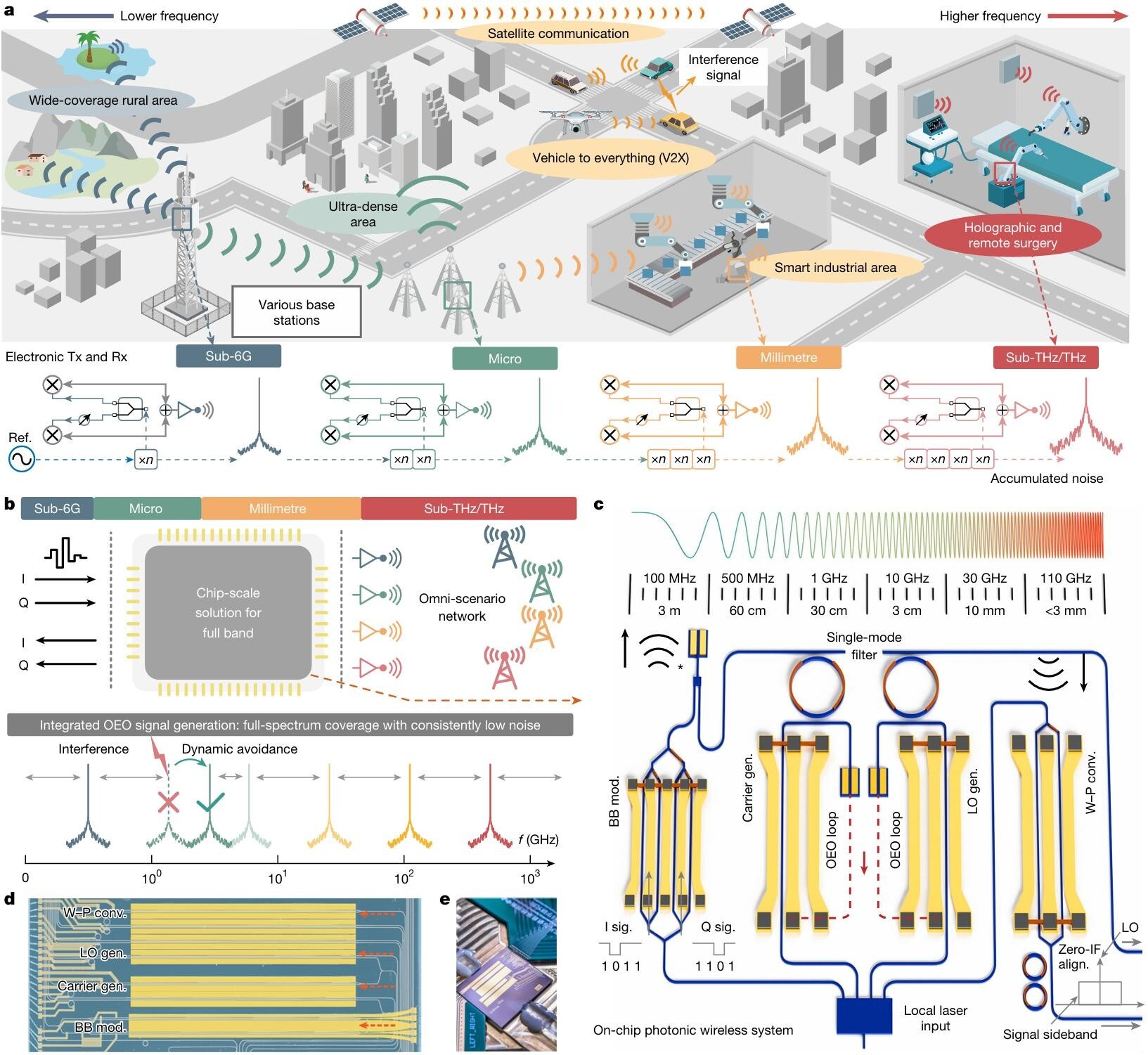
Core Viewpoint - The upcoming sixth generation (6G) wireless networks will operate across a wide frequency range, requiring a universal hardware solution capable of adaptive reconstruction to achieve full-band coverage and dynamic spectrum management [3][4]. Group 1: Research Breakthrough - The concept of a "universal optoelectronic integrated wireless transceiver engine" has been proposed, leading to the successful development of an ultra-broadband optoelectronic integrated chip that overcomes fundamental challenges related to bandwidth, noise performance, and reconfigurability [4]. - This milestone breakthrough is expected to clear key obstacles for the efficient development of terahertz and higher frequency spectrum resources for 6G communication, potentially reshaping the wireless communication landscape and driving significant advancements in the industry [4]. Group 2: Future Network Requirements - Future 6G networks are anticipated to adaptively utilize full spectrum resources to meet the growing demand for ubiquitous information access, supporting diverse application scenarios such as extended reality (XR) and remote surgery [5]. - The system must possess real-time spectrum reconfigurability to ensure efficient spectrum utilization and reliable access in complex spectrum environments, often referred to as intelligent radio [5]. Group 3: Technical Implementation - The research team demonstrated adaptive wireless communication across an unprecedented frequency range exceeding 100 GHz (0.5 GHz to 115 GHz) using a thin-film lithium niobate (TFLN) photonic wireless system [5][6]. - Key functional units, including baseband modulation, broadband wireless-photon conversion, and reconfigurable carrier and local oscillator signal generation, have been integrated on-chip, showcasing high-frequency stability and coherence [6]. - The system achieved a record transmission rate of 100 Gbps over nine continuous frequency bands, marking a significant step towards realizing a full-spectrum, all-scenario wireless network [6].

超宽带光电融合6G无线通信有了新突破
Zhong Guo Jing Ji Wang· 2025-08-28 05:41
Core Insights - A significant breakthrough in 6G and optoelectronic integration has been achieved by researchers from Peking University and City University of Hong Kong, resulting in adaptive high-speed wireless communication across all frequency bands [1][3]. Group 1: Technological Advancements - The concept of "ultra-broadband optoelectronic integrated wireless transceiver engine" has been proposed, utilizing advanced thin-film lithium niobate photonic material to develop an ultra-broadband optoelectronic integrated chip, achieving a coverage range exceeding 110 GHz for adaptive reconfigurable high-speed wireless communication [3]. - The core chip has led to the development of a high-performance optical micro-ring resonator integrated optoelectronic oscillator (OEO) architecture, enabling real-time, flexible, and rapid reconfiguration capabilities across a frequency range from 0.5 GHz to 115 GHz, spanning nearly 8 octaves of low-noise signal tuning performance [3]. Group 2: Future Implications - 6G technology is expected to revolutionize communication with faster speeds, lower latency, and higher reliability, supporting emerging applications such as seamless connectivity with satellites, enabling high-speed Wi-Fi in remote locations, and enhancing telemedicine capabilities [4]. - Future development will focus on increasing system integration to achieve single-chip integration of lasers, photodetectors, and antennas, ultimately creating "plug-and-play" smart optoelectronic integrated wireless communication modules adaptable to any system [4].