光网络技术

Search documents
用光纤充当缓存?芯片被颠覆了
半导体行业观察· 2026-02-13 01:09
Core Viewpoint - The article discusses the potential of using fiber optics instead of silicon to define how artificial intelligence stores and retrieves knowledge, as proposed by John Carmack, highlighting the advantages of fiber optics in data transmission and storage [2][3]. Group 1: Fiber Optics in AI - John Carmack suggests using fiber optic loops as high-speed data caches for AI models, which could revolutionize data storage and retrieval methods [2]. - Current single-mode fiber can transmit data at a speed of 256 terabits per second over 200 kilometers, allowing for approximately 32 GB of information to be stored at any given moment [2]. - The proposed method would function as a secondary cache, enabling model weights to be stored at light speed with minimal latency and significantly higher bandwidth compared to traditional memory [2][3]. Group 2: Advantages Over Traditional Memory - Fiber optics offer predictable performance, low power consumption, and substantial bandwidth potential compared to volatile DRAM, which requires constant refreshing of electrical signals [3]. - The efficiency advantages of fiber optics are appealing, especially as the miniaturization of components slows down, potentially making fiber optics a more favorable option than DRAM [3]. Group 3: Challenges and Future Directions - A significant challenge is the high cost of high-quality fiber optics over long distances, which may offset energy savings from reduced power consumption [3]. - Carmack's more practical next step involves tightly coupling flash memory chips with AI accelerators to facilitate rapid movement of model weights without relying on DRAM, requiring collaboration between semiconductor manufacturers and accelerator designers [4]. - Research teams are exploring architectures that utilize solid-state storage, indicating a trend towards blurring the lines between storage and memory [4].


长飞光纤2025年中报简析:增收不增利,公司应收账款体量较大
Zheng Quan Zhi Xing· 2025-08-30 23:26
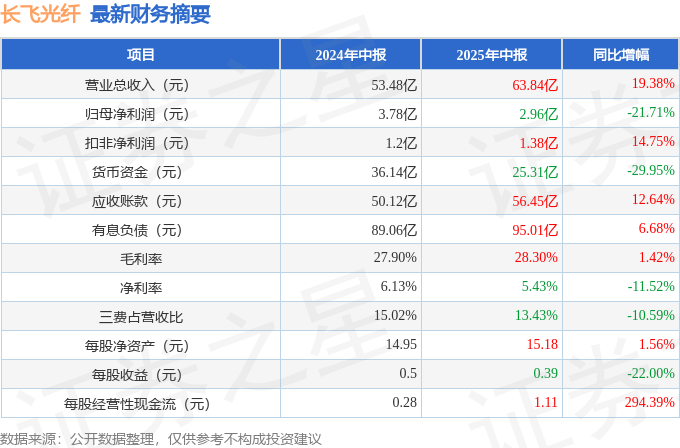
Core Viewpoint - Changfei Fiber's recent financial report shows a mixed performance with a significant increase in revenue but a notable decline in net profit, indicating potential challenges in profitability despite revenue growth [1] Financial Performance - Total revenue for the first half of 2025 reached 6.384 billion yuan, a year-on-year increase of 19.38% compared to 5.348 billion yuan in 2024 [1] - Net profit attributable to shareholders was 296 million yuan, down 21.71% from 378 million yuan in the previous year [1] - In Q2 2025, total revenue was 3.491 billion yuan, up 17.88% year-on-year, while net profit fell 54.96% to 144 million yuan [1] - The company's gross margin improved to 28.3%, up 1.42% year-on-year, while net margin decreased to 5.43%, down 11.52% [1] - Total receivables reached 5.645 billion yuan, an increase of 12.64% from 5.012 billion yuan in 2024, with receivables accounting for 835.25% of net profit [1][3] Cash Flow and Debt Situation - The company's cash flow situation is concerning, with cash and cash equivalents to current liabilities at only 49.26% and the average operating cash flow over the past three years to current liabilities at 18.84% [3] - The interest-bearing debt ratio has reached 29.85%, indicating a significant level of debt [3] Business Model and Market Position - The company's performance is primarily driven by research and marketing efforts, necessitating a deeper examination of these underlying drivers [2] - Changfei Fiber is focusing on the development and commercialization of hollow-core fiber technology, which has potential applications in data centers and high-frequency trading [6] - The hollow-core fiber technology is still in its early stages, with commercial viability dependent on production capacity, cost optimization, and the maturity of application scenarios [6] Investment Interest - Notable institutional interest has been observed, with a prominent fund manager increasing their stake in the company, indicating confidence in its long-term potential [3][5]