全国统一电力市场评价制度

Search documents
市场监管总局:平台强推“全网最低价”或构成垄断|营商环境周报
2 1 Shi Ji Jing Ji Bao Dao· 2025-12-22 06:45
Group 1: National Power Market Evaluation System - The National Development and Reform Commission and the National Energy Administration have issued a notification to establish a nationwide unified power market evaluation system focusing on four key areas: market operation effectiveness, market role performance, sustainable development of operating entities, and market competition adequacy [2][3] - The evaluation aims to create a scientific, systematic, and dynamic power market evaluation framework that balances multiple objectives such as security of supply, green transition, and economic efficiency [2][3] - The evaluation work will be organized by the National Development and Reform Commission and the National Energy Administration, with participation from market operators, universities, and research institutions [3] Group 2: High-Quality Development of Service Outsourcing - The Ministry of Commerce and six other departments have released an action plan to promote high-quality development in the service outsourcing sector, aiming to cultivate a number of internationally competitive leading enterprises by 2030 [4][5] - The action plan includes six specific measures focusing on enhancing platform capabilities, fostering innovation, nurturing key players, expanding market access, developing industry standards, and training talent [4][5] - The plan emphasizes the integration of digital economy with the real economy, promoting the development of international data service businesses and establishing a data service industry chain [5] Group 3: Antitrust Compliance Guidance - The State Administration for Market Regulation has introduced compliance guidelines addressing eight new types of monopoly risks for platform enterprises, including algorithm collusion and unfair pricing practices [6][8] - The guidelines aim to help platform operators identify, assess, and prevent antitrust compliance risks, promoting a shift from reactive enforcement to proactive compliance management [7][8] - The guidelines encourage platforms to develop internal management systems for antitrust compliance, ensuring sustainable development and healthy market competition [8] Group 4: Element Market Reform in Henan Province - The Henan Provincial Government has released a comprehensive reform pilot plan for market-oriented allocation of factors, proposing 70 specific measures to enhance the flow and efficient allocation of resources [10][11] - The plan includes initiatives to promote technological innovation, improve land allocation efficiency, facilitate human resource mobility, and establish data circulation rules [10][11][12] - The plan aims to support the development of high-end equipment, new materials, and biomedicine sectors through the establishment of verification centers and pilot bases [10][11] Group 5: Support for Biomedicine and Medical Devices in Sichuan Province - The Sichuan Provincial Government has issued policies to support the high-quality development of the biomedicine and medical device industries, including financial incentives for innovative drugs and devices [13][14] - The policies focus on enhancing research capabilities, improving clinical trial quality, and optimizing approval processes for innovative products [13][14] - The initiative aims to create a favorable ecosystem for industry development, including support for intellectual property protection and financial leasing for medical equipment [14] Group 6: Innovative "Rent-Equity Linkage" Mechanism in Zhejiang - The Taizhou Bay New Area in Zhejiang has introduced a "rent-equity linkage" mechanism to alleviate financial pressures on startups while enhancing the park's service capabilities [16][17] - This model allows selected high-potential tech companies to defer rent payments, enabling them to focus on research and market expansion [16][17] - The mechanism aims to foster a long-term partnership between the park and enterprises, facilitating investment and shared growth opportunities [17]
国家发改委、国家能源局重要通知
中国有色金属工业协会硅业分会· 2025-12-22 02:30
Core Viewpoint - The article discusses the establishment of a national unified electricity market evaluation system aimed at enhancing the efficiency and regulation of the electricity market in China, aligning with the country's broader economic and energy reform goals [2][3]. Group 1: Overall Requirements - The evaluation system is guided by Xi Jinping's thoughts and aims to create a scientific, systematic, and dynamic evaluation framework that balances safety, green transition, and economic efficiency [3]. - The system will provide a decision-making basis for electricity market construction and regulation, promoting scientific and precise regulatory work [3]. Group 2: Market Operation Effect Evaluation - The evaluation will assess the progress of market construction, including the establishment of a complete set of basic rules and the implementation of local regulations [5]. - It will also evaluate the technical standards and operational foundations of the electricity market, ensuring timely and accurate information disclosure and effective market management [5]. - The effectiveness of the regulatory framework will be assessed, focusing on the establishment of a unified regulatory system and the application of digital tools to enhance regulatory efficiency [5]. Group 3: Market Function Evaluation - The evaluation will measure the efficiency of electricity factor circulation across regions, the safety benefits of energy supply, and the environmental benefits of promoting renewable energy [6][7]. - Economic benefits will be assessed by analyzing the overall economic impact of the electricity market, including dynamic pricing and resource allocation [7]. Group 4: Sustainable Development of Operating Entities - The evaluation will focus on the operational status of electricity enterprises, ensuring cost recovery and sustainable development [8]. - It will also assess the market's ability to foster new business models and enhance participation from private enterprises [8]. Group 5: Market Competition Adequacy Evaluation - The evaluation will analyze the competitive behavior of market participants and the effectiveness of mechanisms to prevent unfair competition [9]. - It will monitor market concentration levels to ensure they remain within reasonable limits, thereby managing risks associated with supply and price fluctuations [9]. Group 6: Evaluation Methods - A comprehensive evaluation indicator system will be established, focusing on practicality and representativeness [10]. - The evaluation will combine qualitative and quantitative analyses, as well as horizontal and vertical comparisons to assess market performance over time [11][12]. - Digital technologies will be leveraged to enhance the timeliness and responsiveness of market evaluations [13]. Group 7: Implementation and Application - The evaluation will commence in 2026, with local adaptations encouraged to address specific regional needs [14]. - Results from the evaluations will be compiled into reports for reference by government departments and market operators, emphasizing the importance of applying these findings for continuous improvement [15]. - The evaluation process will be organized collaboratively by relevant national and local authorities, ensuring a comprehensive and objective assessment [16].

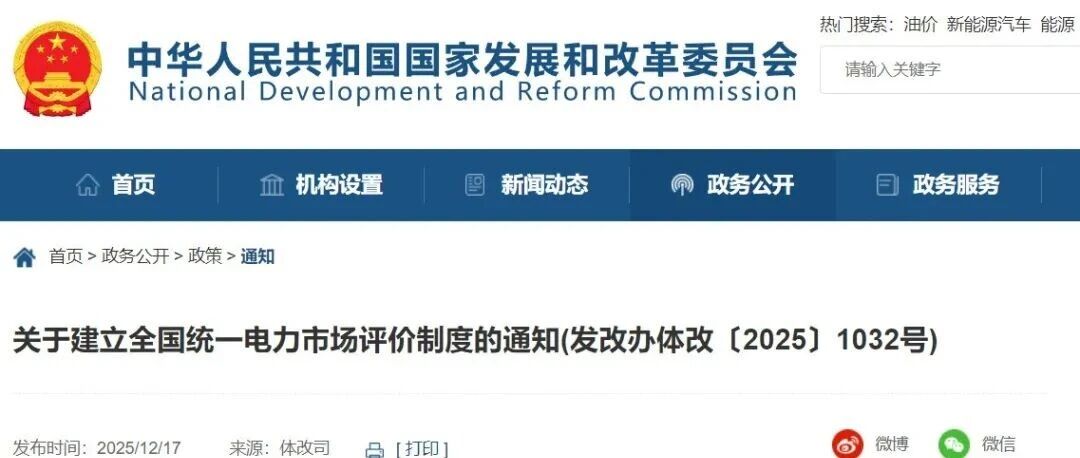
国家发展改革委办公厅 国家能源局综合司关于建立全国统一电力市场评价制度的通知
国家能源局· 2025-12-17 09:57
Core Viewpoint - The article outlines the establishment of a national unified electricity market evaluation system to enhance the efficiency and regulation of the electricity market in China, aligning with the country's broader economic and energy reform goals [3][4]. Group 1: Overall Requirements - The evaluation system aims to create a scientific, systematic, and dynamic framework that balances safety, green transformation, and economic efficiency, providing a basis for decision-making in market construction and regulation [4]. Group 2: Evaluation Content - The evaluation will focus on four key areas: market operation effectiveness, market role performance, sustainable development of operating entities, and the degree of market competition [5]. Group 3: Market Operation Effectiveness Evaluation - The evaluation will assess the progress of market construction, including the establishment of a complete rule system and the implementation of local regulations [6]. - It will also evaluate the technical standards and the operational foundation of the electricity market, ensuring timely and accurate information disclosure and transaction organization [6]. - The effectiveness of the regulatory framework and the role of the market management committee in maintaining fairness and order in the market will be assessed [7]. Group 4: Market Role Performance Evaluation - The evaluation will measure the efficiency of electricity factor circulation across regions, the safety benefits of market mechanisms, and the environmental benefits related to renewable energy development [8]. - Economic benefits will be analyzed through the overall economic impact of the electricity market, focusing on dynamic pricing and resource optimization [8]. Group 5: Sustainable Development of Operating Entities Evaluation - The evaluation will consider the operational status of electricity enterprises and their ability to recover costs and maintain stable operations [9]. - It will also assess the market's support for new business models and the participation of private enterprises, contributing to job creation and industry growth [9][10]. Group 6: Market Competition Adequacy Evaluation - The evaluation will analyze the competitive behavior of market participants and the effectiveness of mechanisms to prevent market manipulation [11]. - It will also monitor market concentration levels and the effectiveness of risk prevention mechanisms [11]. Group 7: Evaluation Methods - A comprehensive evaluation index system will be established, focusing on practicality, accessibility, and representativeness [12]. - The evaluation will combine qualitative and quantitative analyses, as well as horizontal and vertical comparisons [13]. Group 8: Digital Technology Support - The use of digital technology will enhance the evaluation process, allowing for real-time monitoring of market conditions and improving the timeliness and responsiveness of evaluations [15]. Group 9: Implementation and Organization - The evaluation work will be organized by the National Development and Reform Commission and the National Energy Administration, with collaboration from various stakeholders [18].

两部门部署建立全国统一电力市场评价制度
Xin Hua She· 2025-12-17 09:20
Core Viewpoint - The establishment of a national unified electricity market evaluation system aims to enhance the effectiveness and sustainability of the electricity market while ensuring comprehensive assessment across multiple dimensions [1][2]. Group 1: Evaluation Framework - The evaluation work will focus on four key aspects: market operation effectiveness, market role performance, sustainable development of operating entities, and the degree of market competition [1][2]. - A scientific, systematic, and dynamic evaluation system will be constructed to balance safety, green transition, and economic efficiency [1]. Group 2: Market Operation Effectiveness - A complete unified electricity market rule system will be formed, enabling local authorities to promptly issue implementation details, achieving comprehensive coverage of various market types including long-term, spot, and ancillary services [2]. - The frequency and scale of cross-province and cross-region electricity transactions will continue to grow, enhancing overall grid operation efficiency [2]. Group 3: Sustainable Development of Operating Entities - Market mechanisms will guide reasonable investment layouts, ensuring cost recovery for electricity companies and stable operations, thereby enhancing the industry's sustainable development capacity [2]. Group 4: Market Competition Adequacy - The electricity market will achieve unified openness, allowing orderly competition among operating entities, with effective constraints on improper market competition and abuse of market power [2]. - A sound credit mechanism will be established to penalize market misconduct and enhance market integrity [2]. Group 5: Organizational Responsibilities - The evaluation work will be organized by the National Development and Reform Commission and the National Energy Administration, with participation from market operators, universities, and research institutions [2]. - Provincial development and reform and energy departments will take on primary responsibilities under the leadership of provincial governments, collaborating with national agencies to conduct market evaluations [2].
国家发改委、国家能源局重要通知
中国能源报· 2025-12-17 07:53
Core Viewpoint - The article discusses the establishment of a national unified electricity market evaluation system aimed at enhancing the efficiency and regulation of the electricity market in China, aligning with the country's broader economic and energy reform goals [1][2]. Group 1: Overall Requirements - The evaluation system is guided by Xi Jinping's thoughts and aims to create a scientific, systematic, and dynamic evaluation framework that balances safety, green transition, and economic efficiency [2][3]. Group 2: Evaluation Content - The evaluation will focus on four key areas: market operation effectiveness, market role performance, sustainable development of operating entities, and market competition adequacy [4]. Market Operation Effectiveness Evaluation - Progress in market construction includes establishing a complete set of unified market rules and ensuring coverage of various market types [5]. - A comprehensive technical standard system for the electricity market is necessary to meet current needs and industry development [5]. - The operational foundation of the electricity market should ensure efficient management, timely information disclosure, and effective market intervention mechanisms [5]. - The market management committee must effectively coordinate market rules and ensure fair and orderly market operations [5]. - A unified regulatory system with standardized methods is essential for enhancing regulatory effectiveness [5]. Market Role Performance Evaluation - The evaluation will assess the efficiency of electricity factor circulation and the growth of cross-regional electricity trading [6]. - Safety benefits will be evaluated based on the collaborative operation of energy markets and capacity compensation mechanisms [6]. - Environmental benefits will focus on promoting high-quality development and consumption of renewable energy, supporting carbon reduction goals [7]. - Economic benefits will be measured by the overall economic impact of the electricity market and its ability to maintain reasonable price fluctuations [7]. Sustainable Development of Operating Entities Evaluation - The evaluation will consider the operational status of electricity enterprises and their ability to recover costs and maintain stable operations [8]. - The market will provide development opportunities for new business models, fostering private sector participation and job creation [8]. - Market satisfaction among operating entities will be assessed to gauge their perception of the market environment [8]. Market Competition Adequacy Evaluation - The evaluation will analyze competitive behaviors within the market and the effectiveness of mechanisms to prevent unfair competition [9]. - The concentration index of the electricity market will be monitored to ensure it remains within a reasonable range [9]. Group 3: Evaluation Methods - A comprehensive evaluation indicator system will be established to reflect the multi-dimensional aspects of market evaluation [10]. - The evaluation will combine qualitative and quantitative analyses, as well as horizontal and vertical comparisons [12]. - Digital technology will play a crucial role in supporting real-time monitoring and enhancing the evaluation's responsiveness [13]. Group 4: Implementation and Application - The evaluation will commence in 2026, with local adaptations encouraged to suit regional needs [14]. - Evaluation results will be compiled into reports for reference by government departments and market operators [15]. - The evaluation work will be organized by the National Development and Reform Commission and the National Energy Administration, with collaboration from various stakeholders [16].