全球汇市波动

Search documents
人民币对美元汇率中间价“三连涨” 创近一年新高
Zhong Guo Xin Wen Wang· 2025-10-17 13:43
Core Viewpoint - The Chinese yuan (RMB) against the US dollar has experienced a "three consecutive increases," reaching a new high since October 2024, with the central parity rate set at 7.0949 on October 17, 2023, reflecting an increase of 19 basis points from the previous trading day [1] Group 1: Exchange Rate Movements - The RMB/USD central parity rate has risen over 900 basis points this year [1] - The recent increase in the RMB exchange rate is attributed to a decline in overnight US dollar interest rates [1] - The RMB has strengthened against the backdrop of a fluctuating US dollar index and increased volatility in global foreign exchange markets [1] Group 2: Economic Insights - The People's Bank of China (PBOC) indicates that the macroeconomic fundamentals are stable, and the international balance of payments is expected to maintain a self-balanced state [1] - The PBOC emphasizes the importance of market forces in the determination of exchange rates while maintaining flexibility and guiding expectations to prevent excessive fluctuations [1]
贸易不确定性持续 全球汇市跌宕起伏
Shang Hai Zheng Quan Bao· 2025-08-12 19:15
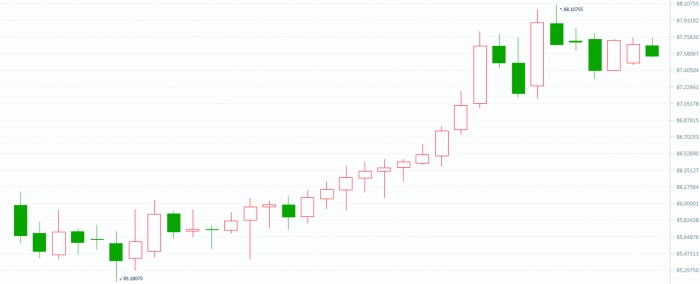
Core Viewpoint - The Indian Rupee is experiencing significant depreciation against the US Dollar, primarily due to the impact of US trade policies, leading to concerns about India's export competitiveness and economic recovery [2][3]. Group 1: Indian Rupee Performance - The Indian Rupee has depreciated over 2% against the US Dollar this year, making it one of the worst-performing major Asian currencies [3]. - The recent decline saw the Rupee drop to 88.1075 against the Dollar, nearing historical lows [3]. - The Indian central bank has intervened by selling at least $5 billion to stabilize the Rupee's exchange rate [3]. Group 2: US Trade Policy Impact - The US imposed an additional 25% tariff on Indian products due to concerns over India's imports of Russian oil, raising the overall tariff rate to 50% [3]. - This policy is expected to severely impact India's export competitiveness and suppress capital inflows, further weakening the Rupee [3]. Group 3: Dollar Index Fluctuations - The Dollar Index has shown volatility, initially rising above 100 after a hawkish statement from the Federal Reserve, but later fell back to above 98 following disappointing employment data [6]. - Market sentiment has shifted towards a "weak dollar" narrative, influenced by uncertainties in US economic policies and data [6]. Group 4: Renminbi Stability - The Renminbi has maintained stability against the Dollar, with a slight appreciation noted in recent months [7]. - The onshore and offshore Renminbi rates have remained around 7.18 to 7.19 against the Dollar, despite fluctuations in the Dollar Index [7]. - Factors contributing to the Renminbi's resilience include improved export competitiveness, valuation recovery potential, and favorable external conditions [7][8]. Group 5: Future Outlook for Renminbi - Analysts predict that the Renminbi will continue to face favorable conditions, with expectations of appreciation due to better-than-expected economic fundamentals in China and a likely weak Dollar environment [8]. - Factors such as reduced interest rate differentials and increased foreign investment in Renminbi assets are expected to support this trend [8].