
全球石油需求达峰

Search documents
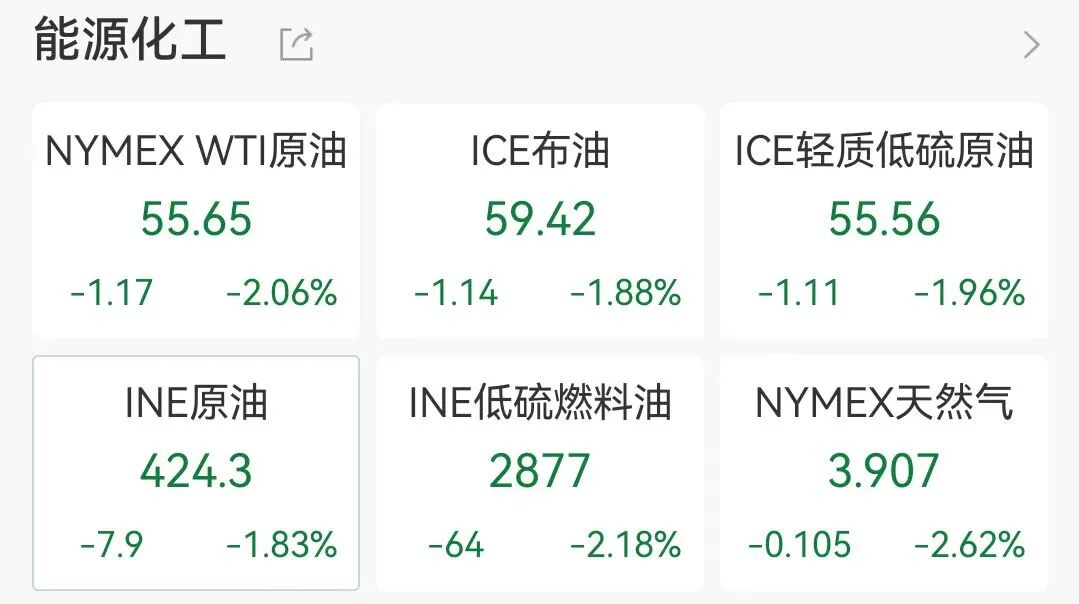
油价急速跳水失守60美元,黄金冲破4330美元,逼近历史新高
2 1 Shi Ji Jing Ji Bao Dao· 2025-12-16 14:56
Core Viewpoint - The recent sharp decline in international oil prices is attributed to a combination of disappointing U.S. employment data and ongoing concerns about global economic recovery, leading to a bearish outlook on oil demand [3][5]. Group 1: Oil Price Movement - On December 16, WTI crude oil futures fell by 2.06% to $55.65 per barrel, while ICE Brent crude dropped nearly 2% to $59.62 per barrel, marking the first time it fell below $60 since May [1]. - As of December 15, ICE Brent crude has seen a year-to-date decline of 19.13%, and WTI crude has dropped 20.97%, indicating a significant downward trend in both major oil futures [5]. Group 2: Economic Indicators - The U.S. non-farm payroll data for November showed an increase of 64,000 jobs, surpassing market expectations, but the unemployment rate rose to 4.6%, the highest since September 2021 [3]. - The International Monetary Fund (IMF) projects global economic growth rates of 3.2% in 2025 and 3.1% in 2026, which, while slightly improved from earlier forecasts, remain below the growth expected for 2024 [5]. Group 3: Supply and Demand Dynamics - The OECD has issued a cautious forecast, predicting a decline in U.S. economic growth from 2.8% in 2024 to 2.0% in 2025, and further down to 1.7% in 2026, influenced by tariffs, slowing consumer spending, and government shutdowns [6]. - The International Energy Agency (IEA) reported a significant oversupply in the oil market, with global oil supply expected to exceed demand by 3.84 million barrels per day [6]. Group 4: Future Trends - Despite short-term pressures on the oil market, long-term dynamics may shift due to the rising demand for electricity driven by AI technology, which could increase natural gas demand and subsequently impact oil prices [7]. - Morgan Stanley has warned that by 2028, the rapid growth of AI data centers could lead to a potential electricity shortfall of up to 20% in the U.S., while the EIA predicts that global electricity demand from data centers will more than double by 2030 compared to 2024 [7].

BP:全球石油需求2030年达峰
Zhong Guo Hua Gong Bao· 2025-09-30 03:12
Core Insights - BP forecasts that global oil demand will continue to grow until 2030, delaying the peak demand prediction from 2025 to 2030 due to slower improvements in energy efficiency [1] Group 1: Demand Projections - According to BP's latest annual report, oil demand is expected to reach 103.4 million barrels per day by 2030 and decline to 83 million barrels per day by 2050 under the current trajectory scenario [1] - The previous year's report anticipated peak oil demand at 102 million barrels per day in 2025 [1] - If energy efficiency improvements remain slow, oil demand could rise to approximately 106 million barrels per day by 2035 [1] Group 2: Scenarios - BP's report includes two scenarios: "business as usual," which considers existing policies and commitments, and a "below 2°C" scenario that aims to limit global temperature rise to below 2°C as per the Paris Agreement [1] - In the "below 2°C" scenario, oil demand is projected to peak at around 102.2 million barrels per day in 2025 and drop to 33.8 million barrels per day by 2050 [1]
