
全球算力需求爆发

Search documents
数观丨2026年半导体集成电路产业融资分析
Sou Hu Cai Jing· 2026-01-21 07:56
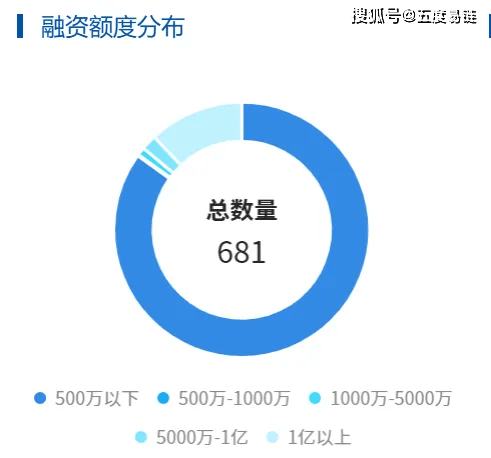
Core Insights - The domestic semiconductor integrated circuit industry is experiencing a financing boom from July 2025 to January 2026, characterized by frequent capital layouts, focused sectors, and regional clustering [1] - The industry is entering a critical phase of deep integration of capital and technology, driven by domestic substitution efforts and a global surge in computing power demand [1] National Financing Overview - A total of 681 financing events occurred across 610 companies, with 1,130 investment institutions participating, indicating a strong capital interest in the semiconductor sector [2] - There were 82 financing events exceeding 1 billion yuan, highlighting significant capital concentration in capital-intensive fields, with leading companies like Longxin Technology and Moer Thread attracting substantial investments [2] - The financing structure shows a "small amount dense, large amount concentrated" pattern, with over 84.9% of events being under 5 million yuan, providing essential funding for innovation [2] Financing Round Distribution - Strategic financing dominated with 307 events, accounting for 45.1%, followed by A rounds (156 events, 22.9%) and B rounds (59 events, 8.7%), indicating accelerated industry consolidation [4] - The high proportion of strategic financing reflects the trend of industry chain integration, with resources being allocated efficiently towards mature enterprises and high-potential early-stage projects [4] Regional Financing Landscape - The financing landscape is characterized by three major clusters: the Yangtze River Delta, the Guangdong-Hong Kong-Macao Greater Bay Area, and the Beijing-Tianjin-Hebei region, collectively accounting for over 80% of financing events [6] - The Yangtze River Delta leads with 377 financing events and 53.205 billion yuan, benefiting from a complete semiconductor industry chain [6] - The Guangdong-Hong Kong-Macao Greater Bay Area focuses on packaging, testing, and automotive electronics, while the Beijing-Tianjin-Hebei region excels in high-performance computing chips and semiconductor materials [6][8] Benchmark Enterprises Layout - Key enterprises in each region leverage their technological advantages and capital support to position themselves in core sectors, driving industry development [9] - In the Beijing-Tianjin-Hebei region, companies focus on high-end computing chips, while the Yangtze River Delta hosts firms covering storage and computing core sectors [12] - The Greater Bay Area's financing vitality relies on leading investment institutions targeting specialized chips and advanced materials [12] Industry Trend Summary - The financing market from July 2025 to January 2026 is characterized by high frequency, strong concentration, and precise sector focus, with capital supporting high-performance and domestic substitution sectors [15] - The industry is accelerating technology implementation and supply chain integration through capital empowerment, with a focus on companies possessing core technologies and production capabilities [15]


半导体产业复苏正当时!半导体材料ETF(562590)近1周涨幅居同类产品首位
Mei Ri Jing Ji Xin Wen· 2025-06-10 07:04
Core Viewpoint - The semiconductor materials and equipment sector is experiencing a steady recovery, driven by domestic manufacturing growth and global demand for computing power, with significant opportunities arising from domestic substitution policies and technological advancements in key areas [1][2]. Group 1: Market Performance - As of June 10, 2025, the CSI Semiconductor Materials and Equipment Theme Index (931743) fell by 2.53%, with leading stocks such as Tuojing Technology down 4.43% and Zhongwei Company down 4.19% [1]. - The Semiconductor Materials ETF (562590) also decreased by 2.52%, with the latest price at 1.05 yuan, although it had a weekly increase of 2.39% as of June 9, 2025, ranking first among comparable funds [1]. Group 2: Domestic Manufacturing Data - From January to April 2025, China's electronic information manufacturing industry saw a year-on-year increase of 11.3% in added value, surpassing the growth rates of the industrial and high-tech manufacturing sectors by 4.9 and 1.5 percentage points, respectively [1]. - The production of integrated circuits reached 150.9 billion units (+5.4%), while microcomputer equipment production was 10.5 million units (+4.7%), and mobile phone production was 454 million units (-6.8%) [1]. - The industry achieved revenue of 5.12 trillion yuan (+10.1%) and profits of 159.7 billion yuan (+11.6%), with a profit margin of 3.1%, an increase of 0.4 percentage points from the first quarter [1]. Group 3: Global Market Outlook - The World Semiconductor Trade Statistics Association (WSTS) predicts that the global semiconductor market will reach $700.9 billion in 2025, with an 11.2% year-on-year growth, driven by AI, cloud infrastructure, and consumer electronics upgrades [2]. - The growth in the semiconductor materials and equipment sector is expected to benefit from both domestic substitution policies and the global surge in computing power demand [2]. Group 4: Industry Composition - The Semiconductor Materials ETF (562590) closely tracks the CSI Semiconductor Materials and Equipment Theme Index, selecting 40 listed companies in the equipment and materials sector, which has a high concentration in the supply chain covering critical areas such as lithography, etching, and thin film deposition [2]. - Key players in the index, such as Northern Huachuang and Zhongwei Company, are making technological breakthroughs and engaging in mergers and acquisitions to fill domestic gaps in critical areas like etching machines and photoresists [2].