全球重质原油市场重构

Search documents
全球重质原油市场将出现结构性调整
Qi Huo Ri Bao Wang· 2026-01-29 03:13
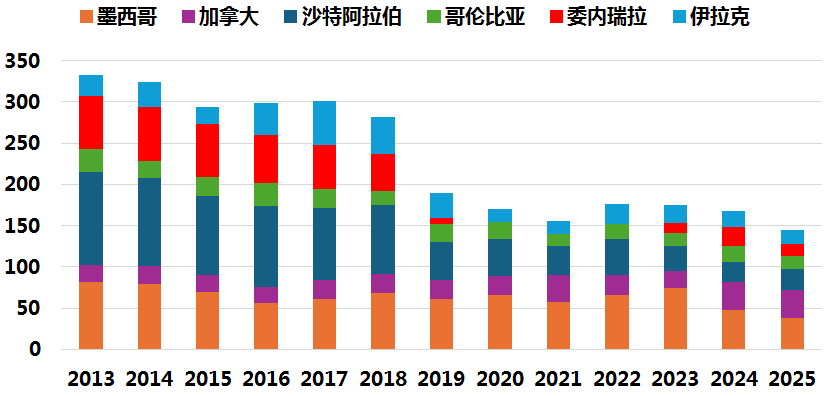
Group 1 - The situation in Venezuela has changed significantly following a large-scale military action by the U.S., which has taken control of President Maduro and his wife, aiming to manage Venezuela and promote investment from U.S. oil companies [1] - Venezuela, a major producer of heavy crude oil, is expected to have its oil production released, which will negatively impact global oil prices amid an oversupply in the market [1][12] - The U.S. has completed its first sale of Venezuelan oil worth $500 million and plans to expand sales, indicating a restructuring of the global heavy crude oil market [1] Group 2 - The U.S. imports heavy crude oil primarily from Canada and Mexico, with projections for 2025 showing imports of 380,000 barrels per day from Mexico, 330,000 barrels per day from Canada, and 140,000 barrels per day from Venezuela [3] - Following the U.S. military action, Venezuela is expected to transfer between 30 million to 50 million barrels of oil to the U.S., which will increase the availability of Venezuelan heavy crude in the U.S. market [3] - The PADD3 region in the U.S. has complex refining capabilities that can process large amounts of Venezuelan heavy crude, leading to a decrease in refining costs [3][5] Group 3 - The situation in Venezuela will have structural impacts on China's heavy crude oil imports, as Venezuela is the second-largest supplier to China [5] - If Venezuelan oil begins to be sold globally, China will face competition for supplies from countries like the U.S. and India, potentially leading to a shift in import sources [5] - The expansion of Canada's TMX pipeline is expected to increase heavy crude oil exports to Asia, providing an alternative supply source for China [7][8] Group 4 - Canada is looking to diversify its crude oil exports, which could reduce geopolitical risks in the global oil supply chain, especially with the uncertainty surrounding Venezuelan oil exports [7] - By increasing imports from Canada, China can reduce its reliance on traditional suppliers in the Middle East, optimizing its energy import structure [7] - In 2025, Canada is projected to export 360,000 barrels per day of crude oil to China, accounting for 60% of its total exports [8] Group 5 - Venezuela's oil production is expected to rise to over 1 million barrels per day by the end of 2026 and nearly 2 million barrels per day by 2028, but significant investment will be required to reach higher production levels [9] - The U.S. government's indefinite control over Venezuelan oil sales could lead to a substantial increase in Venezuela's market share in the global oil supply [12]