
石油焦

Search documents
化纤头条 | 上游迫于成本涨价,下游观望心态不改……纺织人需要多久才能接受成本上涨?
Xin Lang Cai Jing· 2026-02-27 11:43
Group 1 - The geopolitical tensions in Iran have escalated, leading to increased military presence from the US and a rise in international oil prices, which has subsequently affected the polyester chain, resulting in a price increase across various products after the Spring Festival [2][3] - After the Spring Festival, Brent crude oil prices rose by 5.52% compared to pre-holiday levels, significantly boosting the costs in the petrochemical market, with 67% of 42 major petrochemical products experiencing price increases [3] - Specific petrochemical products that saw price increases include petroleum coke (5.1%), PX (3.67%), styrene (3.06%), pure benzene (2.92%), and PTA (2.8%) [3] Group 2 - Despite the price increases in upstream materials, downstream weaving enterprises remain cautious, with many still on holiday and those operating hesitant to ramp up production without existing orders, resulting in average sales rates for polyester filament remaining at 20-30% [5] - The chemical industry, including polyester, is expected to operate under a "de-involution" logic in 2026, moving away from the previous model of exchanging price for volume, with a focus on controlling production capacity to prevent excessive inventory growth [7] - The textile industry faces challenges in raising fabric prices due to significant existing inventory, which continues to exert pressure on the spot market, indicating that while upstream de-involution is showing effects, the downstream sector still has a long way to go [7] Group 3 - Recent tariff issues in the US may create a temporary window for textile exports, allowing Chinese textiles to face only a 10% tariff, similar to Southeast Asia and Mexico, potentially leading to a surge in exports and supporting market conditions in the first half of the year [8]


【图】2025年10月江西省石油焦产量数据
Chan Ye Diao Yan Wang· 2026-02-27 07:45
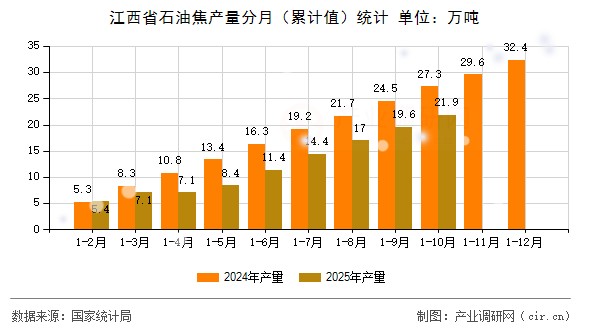
Group 1 - In the first ten months of 2025, the petroleum coke production in Jiangxi Province reached 21.9 thousand tons, representing a decrease of 19.9% compared to the same period in 2024, with a growth rate 22.1 percentage points lower than in 2024 and 15.9 percentage points lower than the national average [1] - The total petroleum coke production in Jiangxi accounted for 0.8% of the national production of 2,617.4 thousand tons during the same period [1] Group 2 - In October 2025, the petroleum coke production in Jiangxi Province was 2.2 thousand tons, which is a decline of 20.7% compared to October 2024, with a growth rate 32.7 percentage points lower than in 2024 and 20.2 percentage points lower than the national average [2] - The production in October represented 0.8% of the national petroleum coke production of 268.1 thousand tons [2]
研客专栏 | 能化品种的做多机会来了吗?
对冲研投· 2026-02-26 07:52
Core Viewpoint - The current commodity market is experiencing significant structural differentiation, particularly between the non-ferrous/energy chemical sector and the non-ferrous/black sector, with notable price divergence driven by various factors [4]. Group A: Energy Chemical Sector Dynamics - The energy chemical sector is under long-term pressure due to weak cost support, with predictions of a global oil surplus of approximately 3 million barrels per day in the first half of the year, limiting upward price elasticity [4]. - Recent marginal changes, including geopolitical fluctuations and supply disruptions, are stimulating market enthusiasm for energy chemical products, potentially leading to a phase of valuation recovery [4]. - The petrochemical industry is facing profound raw material supply bottlenecks, with global oil demand entering a slow growth phase and significant structural contradictions emerging [4]. - The global refining capacity landscape is being reshaped, with marginal capacity vulnerabilities becoming apparent as production shifts from developed economies to emerging markets like China and India [5]. - The geopolitical tensions between the U.S. and Iran have injected a strong short-term risk premium into the market, with the probability of localized military conflict rising to over 70%, pushing Brent crude prices to near six-month highs [5][6]. Group B: Supply Chain Interdependencies - The concept of "passive supply" is crucial in understanding the supply dynamics within the energy chemical sector, where supply changes are often driven by interdependencies within the production chain rather than direct supply-demand balances [6][7]. - In the chlor-alkali industry, the supply of PVC is a typical example of passive supply, where the production of caustic soda and liquid chlorine is interlinked, leading to supply constraints even when PVC profits are low [7][11]. - The interaction between the aromatics industry and fuel oil markets creates a passive supply transfer effect, where high demand for gasoline can lead to a reallocation of resources from chemical production to fuel oil, impacting the supply of key chemical feedstocks [13][17]. Group C: Market Dynamics and Price Elasticity - The analysis of supply in the energy chemical sector must transcend single-product supply-demand balances, focusing on the overall industry chain and cross-market linkages [28]. - The current configuration in the energy chemical sector suggests that the aromatics industry chain (PTA, PX, styrene, and pure benzene) and asphalt may become preferred options, with caustic soda showing favorable odds [29].

银河期货沥青日报-20260224
Yin He Qi Huo· 2026-02-24 09:30
Group 1: Report Industry Investment Rating - No relevant content Group 2: Core View of the Report - Geopolitical fluctuations intensify, and the asphalt market follows the fluctuations of crude oil. The rigid demand in each region has not yet recovered, but it is expected to pick up after the Spring Festival and with better weather. Under the support of low inventory, low supply, and cost, the spot prices in each region remain basically stable. There are still expectations of a medium - term raw material shortage and cost increase for asphalt [6] Group 3: Summary of Related Catalogs Part 1: Related Data - **Futures Prices and Positions**: On February 24, 2026, compared with February 13, 2026, BU2603 (the main contract) rose from 3264 to 3334, an increase of 70 or 2.14%; BU2604 rose from 3280 to 3348, an increase of 68 or 2.07%; BU2605 rose from 3284 to 3364, an increase of 80 or 2.44%; SC2603 rose from 460.7 to 493.3, an increase of 32.6 or 7.08%; Brent first - line rose from 67.33 to 71.65, an increase of 4.3 or 6.42%. The main contract position increased from 14.3 to 14.6 (in ten thousand lots), an increase of 0.3 or 1.76%, and the trading volume decreased from 16.9 to 15.4 (in ten thousand lots), a decrease of 1.5 or 8.59%. The warehouse receipt quantity increased from 69070 to 77620 tons, an increase of 8550 or 12.38% [2] - **Basis and Spread**: BU04 - 05 decreased from - 4.00 to - 16.00, a decrease of 12.00 or - 500.00%; BU04 - 03 increased from - 16.00 to - 14.00, an increase of 2.00 or 12.50%. The Shandong - main contract basis increased from 60.00 to 82.00, an increase of 22.00 or 36.67%; the East China - main contract basis decreased from - 20.00 to - 68.00, a decrease of 48.00 or - 240.00%; the South China - main contract basis decreased from 30.00 to - 38.00, a decrease of 68.00 or - 226.67% [2] - **Industrial Chain Spot Prices**: The Shandong market price rose from 3210 to 3300, an increase of 90.00 or 2.80%; the East China market price rose from 3260 to 3280, an increase of 20.00 or 0.61%; the South China market price remained unchanged at 3310. Shandong gasoline decreased from 7319 to 7225, a decrease of 94.00 or - 1.28%; Shandong diesel decreased from 5619 to 5561, a decrease of 58.00 or - 1.03%; Shandong petroleum coke increased from 2750 to 2800, an increase of 50.00 or 1.82%. The diluted asphalt discount remained unchanged at - 13.2, and the exchange - rate middle price increased from 6.9398 to 6.9414, an increase of 0.00 or 0.02% [2] - **Spread and Profit**: The asphalt refinery profit decreased from - 26.90 to - 199.13, a decrease of 172.23 or - 640.17%; the refined oil comprehensive profit decreased from - 49.69 to - 307.39, a decrease of 257.70 or - 518.63%; the BU - SC cracking decreased from - 460.46 to - 638.26, a decrease of 177.80 or - 38.61%; the gasoline spot - Brent decreased from 861.57 to 552.67, a decrease of 308.90 or - 35.85%; the diesel spot - Brent decreased from 47.14 to - 229.90, a decrease of 277.04 or - 587.68% [2] Part 2: Market Judgment - **Market Overview**: On February 24, the average domestic asphalt market price was 3365 yuan/ton, a 40 - yuan/ton increase or 1.18% compared with the previous day. During the Spring Festival, demand and road transportation were restricted, but crude oil prices rose significantly. Supported by costs, northern traders mainly raised their quotes, driving up the average domestic asphalt market price. In the Shandong market, the mainstream transaction price rose by 85 to 3250 - 3350 yuan/ton. Although the international situation was volatile and crude oil prices were strong, the overall transaction was average due to insufficient recovery of rigid demand. In addition, some refineries in Shandong resumed production, and there was still a contract to be executed at the end of the month, so the short - term asphalt price was weak. In the Yangtze River Delta market, the mainstream transaction price remained stable at 3280 - 3280 yuan/ton. Although the cost and futures market were strong during the Spring Festival, the demand in the region had not recovered, and the overall market transaction was average. The inventory of the main refineries was controllable, and the shipping price might still rise. In the South China market, the mainstream transaction price remained stable at 3240 - 3300 yuan/ton. The market demand was gradually weakening, and the inventory level was low, so the price remained stable. The actual market demand may continue to decrease, and the local mainstream price may remain stable in the short term [4][5] - **Market Outlook**: Geopolitical fluctuations intensify, and the asphalt market follows the fluctuations of crude oil. The rigid demand in each region has not yet recovered, but it is expected to pick up after the Spring Festival and with better weather. Under the support of low inventory, low supply, and cost, the spot prices in each region remain basically stable. There are still expectations of a medium - term raw material shortage and cost increase for asphalt [6] Part 3: Related Attachments - The report provides multiple figures, including the closing price of the BU main contract, the position of the BU main contract, the market price of asphalt in East China, the market price of asphalt in Shandong, the price of gasoline from Shandong local refineries, and the price of diesel from Shandong local refineries [9]
【图】2025年9月江西省石油焦产量数据
Chan Ye Diao Yan Wang· 2026-02-24 09:05
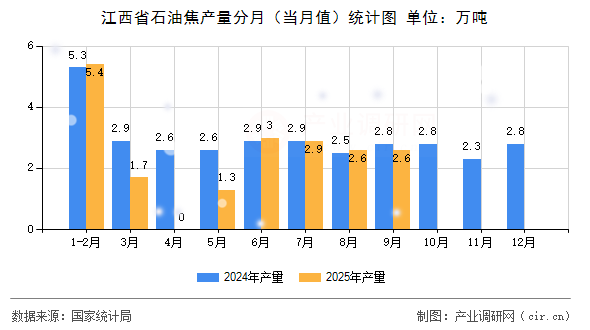
Group 1 - The core viewpoint of the article highlights a decline in petroleum coke production in Jiangxi Province, with a significant year-on-year decrease in both September and the cumulative production for the first nine months of 2025 [1][4]. Group 2 - In September 2025, the petroleum coke production in Jiangxi Province was 26,000 tons, representing a year-on-year decrease of 5.1%, with the growth rate falling by 17.5 percentage points compared to the same period last year [1]. - The production accounted for 1.0% of the national petroleum coke output of 2,597,000 tons during the same period [1]. Group 3 - From January to September 2025, the total petroleum coke production in Jiangxi Province reached 196,000 tons, reflecting a year-on-year decline of 19.8%, with the growth rate down by 21.0 percentage points compared to the previous year [4]. - This production volume represented 0.8% of the national petroleum coke output of 23,429,000 tons for the same timeframe [4].
【图】2025年9月河北省石油焦产量统计分析
Chan Ye Diao Yan Wang· 2026-02-16 00:40
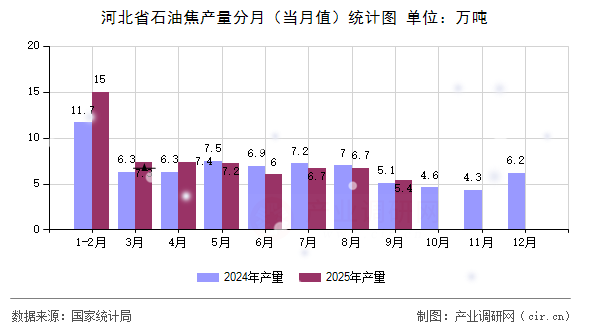
Group 1 - The core viewpoint of the article highlights the growth in petroleum coke production in Hebei Province, with a production of 54,000 tons in September 2025, reflecting a year-on-year increase of 5.3% [1] - The growth rate in September 2025 is 17.4 percentage points higher than the same period last year, and it is 8.5 percentage points higher than the national average [1] - Hebei's petroleum coke production accounts for 2.1% of the national total production of 2,597,000 tons for the same period [1] Group 2 - From January to September 2025, the total petroleum coke production in Hebei Province reached 616,000 tons, with a year-on-year growth of 6.4% [4] - The growth rate for the first nine months of 2025 is 16.1 percentage points lower than the same period last year, indicating a slowdown in growth [4] - Hebei's production during this period represents 2.6% of the national total production of 2,342,900 tons [4]
【图】2025年1-8月河南省石油焦产量数据分析
Chan Ye Diao Yan Wang· 2026-02-15 04:13
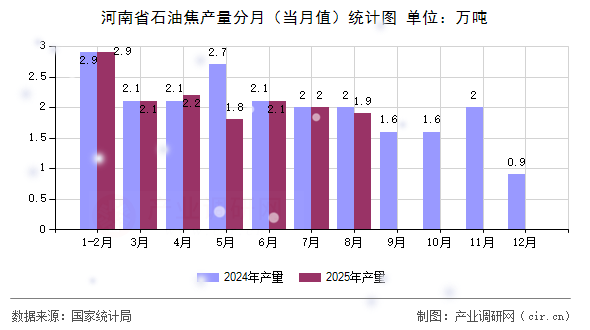
Core Viewpoint - The petroleum coke production in Henan Province for August 2025 shows a decline compared to the previous year, indicating a significant change in growth rate and production levels within the industry [1]. Group 1: August 2025 Production Data - Petroleum coke production in August 2025 reached 19,000 tons, representing a year-on-year decrease of 4.5% [1]. - The growth rate change compared to the same month last year is an increase of 21.0 percentage points [1]. - The production accounted for 0.7% of the national petroleum coke output of 2,549,000 tons during the same period [1]. Group 2: Cumulative Production Data (January to August 2025) - Cumulative petroleum coke production from January to August 2025 totaled 152,000 tons, reflecting a year-on-year decline of 4.2% [4]. - The growth rate change compared to the previous year is a decrease of 9.6 percentage points [4]. - This production volume represents 0.7% of the national total of 2,083,100 tons for the same timeframe [4].
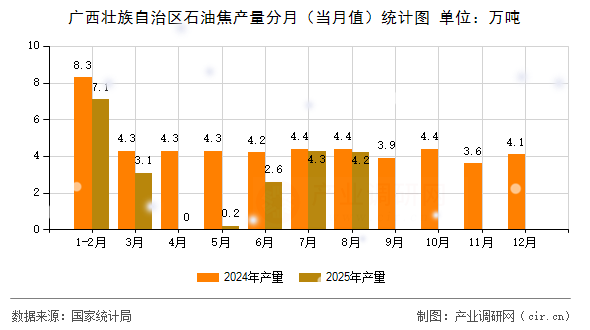
【图】2025年8月广西壮族自治区石油焦产量统计分析
Chan Ye Diao Yan Wang· 2026-02-12 05:59
Group 1 - The core viewpoint of the article highlights the production statistics of petroleum coke in Guangxi Zhuang Autonomous Region for August 2025, indicating a decrease in production compared to the previous year [1] - In August 2025, the petroleum coke production reached 42,000 tons, reflecting a year-on-year decline of 2.5%, but with an increase in growth rate by 1.4 percentage points compared to the same month last year [1] - The production in Guangxi accounted for 1.6% of the national petroleum coke production of 2,549,000 tons during the same period [1] Group 2 - From January to August 2025, the total petroleum coke production in Guangxi was 216,000 tons, showing a significant year-on-year decrease of 36.7% [1] - The growth rate for the first eight months of 2025 was 39.7 percentage points lower than the same period last year, and 32.1 percentage points lower than the national average [1] - Guangxi's production during this period represented 1.0% of the national total petroleum coke production of 2,083,100 tons [1]
石油焦:偏强震荡呈现结构性分化
Zhong Guo Hua Gong Bao· 2026-02-12 00:38
Core Viewpoint - The petroleum coke market in China is expected to experience strong fluctuations in 2026, with a structural differentiation in supply and demand, particularly in the low-sulfur coke market, which is likely to remain tight [1] Market Performance - In 2025, the petroleum coke market exhibited a significant upward trend, with prices rising from 1615 RMB/ton on January 1 to 2598.25 RMB/ton by December 31, marking an annual increase of 60.88% [2] - The market followed an "M" shaped trajectory, with a notable price surge before the Spring Festival due to reduced supply and increased downstream stocking demand [2] - In the first half of 2025, prices fluctuated downwards as imported petroleum coke arrived at ports, leading to increased inventory and a cautious demand outlook from downstream buyers [2][3] Supply Dynamics - The growth rate of new petroleum coke production capacity is expected to slow down in 2026, resulting in limited supply increases [5] - Analysts indicate that the rapid expansion phase for delayed coking units ended in 2022, with new capacity growth from 2026 to 2030 expected to be significantly lower than the previous cycle [6] - The total new capacity for delayed coking units from 2026 to 2030 is projected to be 9.5 million tons, primarily concentrated in East China, with most projects likely to be completed between 2027 and 2028 [7] Demand Trends - The demand for petroleum coke is anticipated to grow strongly, driven by stable demand in the aluminum carbon industry and increasing orders for negative electrode materials in energy storage and power applications [8] - The calcination process remains the most critical intermediary step for petroleum coke, with significant demand from downstream industries such as prebaked anodes and graphite electrodes [8] - The negative electrode materials market is expected to continue its growth trajectory, with 2025 production reaching approximately 2.95 million tons and a utilization rate of 77.6% [9] Price Outlook - The supply tightness in low-sulfur coke is expected to lead to sustained high prices, while medium-sulfur coke will rely on traditional industrial demand, and high-sulfur coke prices are likely to remain low due to fuel substitution effects [10] - Overall, the petroleum coke prices in 2026 are projected to exhibit a strong fluctuating trend, with further structural differentiation anticipated [10]
石油焦:偏强震荡呈现结构性分化
Zhong Guo Hua Gong Bao· 2026-02-11 02:21
Core Viewpoint - The petroleum coke market in China is expected to experience strong fluctuations in 2026, with a structural differentiation in supply and demand, particularly in the low-sulfur coke segment, which is likely to remain tight [1] Group 1: Market Performance in 2025 - In 2025, the petroleum coke market exhibited a significant upward trend, with the price rising from 1615 RMB/ton on January 1 to 2598.25 RMB/ton by December 31, marking an annual increase of 60.88% [2] - The price surge was driven by supply constraints and increased downstream stocking demand, particularly before the Spring Festival, leading to a tight supply situation [2][3] - In the first half of 2025, prices fluctuated due to an influx of imported petroleum coke and a cautious demand outlook from downstream sectors [2] Group 2: Supply Dynamics - Analysts predict a slowdown in the growth of new petroleum coke production capacity in 2026, with limited supply increases expected [5] - The peak period for delayed coking capacity expansion ended in 2022, and the new cycle from 2026 to 2030 will see a significant reduction in the pace of capacity growth [5] - New capacity additions are primarily focused on refinery upgrades, with a projected total of 9.5 million tons of new delayed coking capacity expected from 2026 to 2030, mainly in East China [5] Group 3: Demand Trends - The demand for petroleum coke is expected to remain strong, driven by stable needs in the aluminum carbon industry and increasing orders for negative electrode materials in energy storage and power applications [6] - The calcination process remains the most critical intermediary for petroleum coke, with significant growth anticipated in the calcined coke sector from 2026 to 2027 [6] - The negative electrode materials market is projected to continue its growth trajectory, with a production volume of approximately 2.95 million tons in 2025 and a utilization rate of 77.6% [6][7] Group 4: Price Outlook - The price of low-sulfur coke is expected to remain high due to tight supply, while medium-sulfur coke will rely on traditional industrial demand, and high-sulfur coke prices are likely to stay low due to fuel substitution effects [7] - Overall, the petroleum coke prices in 2026 are anticipated to show a strong fluctuating trend, with further structural differentiation expected [7]