
公募基金费改

Search documents
东海证券:公募费改三阶段全面落地 差异化安排持续优化行业生态
智通财经网· 2026-01-07 12:57
Core Viewpoint - The comprehensive implementation of the public fund fee reform marks a significant step towards enhancing the stability of fund operations and protecting investor interests, despite limited overall impact from reduced subscription fees under current discount rates [1][7]. Group 1: Regulatory Changes - The China Securities Regulatory Commission (CSRC) revised the "Regulations on the Management of Sales Fees for Publicly Raised Securities Investment Funds," effective January 1, 2026, indicating the full rollout of the three-phase fee reform [2]. - The new regulations include a more detailed categorization of subscription fees, with index funds now having a maximum subscription fee rate of 0.3%, aligning with bond funds, while actively managed equity funds remain at 0.8% [3]. - Redemption fee rules have been made more flexible, allowing for negotiated terms for certain funds held for specified periods, addressing previous concerns about liquidity in bond funds [3]. Group 2: Impact on Investors - The new rules are expected to significantly lower investment costs, with an estimated annual benefit of over 50 billion yuan to investors, primarily from reduced sales fees [4]. - The complete inclusion of redemption fees into fund assets aims to eliminate the incentive for sales agents to promote short-term trading, encouraging long-term investment behaviors [4]. Group 3: Implications for Sales Institutions - Sales institutions may face profitability pressures due to reduced subscription fees and expanded exemptions from sales service fees, particularly affecting smaller firms reliant on trailing commissions [5]. - The regulations encourage a shift from a focus on scale and volume to service and retention, prompting institutions to enhance their advisory capabilities rather than merely selling products [5]. Group 4: Industry Evolution - The reforms are expected to drive the public fund industry towards high-quality development, with increased pressure on smaller firms to improve investment management capabilities [6]. - The competitive landscape will likely see a concentration of resources towards larger firms, enhancing their market position and performance [6]. - The new regulations aim to purify the industry environment by addressing long-standing issues such as "switching old for new" and "double charging," thereby improving the overall competitiveness of public funds [7].
公募基金降费第三阶段落地,引导权益类基金发展,平滑对短债基金的影响
Soochow Securities· 2026-01-03 03:03
Investment Rating - The report maintains an "Overweight" rating for the non-bank financial industry [1] Core Insights - The implementation of the third phase of fee reduction for public funds is expected to guide the development of equity funds and mitigate the impact on short-term bond funds [5] - The overall fee reduction is estimated to be around 30 billion yuan, with a reduction rate of approximately 34% [5] - Key changes in the final draft include differentiated exemptions for redemption fees on bond funds and ETFs, encouraging long-term holding by investors [5] - The fee structure for subscription and sales service fees has been adjusted, with significant reductions across various fund types, promoting a more favorable investment environment [5][6] Summary by Sections Regulatory Changes - The China Securities Regulatory Commission revised the "Management Regulations on Sales Fees for Open-End Securities Investment Funds," which took effect on January 1 [5] - The new regulations lower the maximum subscription and sales service fees for equity and mixed funds, with reductions from 1.2%/1.5% to 0.8%/0.5% respectively [6] Impact on Fund Types - For equity and mixed funds, the new regulations encourage long-term holding by eliminating sales service fees for holdings over one year [7] - Bond funds see a larger fee reduction, with the previous punitive redemption fees being adjusted to improve their attractiveness [7] - Money market funds will continue to charge sales service fees for holdings over one year, but overall fee structures are optimized to enhance yield [7] Fee Reduction Phases - The fee reduction initiative is structured in three phases, cumulatively expected to save investors 50 billion yuan annually [5] - The first phase focused on reducing management and custody fees, while the second phase targeted transaction commission reductions [5]
券商分析师数量创新高 重规模更须重研发能力
Guo Ji Jin Rong Bao· 2025-10-09 13:17
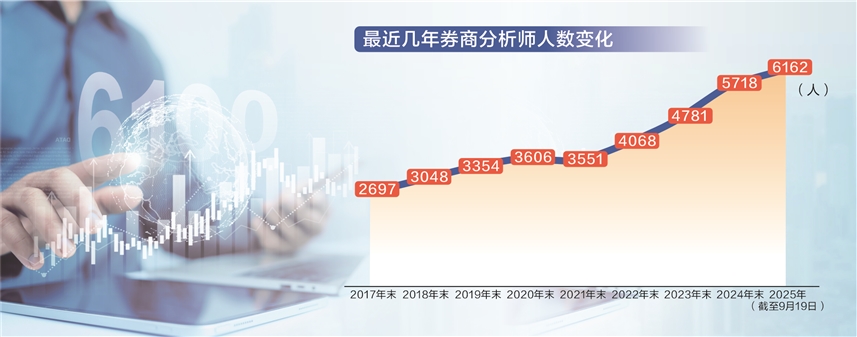
Core Insights - The number of securities analysts in China has surpassed 6,000, marking a historical high, which reflects the development of the market and the industry [1][2] - The rapid growth of analysts has raised concerns about the sustainability of such a large workforce, especially in light of the upcoming changes in public fund fee structures [2][3] - The need to enhance research and development capabilities among analysts is emphasized, as the industry faces challenges from market changes and increased competition [3] Analyst Growth - The number of analysts has doubled in less than a decade, from over 3,000 in 2018 to 6,162 by September 16, 2025 [1] - Major firms like CITIC Securities, Guotai Junan, and CICC have more than 300 analysts, while many others have fewer than the average [1] Analyst Recruitment and Retention - Analysts are sourced mainly through internal training and external recruitment, with high personnel mobility being a characteristic of the industry [2] - The upcoming public fund fee reform is expected to significantly reduce trading commissions, impacting the revenue of brokerage firms [2] Industry Consolidation - The brokerage industry has seen a wave of mergers and acquisitions, with firms like CITIC Securities expanding their influence through strategic consolidations [3] - The lack of top-tier analysts in the domestic market is noted, with a call for investment in talent development to create industry leaders akin to the "Axes" of Wall Street [3]
今年以来新增超400人,券商分析师数量创历史新高
Zheng Quan Shi Bao· 2025-09-22 00:48
Core Insights - The number of securities analysts in China has reached a historical high, surpassing 6,000, with significant growth observed in recent years [2][3] - Despite the increase in analysts, the market environment is challenging, with a decline in commission income due to public fund fee reforms, necessitating a transformation in brokerage research departments [8] Analyst Growth - As of September 19, 2023, there are 6,162 analysts, with over 400 new additions this year [3] - The analyst count has shown rapid expansion, crossing 3,000 in 2018 and 4,000 in 2022, with projections indicating over 5,000 by 2024 [3] - The growth is attributed to the expansion of institutional investors and a significant talent gap in brokerage research, leading to large-scale recruitment, especially from recent graduates [3][5] Structural Changes in Recruitment - Large brokerages primarily focus on internal growth, while smaller firms are combining internal development with external recruitment [5] - Among firms with over 150 analysts, notable growth is seen in companies like CITIC Securities and Industrial Securities, with a majority of new analysts being internally trained [5][6] - Smaller firms like Guojin Securities and Dongfang Fortune Securities have also seen significant external recruitment, with many analysts transferring from other brokerages [6][7] Revenue Challenges and Strategic Shifts - The brokerage research environment is under pressure, with commission income dropping over 30% in the first half of 2023, highlighting the need for diversification in revenue sources [8] - Brokerages are exploring new profit growth points, including collaborations with local governments and expanding international and fintech operations [8] - Some firms are shifting towards comprehensive research models, balancing external revenue generation with internal services [8] Trends in Analyst Employment - The pace of recruitment among top brokerages has slowed, with firms like CICC and CITIC Securities showing minimal growth in analyst numbers this year compared to previous years [9] - A trend of experienced analysts moving to buy-side institutions or other sectors is emerging, indicating a rebalancing of talent within the industry [9]




突破6000人!券商分析师,创历史新高!
券商中国· 2025-09-21 23:36
Core Insights - The number of securities analysts in China has surpassed 6,000, reaching a historical high of 6,162 as of September 19, 2023, indicating rapid expansion in the analyst workforce [2][4][10] - The growth in analyst numbers is driven by the increasing demand from institutional investors and the need for talent in the face of regulatory changes affecting commission income [4][10] - Despite the increase in analyst numbers, the industry is facing significant revenue challenges due to a more than 30% decline in commission income from the public fund sector [2][10] Analyst Growth - The analyst workforce has seen a rapid increase, with the number surpassing 3,000 in 2018 and crossing 4,000 in 2022, now exceeding 6,000 in less than two years [4] - Major firms like CITIC Securities and CICC lead in analyst numbers, with CICC having 344 analysts and CITIC Securities surpassing 300 [4][5] - The growth is characterized by a mix of internal promotions and external hiring, particularly among smaller firms seeking to enhance their research capabilities [6][8] Structural Changes in Hiring - Large firms primarily rely on internal growth for expanding their analyst teams, while smaller firms are increasingly hiring externally to fill gaps [6][8] - For instance, CITIC Securities registered 62 new analysts this year, with 59 being internal promotions, while smaller firms like Guojin Securities have seen significant external hiring [6][8] Industry Challenges and Transformation - The research environment is changing, with a notable decline in income from commission-based models, prompting firms to seek new revenue streams [10] - Firms are focusing on diversifying their income sources, including expanding into non-public fund clients and exploring international business opportunities [10] - Some leading firms have slowed their hiring pace, with CICC reporting a decrease in analyst numbers this year, indicating a potential shift in strategy [11]

非银金融行业跟踪周报:公募基金费改第三阶段启动,上市险企继续增配OCI股票-20250907
Soochow Securities· 2025-09-07 09:42
Investment Rating - The report maintains an "Overweight" rating for the non-bank financial sector [1]. Core Insights - The public fund fee reform's third phase has commenced, and listed insurance companies continue to increase their allocation to OCI stocks [1]. - The non-bank financial sector has shown a decline of 5.05% recently, underperforming the CSI 300 index, which fell by 0.81% [10]. - The insurance sector's net profit has generally increased, with a notable growth in new business value (NBV) for life insurance [24][25]. - The securities sector has experienced a significant increase in trading volume, with a year-on-year rise of 223.25% in daily average stock trading value [16]. - The multi-financial sector is transitioning into a stable growth phase, with trust assets continuing to grow despite a decline in profits [35]. Summary by Sections Non-Bank Financial Sector Performance - All sub-sectors of non-bank financials underperformed the CSI 300 index in the recent five trading days, with declines of 4.07% in insurance, 5.29% in securities, and 6.32% in multi-financials [10][12]. Securities Sector - Trading volume has significantly increased, with a daily average stock trading value of CNY 29,496 billion as of September 5, 2025, marking a 223.25% increase year-on-year [16]. - The margin balance reached CNY 22,795 billion, up 63.74% year-on-year [16]. - The average price-to-book (PB) ratio for the securities industry is projected at 1.3x for 2025 [22]. Insurance Sector - Listed insurance companies reported a total net profit of CNY 1,782 billion for the first half of 2025, reflecting a 3.7% year-on-year increase [24]. - The NBV for life insurance has shown substantial growth, with increases of 20% to 72% across major companies [25]. - The insurance sector's valuation is currently between 0.62-0.93 times the expected P/EV for 2025, indicating a historical low [34]. Multi-Financial Sector - The trust industry saw its asset scale reach CNY 29.56 trillion by the end of 2024, a 23.58% increase year-on-year, despite a 45.5% drop in total profits [35]. - The futures market experienced a trading volume of 10.59 billion contracts in July 2025, with a transaction value of CNY 71.31 trillion, representing year-on-year growth of 48.89% and 36.03%, respectively [41]. Industry Ranking and Recommendations - The report ranks the sectors as follows: Insurance > Securities > Other Multi-Financials, with key recommendations including China Ping An, New China Life, China Pacific Insurance, CITIC Securities, Tonghuashun, and Jiufang Zhitu Holdings [51].