
关税诉讼

Search documents
特朗普政府面临的关税诉讼已达2000起
Yang Shi Xin Wen· 2026-02-27 18:08
Core Viewpoint - The U.S. Supreme Court ruled that the Trump administration's large-scale tariff policy was unlawful, leading to over 100 companies filing new lawsuits for the refund of tariffs paid, increasing the total number of tariff-related lawsuits to 2,000 [1]. Group 1: Legal Actions - More than 100 companies, including FedEx, Dyson, and Bausch & Lomb, have filed lawsuits in the U.S. International Trade Court seeking refunds of tariffs [1]. - The total number of lawsuits against the Trump administration regarding tariffs has now reached 2,000 [1]. Group 2: Supreme Court Ruling - The Supreme Court's ruling on February 20 stated that the International Emergency Economic Powers Act does not authorize the president to impose large-scale tariffs [1]. - Following the ruling, Trump signed an executive order to terminate some tariff measures [1]. Group 3: Next Steps - The U.S. Department of Justice is expected to provide opinions on the next legal steps regarding the refund issue on February 27 [1].
比亚迪起诉美国政府:退钱!
Xin Lang Cai Jing· 2026-02-11 10:16
Core Viewpoint - BYD has filed a lawsuit against the U.S. government, challenging tariffs imposed under the International Emergency Economic Powers Act (IEEPA) and seeking refunds for tariffs paid since April 2025 [1][2][9] Group 1: Lawsuit Details - BYD's lawsuit includes demands for a permanent injunction against the enforcement of the tariffs, refunds of all IEEPA tariffs and interest paid since April 2025, and for the defendant to bear reasonable litigation costs [3][10] - The company emphasizes that it has incurred significant tariffs for imported materials necessary for its electric bus and truck operations in the U.S. [3][10] Group 2: Legal Context and Strategy - The central legal issue revolves around whether the IEEPA authorizes the president to impose tariffs [7][14] - BYD strategically filed the lawsuit during a "window period" after the Supreme Court's hearings but before a ruling, minimizing political risks and leveraging existing judicial precedents [7][14] Group 3: Potential Implications - A favorable ruling for BYD could lead to significant growth opportunities for its passenger vehicle business in the U.S. and surrounding countries, with potential refunds ranging from tens of millions to over a hundred million dollars [9][15] - The outcome may also influence the tariff policy environment for Chinese new energy companies in the U.S. [15]


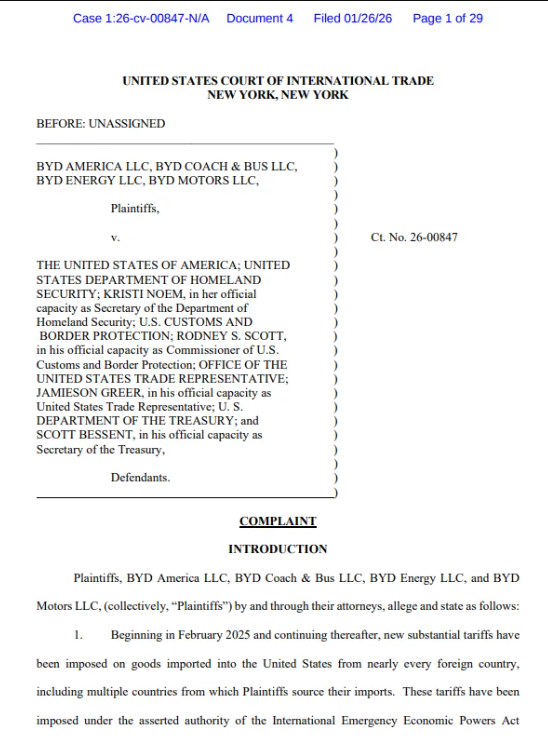
比亚迪就关税起诉美国政府
Bei Jing Ri Bao Ke Hu Duan· 2026-02-10 12:08
Core Viewpoint - BYD has filed a lawsuit against the U.S. government seeking a refund of tariffs imposed on imported materials, marking the first time a Chinese automaker has taken such legal action regarding U.S. tariffs [1] Group 1: Legal Action and Context - BYD's lawsuit is part of a broader trend where numerous global companies, including Costco, Goodyear, Toyota, and Kawasaki Heavy Industries, have challenged the legality of tariffs imposed under the International Emergency Economic Powers Act (IEEPA) [1] - The lawsuit was initiated to ensure that BYD's U.S. subsidiary can secure refunds for tariffs before the Supreme Court makes a final ruling on the legality of the tariffs [1] - BYD's legal action not only addresses tariffs related to the V.O.S. case but also includes additional tariffs imposed on imports from Brazil and India after the V.O.S. case [1] Group 2: Business Operations and Financial Impact - BYD has established a manufacturing facility in Lancaster, California, which is one of the largest electric bus factories in North America, with an annual production capacity of approximately 1,500 units and over 750 local union workers employed [1] - The company's primary business in the U.S. focuses on electric buses and energy storage systems, providing products for municipal transit systems and utility projects across the country [1] - BYD's North American business generates annual revenue between $500 million and $1 billion, serving as a crucial market for showcasing its high-end manufacturing capabilities and enhancing its global brand influence [1]
美国贸易代表格里尔 :关税诉讼并未影响贸易谈判。
news flash· 2025-05-30 12:16
Core Viewpoint - The U.S. Trade Representative, Katherine Tai, stated that the ongoing tariff litigation has not impacted trade negotiations with China [1] Group 1 - The U.S. Trade Representative emphasized the importance of continuing trade discussions despite the legal challenges posed by tariffs [1] - The statement indicates a commitment to resolving trade issues through dialogue rather than solely relying on litigation [1]
美国贸易代表格里尔 :如果关税裁决“走向相反的方向”,我们还有其他工具
news flash· 2025-05-30 12:16
Core Viewpoint - The U.S. Trade Representative, Tai, indicated that if tariff rulings "go in the opposite direction," there are other tools available, suggesting that tariff litigation has not harmed trade negotiations [1] Group 1 - The statement emphasizes the readiness to utilize alternative measures if tariff decisions are unfavorable [1] - The assertion that tariff litigation has not negatively impacted trade negotiations highlights the resilience of ongoing discussions [1]