
关键矿产供应链韧性

Search documents
34国没签协议,美盟友倒戈中国,特朗普防稀土卡脖子,第一步走错
Sou Hu Cai Jing· 2026-02-11 07:43
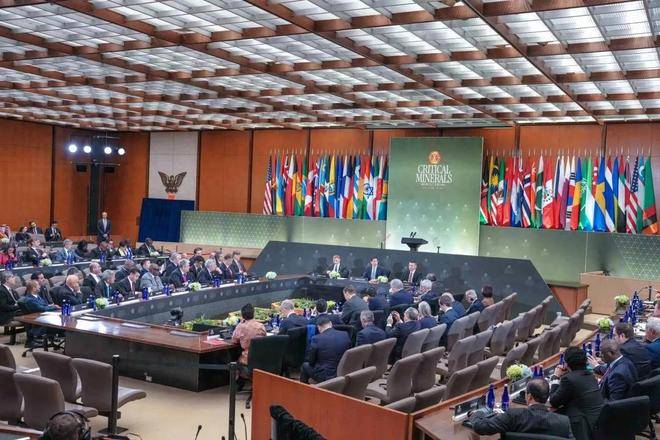
Group 1 - The U.S. Department of State announced the signing of critical mineral agreements or memorandums of understanding with 11 countries during the first ministerial meeting on critical minerals in Washington, bringing the total to 21 countries that have reached cooperation intentions with the U.S. in this area [1] - The U.S. aims to reduce its dependence on China for mineral supplies, particularly in rare earths and lithium, through a strategic reserve plan worth $12 billion [3] - The meeting revealed that less than half of the 55 participating countries signed agreements, indicating that many are aware of China's dominance in the critical minerals market, which accounts for 70% to 90% of global processing capacity [5] Group 2 - Countries that did not sign agreements are cautious about the potential economic consequences of breaking away from existing mineral cooperation systems, which could lead to significant economic losses and even systemic crises for resource-dependent nations [7][8] - Notably, U.S. allies South Korea and Canada chose to strengthen cooperation with China instead of signing agreements with the U.S., indicating a rift in relationships and challenges for U.S. strategies in the critical minerals sector [9]

美拉拢50国开展关键矿产特惠贸易
Xin Lang Cai Jing· 2026-02-09 00:44
Core Points - The United States, in collaboration with the EU, Japan, and Mexico, is implementing a critical minerals strategy essential for defense and high-tech industries [1][2] - A joint action plan will be developed to enhance the resilience of critical mineral supply chains, including trade policies and mechanisms such as country-specific minimum prices [1][2] - A multilateral agreement on critical mineral trade is anticipated to be established among like-minded partners within 30 days [2][3] Group 1 - The U.S. and Mexico have reached a partnership agreement to address vulnerabilities in critical mineral supply chains, with a 60-day action plan focusing on trade policies [3] - The action plan will include negotiations on minimum prices within binding multilateral agreements [3] - The collaboration between the U.S. and Mexico highlights their commitment to addressing global market distortions that threaten North American supply chains [3] Group 2 - The international critical mineral market is currently unstable, with unpredictable price fluctuations and challenges in sustaining investment [2][3] - A proposal was made to establish a "preferential trade center" to mitigate external disruptions and reach consensus on minimum prices [4]
