兵棋推演

Search documents
台海观澜 | 美国“药方”
Jing Ji Guan Cha Wang· 2025-12-03 04:53
Core Viewpoint - The article critiques the recent wargaming reports by American think tanks regarding the Taiwan Strait situation, arguing that the foundational knowledge of these experts about modern China is insufficient, leading to flawed conclusions [2][4]. Group 1: Wargaming Reports - The Center for Strategic and International Studies (CSIS) released a report in January 2023 titled "The First Battle of the Next War: Wargaming a Chinese Invasion of Taiwan," which outlined 24 battle scenarios, with the US, Japan, and Taiwan winning in 22 of them [4][5]. - The report has been widely circulated and commented on by Japanese and Taiwanese media, indicating a coordinated narrative supporting Japanese Prime Minister's statements on Taiwan [6][7]. - CSIS has conducted wargaming exercises for three consecutive years, with different focuses each year: nuclear deterrence in 2024 and blockade scenarios in 2025, totaling 65 scenarios across all years [8][11][12]. Group 2: American Think Tanks' Perspectives - Analysts from American think tanks exhibit a "savior complex" regarding Taiwan, influenced by historical, political, and financial factors, leading to a biased perspective [9]. - The reports acknowledge the significant military and economic disparity between Taiwan and China, emphasizing that Taiwan cannot face China alone and requires US assistance to maintain its democratic system [10]. - The wargaming exercises are criticized for their limited practical military value, as they primarily serve as a basis for future propaganda rather than actionable strategies [14][15]. Group 3: Proposed Solutions - American think tanks have suggested two main responses to potential Chinese military actions: military intervention and economic sanctions, though the latter is seen as beyond their expertise [17][19]. - A new approach introduced by CSIS includes diplomatic mediation, suggesting that the US should provide China with a way to save face, such as allowing international observers in Taiwan's customs and reiterating the "1992 Consensus" [20][22]. - The article argues that ultimately, China's strategy regarding Taiwan will not be significantly influenced by American interventions, rendering the think tanks' wargaming efforts largely ineffective [24][25].

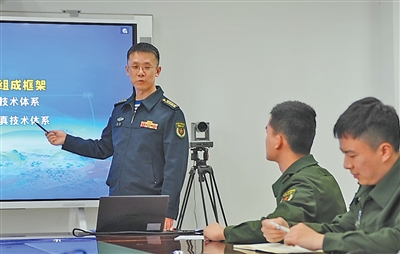
持续攻关兵棋系统研发难题(最美新时代革命军人)
Ren Min Ri Bao· 2025-06-23 22:10
Core Viewpoint - The article highlights the advancements in military simulation technology, particularly the development of a strategic wargaming system at the National Defense University, emphasizing the importance of integrating modern technology into military training and operations [2][3]. Group 1: Development of Wargaming Systems - The wargaming system is described as a crucial tool for simulating warfare, referred to as the "0.999th war," which helps military leaders understand modern battlefields [3]. - The first large-scale computer wargaming system was initiated at the National Defense University, leading to the successful development of the military's first strategic wargaming system [3][6]. - The transition of the wargaming system from the laboratory to practical military exercises marked a significant improvement in its usability and effectiveness [3][6]. Group 2: Leadership and Team Development - Wu Lin, a key figure in the wargaming team, emphasizes the need for continuous innovation and adaptation in wargaming technology to keep pace with modern warfare complexities [3][6]. - The team has expanded from fewer than 10 members to nearly 1,000 experts, showcasing a collaborative effort to enhance military training capabilities [8]. - Wu Lin's leadership style focuses on nurturing talent and empowering younger team members, leading to significant advancements in wargaming technology [7][8]. Group 3: Practical Applications and Challenges - The wargaming system was tested during a major military exercise, where the team faced tight deadlines and technical challenges, ultimately succeeding in simulating modern information warfare [5][6]. - Continuous feedback from military personnel during exercises has led to iterative improvements in the wargaming system, ensuring it meets the evolving needs of the military [6]. - The article illustrates a specific instance where the wargaming simulation provided unexpected insights, demonstrating its effectiveness in training and strategy development [6].