
冷链物流产业发展

Search documents
港股招股进行时,红星冷链(01641)借中部冷链产业发展“东风”起航
智通财经网· 2026-01-02 04:41
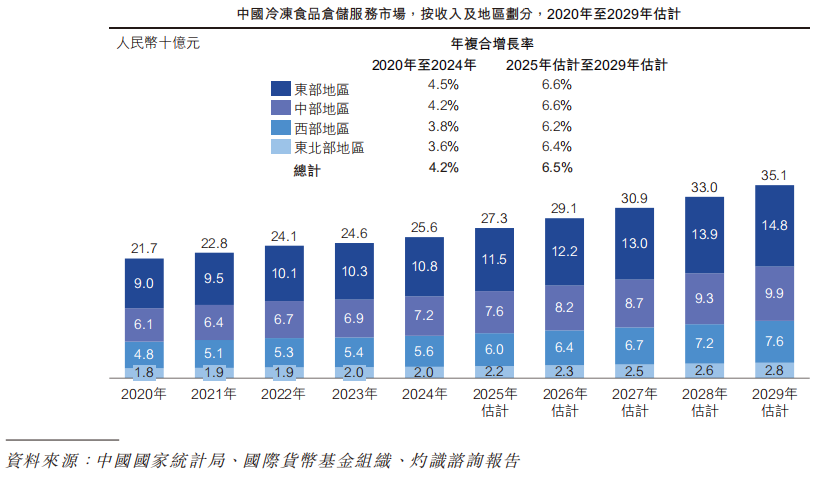
Core Viewpoint - The Hong Kong IPO market remains active, with significant improvements in new share performance, including an average first-day increase of 38% and a low failure rate of 28%, marking the best performance in five years [1] Company Overview - Red Star Cold Chain (01641) is set to launch its IPO from December 31, 2025, to January 8, 2026, with a global offering of 23.263 million H-shares priced at HKD 12.26 per share, aiming for a total market capitalization of approximately HKD 1.203 billion and a price-to-earnings ratio of about 13.04 times [2][3] - The company has a strong backing from cornerstone investors, indicating confidence in its long-term value [2] Business Model and Strategy - Red Star Cold Chain has been deeply rooted in the cold chain market for nearly 20 years, evolving from a frozen food trading platform to a comprehensive service provider [3] - The company operates on a dual-driven model combining storage services and trading platforms, focusing on the needs of merchants [3][4] - It has developed a full industry chain system, including cold storage, import-export trade, e-commerce, customs operations, processing, and logistics [4] Financial Performance - The company maintains a high gross profit margin above 50% and a net profit margin between 33% and 38%, significantly outperforming the industry average of 8%-12% [5] - Red Star Cold Chain holds a leading market position in the central region and Hunan province, with a market share of approximately 54.7% in cold storage services [5][6] Market Expansion - The company aims to expand beyond Hunan into the broader central market, with plans to allocate about 57.5% of IPO proceeds for new capacity to meet growing demand [6][7] - The central region is projected to experience significant growth in the cold chain market, with a compound annual growth rate of approximately 6.6% for cold storage services and 8.5% for cold chain services from 2025 to 2029 [7][9] Industry Environment - The cold chain logistics industry is positioned for growth, supported by favorable policies and increasing consumer demand [9] - The "14th Five-Year Plan" emphasizes the importance of cold chain logistics in agricultural and pharmaceutical sectors, providing a framework for high-quality development [9] Competitive Landscape - Red Star Cold Chain faces new competition from Yuhu Cold Chain, which is establishing a significant presence in the local market, prompting the company to seek growth opportunities outside Hunan [7][10] - The company benefits from its parent company, Red Star Industrial, which has established a robust agricultural product trading network across multiple provinces, enhancing its market entry capabilities [10][11]

市场规模不断扩大、增长势头良好 冷链物流支撑消费升级
Ren Min Ri Bao· 2025-10-14 00:59
Core Insights - The cold chain logistics industry is experiencing steady growth, driven by increasing consumer demand for fresh seafood and other perishable goods, with a total demand of 192 million tons in the first half of the year, representing a year-on-year increase of 4.35% [2][3] - The investment in cold storage facilities is expanding, with a total investment of 22.306 billion yuan in cold storage projects in the first half of the year, marking a year-on-year increase of 7.67% [3][4] - The sales of new energy refrigerated trucks are surging, with a total of 10,548 units sold in the first half of the year, reflecting a remarkable year-on-year growth of 119.61% [5][6] Cold Chain Logistics Demand - The total demand for food cold chain logistics reached 192 million tons in the first half of the year, with a revenue of 279.94 billion yuan, up 3.84% year-on-year [2] - The logistics network is efficiently delivering fresh products, with daily shipments of up to 20,000 orders for crabs during peak seasons [2] Cold Storage Investment - The investment in cold storage projects reached 22.306 billion yuan in the first half of the year, with a total capacity of 26 million cubic meters, equivalent to approximately 10.4 million tons, an increase of 6.12% year-on-year [4] - New cold storage facilities are being developed to meet market demands, such as a 9.2 billion yuan cold storage facility in Guangdong with a capacity of over 150,000 tons [3] New Energy Refrigerated Trucks - The sales of refrigerated trucks increased by 18.19% year-on-year, with new energy refrigerated trucks accounting for 35.8% of total sales [5] - The demand for refrigerated trucks is robust, with continuous growth in transportation volume, maintaining a 20% growth rate for three consecutive months [6]
冷链物流支撑消费升级
Xin Hua Wang· 2025-10-13 23:57
Core Insights - The cold chain logistics market is experiencing significant growth, driven by increasing consumer demand for fresh products and the expansion of cold storage and refrigerated transport capabilities [1][5][6]. Market Demand and Growth - The total demand for food cold chain logistics reached 192 million tons in the first half of the year, representing a year-on-year increase of 4.35% [5]. - The total revenue of food cold chain logistics service companies was 279.94 billion yuan, up 3.84% year-on-year [5]. - The investment in cold storage projects amounted to 22.306 billion yuan in the first half of the year, reflecting a year-on-year growth of 7.67% [6][8]. Cold Storage and Infrastructure - The total capacity of cold storage facilities reached 26 million cubic meters by the end of June, equivalent to approximately 10.4 million tons, marking a 6.12% increase year-on-year [7]. - A new "super cold storage" facility with an investment of 920 million yuan and a capacity of over 150,000 tons was launched in Guangdong, enhancing the cold chain logistics infrastructure in the region [6][7]. Refrigerated Transport - The sales of refrigerated vehicles reached 29,474 units in the first half of the year, showing an 18.19% increase year-on-year, with new energy refrigerated vehicle sales soaring by 119.61% to 10,548 units [8][9]. - The penetration rate of new energy refrigerated vehicles reached 35.8%, an increase of 16.5 percentage points compared to the previous year [8]. Technological Advancements - Cold storage facilities are increasingly utilizing IoT technology for real-time monitoring and dynamic control of temperature and humidity, ensuring optimal conditions for perishable goods [7]. - The introduction of automation in operations has led to faster processing times for incoming and outgoing goods, enhancing overall efficiency in cold chain logistics [7].


冷链物流支撑消费升级(经济聚焦)
Ren Min Ri Bao· 2025-10-13 22:20
Core Insights - The cold chain logistics market is experiencing steady growth, driven by increasing consumer demand for fresh seafood and other perishable goods [2][3] - The total demand for food cold chain logistics reached 192 million tons in the first half of the year, marking a year-on-year increase of 4.35% [3] - The total revenue of food cold chain logistics service companies was 279.94 billion yuan, up 3.84% year-on-year [3] Cold Chain Logistics Demand - The demand for food cold chain logistics is robust, with a total volume of 192 million tons in the first half of the year [3] - The logistics process includes modern cold chain transportation methods to ensure freshness, such as pre-cooling and efficient distribution [2] - Companies like Huize Agricultural Technology are implementing one-stop cold chain logistics solutions to enhance freshness and reduce transportation losses [2] Cold Storage Investment - Investment in cold storage projects reached 22.306 billion yuan in the first half of the year, reflecting a year-on-year increase of 7.67% [6] - The total capacity of cold storage facilities was 260 million cubic meters, equivalent to approximately 104 million tons, which is a 6.12% increase year-on-year [6] - New cold storage projects, such as a 920 million yuan facility in Guangdong, are being developed to meet growing market demands [5] Growth of Refrigerated Vehicle Sales - Sales of refrigerated vehicles reached 29,474 units in the first half of the year, representing an 18.19% increase year-on-year [7] - Sales of new energy refrigerated vehicles surged to 10,548 units, a remarkable 119.61% increase, with a penetration rate of 35.8% [7][8] - The demand for refrigerated vehicles is driven by the rapid growth of fresh e-commerce and chain restaurants, leading to increased urban delivery needs [7]
市场规模不断扩大,增长势头良好,韧性进一步加强 冷链物流支撑消费升级(经济聚焦)
Ren Min Ri Bao· 2025-10-13 22:13
Core Insights - The seafood market is thriving, with a robust cold chain logistics network ensuring fresh delivery to consumers, supported by increased investment in cold storage and refrigerated vehicles [1][2]. Cold Chain Logistics Demand - The total demand for food cold chain logistics reached 192 million tons in the first half of the year, representing a year-on-year growth of 4.35% [2]. - The total revenue for food cold chain logistics service companies was 279.94 billion yuan, an increase of 3.84% year-on-year [2]. - The growth momentum of the food cold chain logistics industry is strong, with enhanced resilience as fresh products enter the consumption peak season [2]. Cold Storage Investment - Investment in cold storage projects amounted to 22.306 billion yuan in the first half of the year, reflecting a year-on-year increase of 7.67% [4]. - The total capacity of cold storage (public food cold storage) reached 260 million cubic meters by the end of June, equivalent to approximately 104 million tons, which is a 6.12% increase year-on-year [4]. - A new "super cold storage" facility in Guangdong, with an investment of 920 million yuan and a capacity exceeding 150,000 tons, has been put into operation to enhance cold chain logistics in the region [3]. Refrigerated Vehicle Sales - Sales of refrigerated vehicles reached 29,474 units in the first half of the year, marking an 18.19% increase year-on-year, with sales of new energy refrigerated vehicles at 10,548 units, up 119.61% [5]. - The penetration rate of new energy refrigerated vehicles reached 35.8%, an increase of 16.5 percentage points year-on-year [5]. - The demand for refrigerated vehicles remains high, with continuous growth in transportation volume, maintaining a 20% growth rate for three consecutive months [6].