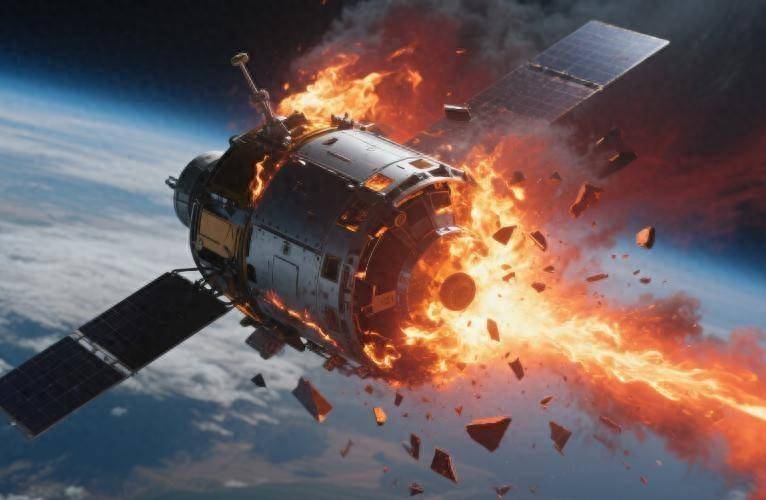
凯斯勒综合征

Search documents
美国星链的傲慢:一场不对等的太空“碰瓷”指控
Guan Cha Zhe Wang· 2025-12-23 00:51
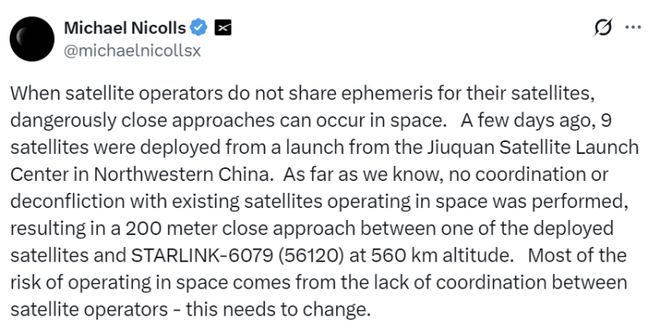
Core Viewpoint - The incident involving a close approach between SpaceX's Starlink satellites and a Chinese satellite highlights the complexities of space safety and international cooperation in the context of escalating US-China technological competition [1][2]. Group 1: Incident Details - SpaceX's Vice President Michael Nichols accused a Chinese satellite of a "dangerous close approach" to Starlink satellites, claiming a distance of only 200 meters [1]. - The close approach occurred approximately 48 hours after the Chinese satellite's launch, indicating that the responsibility for orbital management lies with the satellite operators, not the launch service provider [2]. - The claim of a 200-meter proximity lacks independent verification from space situational awareness companies, raising questions about its reliability [3][4]. Group 2: SpaceX's Historical Context - SpaceX has a history of safety issues, including a 2019 incident where a European satellite had to perform a collision avoidance maneuver due to a close approach with a Starlink satellite [7]. - In 2021, two emergency maneuvers were required by China's Tiangong space station to avoid Starlink satellites, raising concerns about SpaceX's coordination with other space operators [8]. Group 3: Orbital Congestion and Governance - The number of active satellites in orbit has surged from under 3,400 in 2019 to nearly 13,000 today, with SpaceX's Starlink constituting 72% of this total [9]. - SpaceX's planned expansion to 42,000 satellites will further congest near-Earth orbit, necessitating improved coordination among satellite operators [10]. - The lack of effective international space governance and the outdated nature of existing treaties highlight the urgent need for new regulations to manage orbital traffic [13]. Group 4: Potential Solutions and Cooperation - Establishing a technical coordination mechanism free from political interference is essential for effective space traffic management [16]. - Revising or repealing the Wolf Amendment could facilitate US-China cooperation in space safety [16]. - Recent communications between Chinese and US space agencies indicate a potential for improved collaboration, which is crucial for preventing future incidents [12].

马斯克卫星坠落潮引爆太空危机,3毫米碎片成轨道杀手!
Sou Hu Cai Jing· 2025-10-27 23:22
Group 1 - The article highlights the growing threat of space debris, with 25,000 trackable pieces and 170 million smaller particles creating a "death net" that poses risks to human space activities [1] - The "satellite crisis" is exacerbated by Elon Musk's Starlink program, which has deployed 8,600 satellites, accounting for two-thirds of all satellites in orbit, with a significant increase in the rate of satellite re-entry [3] - Solar activity has intensified the situation, increasing the density of the upper atmosphere by over 20%, leading to a drastic reduction in the operational lifespan of Starlink satellites [3] Group 2 - A recent incident involving a 2.5 kg Starlink satellite debris landing in Canada underscores the dangers of space junk, with projections indicating a 61% annual increase in the probability of satellite debris hitting people by 2035 [5] - The destructive potential of space debris is highlighted, with small fragments traveling at high speeds capable of causing significant damage to satellites and space stations [5][7] - The development of protective technologies, such as the Atomic-6 company's space armor, aims to mitigate the risks posed by space debris, showcasing advancements in materials science [7] Group 3 - Scientists warn that a mere 1% failure rate in Starlink satellites could lead to catastrophic collisions, emphasizing the need for international cooperation in space debris management [9] - Initiatives like the European Space Agency's ClearSpace-1 mission aim to remove defunct satellites from orbit, while China's space station is enhancing its debris protection capabilities [9][11] - The article stresses the importance of addressing the root causes of space debris, with NASA estimating that investing in debris protection could yield $50 billion in returns over the next 30 years [9][11]