沃尔夫修正案

Search documents
翟玉成:美国该卸下对华太空合作的包袱了
Huan Qiu Wang· 2025-12-23 23:05
Core Viewpoint - The article argues that it is time for the U.S. to lift the "Wolf Amendment," which has severely harmed U.S. space security and future collaboration with China in space exploration [1][2]. Group 1: Impact of the Wolf Amendment - The Wolf Amendment, enacted in 2011, prohibits any joint research activities between the U.S. and China related to NASA, effectively halting U.S.-China space cooperation and limiting academic exchanges [1][2]. - The amendment has led to significant restrictions, such as preventing Chinese students from obtaining visas to study in the U.S. and barring NASA researchers from responding to emails from Chinese domains [1][2]. Group 2: China's Achievements in Space - Over the past decade, China has made significant advancements in its space program, including the successful deployment of the BeiDou navigation system, the completion of the Tiangong space station, and the successful Mars missions with the Tianwen-1 and Zhurong rover [2]. - These achievements demonstrate China's growing capabilities in space and have altered the balance of power in space exploration between the U.S. and China [2]. Group 3: U.S. Domestic Reflection - There is a growing recognition among some U.S. voices that the Wolf Amendment has failed to achieve its intended goals of slowing China's space program and has instead hindered U.S. technological leadership in space [2][3]. - Former NASA Administrator Charles Bolden has pointed out that the amendment has not succeeded in its objectives, reflecting a shift in some U.S. perspectives on space cooperation with China [2]. Group 4: Need for Cooperation - The article emphasizes that both the U.S. and China, as major space powers, have mutual interests in space cooperation, including information sharing, debris mitigation, and rule-making [4]. - It advocates for the removal of barriers to cooperation, suggesting that genuine collaboration would benefit both nations and humanity as a whole [4].
美国星链的傲慢:一场不对等的太空“碰瓷”指控
Guan Cha Zhe Wang· 2025-12-23 00:51
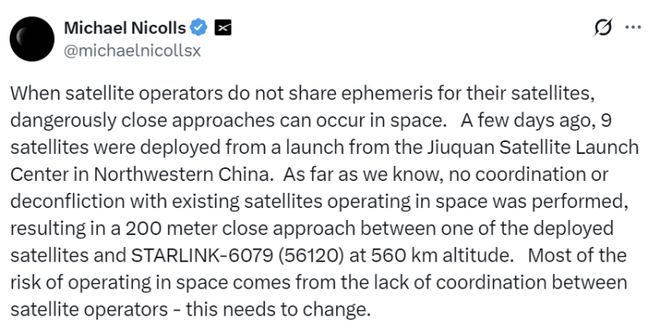
Core Viewpoint - The incident involving a close approach between SpaceX's Starlink satellites and a Chinese satellite highlights the complexities of space safety and international cooperation in the context of escalating US-China technological competition [1][2]. Group 1: Incident Details - SpaceX's Vice President Michael Nichols accused a Chinese satellite of a "dangerous close approach" to Starlink satellites, claiming a distance of only 200 meters [1]. - The close approach occurred approximately 48 hours after the Chinese satellite's launch, indicating that the responsibility for orbital management lies with the satellite operators, not the launch service provider [2]. - The claim of a 200-meter proximity lacks independent verification from space situational awareness companies, raising questions about its reliability [3][4]. Group 2: SpaceX's Historical Context - SpaceX has a history of safety issues, including a 2019 incident where a European satellite had to perform a collision avoidance maneuver due to a close approach with a Starlink satellite [7]. - In 2021, two emergency maneuvers were required by China's Tiangong space station to avoid Starlink satellites, raising concerns about SpaceX's coordination with other space operators [8]. Group 3: Orbital Congestion and Governance - The number of active satellites in orbit has surged from under 3,400 in 2019 to nearly 13,000 today, with SpaceX's Starlink constituting 72% of this total [9]. - SpaceX's planned expansion to 42,000 satellites will further congest near-Earth orbit, necessitating improved coordination among satellite operators [10]. - The lack of effective international space governance and the outdated nature of existing treaties highlight the urgent need for new regulations to manage orbital traffic [13]. Group 4: Potential Solutions and Cooperation - Establishing a technical coordination mechanism free from political interference is essential for effective space traffic management [16]. - Revising or repealing the Wolf Amendment could facilitate US-China cooperation in space safety [16]. - Recent communications between Chinese and US space agencies indicate a potential for improved collaboration, which is crucial for preventing future incidents [12].