
出生公民权

Search documents
敲打上了:“废除出生公民权”最高法院要是也否了,中国就赚爽了!
Guan Cha Zhe Wang· 2026-02-24 04:56
Core Viewpoint - The U.S. Supreme Court is set to review President Trump's executive order on birthright citizenship, which could significantly impact his immigration agenda and provoke legal challenges similar to those faced regarding tariffs [1][2][5]. Group 1: Executive Order and Legal Challenges - Trump's executive order, signed on January 20, aims to eliminate automatic citizenship for children born in the U.S. to non-citizen parents, which has sparked numerous legal challenges [1][4]. - The order threatens the rights of approximately 150,000 children born annually to non-citizen parents and around 4.4 million U.S.-born children living with undocumented immigrant parents [5]. Group 2: Supreme Court Proceedings - The Supreme Court is scheduled to hear arguments on this case in April 2026, with a ruling expected by the end of June [5][6]. - Previous court rulings have shown a mixed response, with a lower court temporarily blocking the executive order, while the Supreme Court previously ruled against nationwide injunctions by district judges [5]. Group 3: Political Implications - Trump's administration views the birthright citizenship issue as central to its hardline immigration policy, which is a hallmark of his second term [6]. - Trump has publicly criticized the Supreme Court, suggesting that unfavorable rulings could benefit countries like China and undermine U.S. interests [2][3].

【环时深度】美国移民政治如何被制度塑造和围困
Huan Qiu Shi Bao· 2026-01-20 23:21
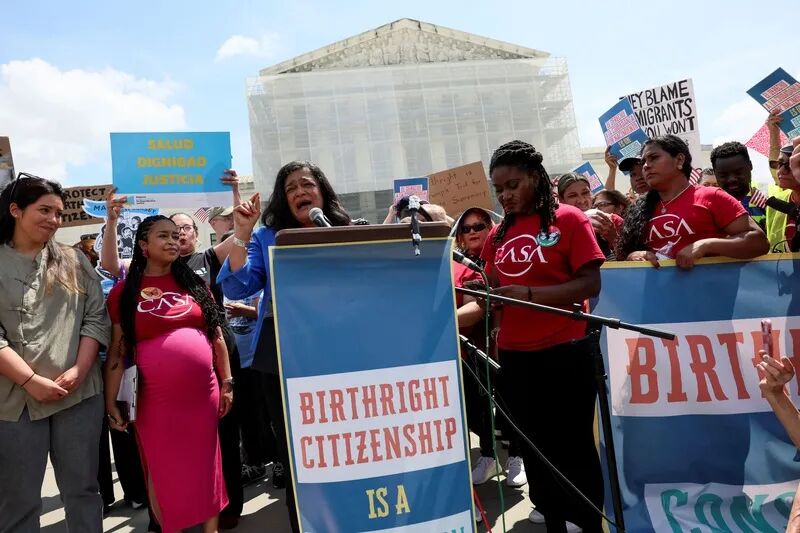
Core Viewpoint - The article discusses the significant impact of immigration policies in the United States over the past year, highlighting the political, economic, and social ramifications of these policies, particularly under the Trump administration, which has led to a net outflow of immigrants for the first time in decades and sparked widespread protests against violent enforcement actions [1]. Historical Context - The history of immigration in the U.S. dates back to 1607 with the establishment of Jamestown, which became a permanent British colony, attracting many Europeans [2]. - By the time of the American Revolutionary War, the population was predominantly white, with the first naturalization law in 1790 allowing only "free white" individuals to become citizens, reflecting early racial biases in U.S. immigration policy [2][3]. Legislative Developments - The original Naturalization Act was replaced by the Immigration and Nationality Act of 1952, which incorporated similar racial and nationalistic principles, allowing the president to restrict immigration based on national interest [3]. - Significant immigration laws, such as the Emergency Quota Act of 1921 and the Immigration Act of 1924, were enacted to maintain the U.S. as a nation of Northern and Western European descent, reflecting economic pressures and racial biases [4]. Political Dynamics - Both Republican and Democratic administrations have utilized the Immigration and Customs Enforcement (ICE) agency for immigration enforcement, with funding exceeding $170 billion over four years, indicating a bipartisan approach to immigration issues [8]. - The political landscape surrounding immigration has become increasingly polarized, with recent events, such as the shooting of a U.S. citizen by ICE agents, igniting nationwide protests and calls for the abolition of ICE [7][8]. Current Challenges - The debate over birthright citizenship has resurfaced, with a significant portion of the population opposing changes to this policy, which is rooted in the post-Civil War amendments aimed at ensuring citizenship for former slaves and their descendants [9][10]. - The complexities of immigration issues are exacerbated by the intersection of economic, social, and racial factors, leading to heightened tensions and divisions within American society [11][13]. Future Implications - The ongoing immigration debate reflects deeper questions about national identity and citizenship in the U.S., with implications for future immigration policies and societal cohesion [10][12].
美法院裁定特朗普政府“出生公民权”限制令违宪
Jing Ji Guan Cha Wang· 2025-10-03 23:07
Core Viewpoint - The U.S. Court of Appeals for the First Circuit ruled that the Trump administration's executive order limiting birthright citizenship is unconstitutional, upholding a nationwide injunction from a lower court [1] Group 1: Legal Context - The executive order, effective January 20 of this year, aimed to deny citizenship to children born in the U.S. to parents who are not U.S. citizens or green card holders [1] - The court found that this order violates the "birthright citizenship" clause of the 14th Amendment of the U.S. Constitution [1] Group 2: Implications for Immigration Policy - This ruling represents another setback for the Trump administration's hardline immigration agenda, following a similar ruling by the Ninth Circuit Court in July [1] - The Trump administration has requested the Supreme Court to review the case, which, if accepted, would bring the matter before the Supreme Court for a second time [1]
地方法院支持“出生公民权”,美政府再次向最高法院上诉请求废止
Huan Qiu Shi Bao· 2025-09-28 22:52
Core Viewpoint - The U.S. government has appealed to the Supreme Court to overturn lower court rulings regarding the "birthright citizenship" issue, aiming to eliminate the legal precedent that grants citizenship to children born in the U.S. to foreign immigrants [1][2]. Group 1: Government Actions - President Trump signed an executive order on his first day back in the White House, prohibiting automatic citizenship for children born to illegal immigrants and temporary visa holders [1]. - The Justice Department filed an appeal to the Supreme Court, arguing that lower courts granted citizenship to "hundreds of thousands" of individuals who do not meet the criteria, thereby undermining U.S. border security [1][2]. Group 2: Legal Context - Lower courts ruled that Trump's executive order violates the 14th Amendment of the U.S. Constitution, which states that all individuals born or naturalized in the U.S. are citizens [2]. - The Justice Department contends that temporary residents and illegal immigrants do not fall under the category of "subject to the jurisdiction" of the U.S., thus their children should not be granted citizenship [2]. Group 3: Implications and Analysis - The Supreme Court is expected to make a ruling by June of the following year, which could significantly impact the midterm elections and the current administration's anti-immigration agenda [2]. - Legal experts suggest that the Trump administration's arguments may not withstand scrutiny, as illegal residents are subject to arrest, prosecution, or deportation, thus technically falling under U.S. jurisdiction [2]. - The conservative majority in the Supreme Court has historically favored government policies aimed at restricting immigration, which may influence the outcome of this case [2].
美国:特朗普政府就终止“出生公民权”案再次上诉至最高法院
Sou Hu Cai Jing· 2025-09-27 09:47
Core Viewpoint - The U.S. government has appealed to the Supreme Court to review the constitutionality of President Trump's executive order aimed at terminating birthright citizenship, marking the second time this issue has been submitted to the Supreme Court this year [1]. Group 1: Background of Birthright Citizenship - The "birthright citizenship" policy has been in place in the U.S. for over 150 years, ensuring that all individuals born in the U.S. are granted citizenship regardless of their parents' status [3]. - On January 20, the first day of his presidency, Trump signed an executive order to abolish birthright citizenship, stating that newborns of non-U.S. citizens or lawful permanent residents would not automatically receive U.S. citizenship [3]. Group 2: Legal Proceedings and Court Rulings - Following Trump's executive order, several federal district courts issued stays against the order, with judges from Maryland, Washington, and Massachusetts ruling it unconstitutional and preventing its nationwide implementation [3]. - On June 27, the Supreme Court ruled in favor of the Trump administration, stating that federal district judges do not have the authority to issue nationwide injunctions to block the measure, while also instructing lower courts to refrain from reconsidering the scope of the order [5]. - However, on July 23, the Ninth Circuit Court of Appeals ruled that Trump's executive order to abolish birthright citizenship was unconstitutional, ordering a nationwide stay on the enforcement of the order, citing a violation of the Fourteenth Amendment which explicitly grants birthright citizenship [5].

美政府要求最高法院审查废除“出生公民权”行政令的合宪性
Yang Shi Xin Wen· 2025-09-27 01:28
Core Viewpoint - The U.S. government has appealed to the Supreme Court to review the constitutionality of President Trump's executive order aimed at terminating birthright citizenship, marking the second time this issue has been submitted to the Supreme Court this year [2] Group 1: Background of Birthright Citizenship - The birthright citizenship policy has been in place for over 100 years in the U.S., ensuring that all individuals born in the country are granted citizenship regardless of their parents' status [2] - On January 20, the first day of his presidency, Trump signed an executive order to abolish birthright citizenship, stating that newborns of parents who are not U.S. citizens or lawful permanent residents would not automatically receive U.S. citizenship [2] Group 2: Legal Proceedings and Court Rulings - The Supreme Court ruled on June 27 in favor of the Trump administration, stating that federal district judges do not have the authority to issue nationwide injunctions to block the implementation of the executive order [2] - Despite the Supreme Court's directive to avoid nationwide injunctions, the Ninth Circuit Court of Appeals ruled on July 23 that Trump's executive order to abolish birthright citizenship is unconstitutional, ordering a nationwide stay on the enforcement of the order [2] - The court found that the executive order violates the birthright citizenship guaranteed by the 14th Amendment of the Constitution [2]
美政府废除“出生公民权”获最高法有利判决后 美上诉法院出手叫停
news flash· 2025-07-24 00:39
Core Viewpoint - The U.S. Ninth Circuit Court of Appeals ruled that President Trump's executive order to abolish birthright citizenship is unconstitutional, temporarily halting its implementation nationwide [1] Group 1: Legal Implications - The court determined that the executive order violates the Fourteenth Amendment, which explicitly grants birthright citizenship [1] - The ruling emphasizes the need for a uniform application of citizenship laws across states to prevent legal confusion and financial losses [1] Group 2: Stakeholder Reactions - Twenty-two states, including Washington, were plaintiffs in the case, arguing that determining citizenship based on the state of birth would lead to irreversible legal chaos [1]
美法院再次阻止政府限制出生公民权
news flash· 2025-07-11 02:21
Core Viewpoint - A federal judge in New Hampshire has blocked the Trump administration's executive order aimed at limiting birthright citizenship, utilizing a legal exception that allows nationwide injunctions in class action lawsuits [1]. Group 1 - The ruling was made on July 10, 2023, and is a continuation of legal challenges against the administration's policies on citizenship [1]. - The U.S. Supreme Court had previously ruled that federal judges do not have the authority to issue nationwide injunctions against such executive orders, but this case invoked an exception [1]. - The decision reflects ongoing legal disputes regarding immigration and citizenship policies under the Trump administration [1].
突发!特朗普废除“出生公民权”命令被叫停!
证券时报· 2025-07-10 23:54
Core Viewpoint - A federal judge in New Hampshire has temporarily blocked President Trump's order to limit birthright citizenship, allowing time for the government to appeal the decision [1][2]. Group 1: Legal Proceedings - Judge Joseph Laplante issued a preliminary injunction to halt the enforcement of Trump's order for seven days [2]. - The case has been granted class action status, indicating broader implications for those affected by the order [3]. - The U.S. Supreme Court previously ruled that federal district judges do not have the authority to issue nationwide injunctions against such measures, suggesting that the nationwide ban may exceed the powers granted to federal district courts [3]. Group 2: Policy Background - The birthright citizenship policy has been in place for over 100 years, ensuring that all individuals born in the U.S. are granted citizenship regardless of their parents' status [4]. - Trump's executive order, signed on his first day in office, aimed to revoke birthright citizenship for children of non-citizen or non-permanent resident parents, leading to multiple legal challenges [4].
美国联邦地区法官再次阻止特朗普政府限制“出生公民权”
news flash· 2025-07-10 19:05
Group 1 - A federal judge in Concord, New Hampshire, Joseph Laplante, has issued a ruling to block the Trump administration's executive order aimed at limiting "birthright citizenship" [1] - The ruling utilizes an exception from a previous Supreme Court decision, allowing judges to continue blocking the administration's policies in nationwide class-action lawsuits [1] - The judge expressed concerns that revoking birthright citizenship would cause irreparable harm to affected individuals [1] Group 2 - The "birthright citizenship" policy has been in place for over 100 years, ensuring that all individuals born in the U.S. are granted citizenship regardless of their parents' status [2] - The executive order signed by Trump on January 20 aims to eliminate automatic citizenship for newborns of non-citizen or non-permanent resident parents, leading to multiple legal challenges [2] - Federal district courts in states like Maryland, Washington, and Massachusetts have issued nationwide injunctions against the executive order, prompting the Trump administration to seek a Supreme Court ruling on the matter [2]