创新药械产业发展

Search documents
研判2025!中国创新药械行业政策、产业链、获批上市数量、市场规模及市场支付结构分析:批准上市数量创历史新高,市场持续扩容,商业险赔付占比小[图]
Chan Ye Xin Xi Wang· 2026-01-14 01:20
Core Insights - The innovative pharmaceutical and medical device market is a crucial part of China's healthcare industry, experiencing rapid growth despite its late development compared to developed economies [1][6] - By 2025, the number of approved innovative drugs reached 69, and innovative medical devices reached 73, marking a historical high in approvals [1][7] - The market size for innovative drugs and devices is projected to grow from 162 billion yuan in 2025 to 440 billion yuan by 2035, driven by demographic changes, clinical needs, and favorable policies [1][7] Group 1: Market Overview - The innovative drug and device market in China is expected to see significant growth, with projections of 2,186 billion yuan in 2026 and 4,102 billion yuan by 2030 [1][7] - The number of innovative drugs approved for market entry in 2024 is 48, while 65 innovative medical devices are expected to be approved [1][6] - The market is characterized by a high number of new drug approvals, with China ranking second globally in the number of drugs under development [1][6] Group 2: Payment Structure - In 2024, personal cash expenditure on innovative drugs and devices is estimated at 786 billion yuan, accounting for 49% of total spending, while insurance funds contribute approximately 710 billion yuan (44%) [7] - By 2035, it is anticipated that personal cash expenditure will decrease to 20%, while insurance fund contributions will rise to 36% [7] Group 3: Industry Chain - The innovative drug and device industry chain includes upstream components such as raw materials and research services, midstream research and manufacturing, and downstream distribution and application [8][9] - The government has been enhancing the policy framework to support the entire chain from research to application, facilitating faster approvals and market entry [9] Group 4: Future Outlook - The innovative drug and device industry in China is poised for opportunities due to ongoing national strategic support, the integration of new technologies like AI, and improved payment environments [11] - Challenges include insufficient global clinical capabilities and geopolitical factors affecting international expansion [11]


第十一批药品集采报量启动,强调“反内卷”!A股最大医疗ETF放量冲高2%!机构:今年行情或呈“先药后医”
Xin Lang Ji Jin· 2025-08-07 02:24
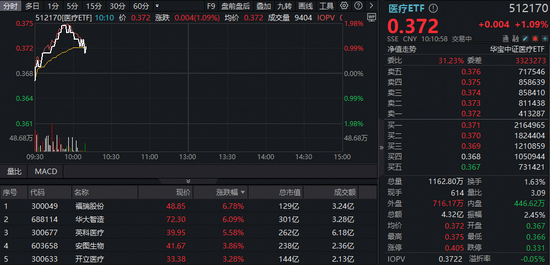
Core Viewpoint - The medical sector in A-shares is experiencing a resurgence, with the largest medical ETF (512170) rising by 2% in early trading on August 7, 2023, and quickly surpassing a transaction volume of 400 million yuan [1]. Group 1: Market Performance - The medical device sector is leading the gains, with stocks like Furuide (福瑞股份) rising nearly 8%, and Huada Zhizao (华大智造) and Yingke Medical (英科医疗) increasing over 6% [1]. - The CXO sector is underperforming, with WuXi AppTec (药明康德) and Zhaoyan New Drug (昭衍新药) both declining by over 1% [1]. Group 2: Industry Trends - The 11th batch of national drug procurement has officially started, involving 55 products that are all mature and competitive, with an emphasis on optimizing procurement rules and adhering to the principle of "anti-involution" [1]. - Citic Securities reports that recent high-level discussions have emphasized principles such as "anti-involution" and "procurement optimization not solely based on low prices," signaling a turning point for the innovative drug and medical device industry [3]. - Citic Jin Investment highlights that increasing international business opportunities in the medical device sector are expected to drive high growth for several companies by 2025, leading to a potential revaluation of these companies [3]. Group 3: Investment Opportunities - Some fund managers believe that the market trend this year may favor medical devices after pharmaceuticals, suggesting that the previously underperforming medical device sector may see a rebound [3]. - The largest medical ETF (512170) is recommended for capturing upward opportunities in the medical device and CXO sectors, focusing on "medical devices + medical services" and being highly correlated with AI medical applications [3].