
制度治党

Search documents
广东省委:坚决拥护党中央决定
券商中国· 2026-03-27 15:34
Group 1 - The article reports that Guo Yonghang, a member of the Guangdong Provincial Political Consultative Conference, is under investigation for serious violations of discipline and law, highlighting the central government's commitment to strict party governance and anti-corruption efforts [1][2] - The Guangdong Provincial Committee emphasizes the need for all party organizations and members to deeply study and implement Xi Jinping's important thoughts on party construction and self-revolution, aiming to maintain a clean political environment [2] - The meeting calls for a focus on political discipline and rules, ensuring that party members respond to and execute central decisions while avoiding prohibited actions, thereby demonstrating loyalty to the party [2] Group 2 - The article stresses the importance of integrating Xi Jinping's thoughts into practical actions, reinforcing ideological foundations, and ensuring that party innovation theories translate into strong guiding forces for practice and work [2] - It highlights the necessity of promoting a correct view of political achievements, emphasizing public service, scientific decision-making, and practical efforts to create results that withstand the test of practice, the people, and history [2] - The article calls for a comprehensive approach to party discipline, linking anti-corruption efforts with the promotion of good party conduct, and emphasizes the need for institutional governance and supervision of power [2]

制度治权、依规用权
Xin Lang Cai Jing· 2026-01-16 18:01
Core Viewpoint - The central theme emphasizes the importance of institutional reform within the Party to effectively manage power and prevent corruption, as highlighted by Xi Jinping's remarks on the necessity of putting power into a "cage of systems" [1][4]. Group 1: Institutional Development - Strengthening the theoretical research and macro design of internal regulations is crucial to avoid the "cow pen catching cats" phenomenon, ensuring that regulations are practical and effective in the context of strict governance [2]. - Since the 18th National Congress, the Party has focused on establishing a comprehensive and effective regulatory system, with Xi Jinping announcing the formation of a relatively complete internal regulatory framework by 2021 [2]. Group 2: Execution of Regulations - The effectiveness of regulations lies in their execution; the "paper cage prohibiting tigers" refers to regulations that appear complete but lack enforcement, leading to a breakdown in compliance [3]. - Xi Jinping stresses that while formulating regulations is important, the emphasis must be on their implementation, as neglecting enforcement can lead to a "broken window effect" [3]. Group 3: Accountability and Transparency - The need for equal treatment under regulations is highlighted, with a call to eliminate "dark doors" and "skylights," ensuring that rules are clear and strictly enforced to prevent selective or symbolic compliance [4]. - The recent Central Commission for Discipline Inspection meeting underscored the need to enhance the regulatory framework to meet the higher demands of the 14th Five-Year Plan, reinforcing the importance of institutional governance and transparent power usage [4].
学习手记|制度治权、依规用权
Xin Hua She· 2026-01-16 13:03
Core Viewpoint - The article emphasizes the importance of institutional governance and the need to confine power within a regulatory framework as a crucial task for the comprehensive and strict governance of the Party in the new era [3]. Group 1: Institutional Governance - The concept of "putting power in a cage of regulations" is highlighted as a significant task for the Party's self-revolution, aiming to minimize the space for power rent-seeking [3]. - Strengthening the construction of internal Party regulations is viewed as a long-term and fundamental strategy for strict governance [3][4]. - The article references Xi Jinping's metaphor of "putting the cat in the cow pen" to illustrate the urgency of effective institutional construction and execution [3][4]. Group 2: Implementation of Regulations - The vitality of regulations lies in their execution, with the article warning against the phenomenon of "paper cages" where regulations appear complete but lack enforcement [6]. - It stresses the necessity of strict implementation of established regulations to avoid the "broken window effect," where minor infractions lead to larger issues [6]. - The article calls for a commitment to transform hard requirements into concrete measures, ensuring that regulations are enforced equally without exceptions [7]. Group 3: Future Goals and Challenges - The Central Commission for Discipline Inspection's report emphasizes the need to understand the higher demands for confining power within a regulatory framework to achieve the goals set for the 14th Five-Year Plan [7]. - There is a call for continuous improvement of institutional regulations to ensure they are effective and not overly complex, alongside enhancing the enforcement of these regulations [7].
学习手记丨制度治权、依规用权
Xin Hua She· 2026-01-16 12:29
Core Viewpoint - The emphasis on strengthening the internal regulations and institutional framework of the Party is crucial for effective governance and to prevent power abuse, as highlighted by Xi Jinping during the recent Central Commission for Discipline Inspection meeting [1][2]. Group 1: Institutional Framework - The concept of "putting power in a cage" is a key task for the comprehensive strict governance of the Party, aiming to minimize opportunities for power rent-seeking [1]. - Since the 18th National Congress, there has been a clear focus on integrating institutional construction into the overall requirements for Party building, emphasizing the importance of regulating power operations and enhancing institutional supply [1][2]. - The Central Eight Regulations, as the first significant internal regulation post-18th National Congress, have led to substantial changes in Party and public conduct [2]. Group 2: Implementation and Enforcement - The effectiveness of regulations is contingent upon their execution; merely having regulations without strict enforcement leads to a "broken window effect," where minor infractions can escalate into larger issues [3]. - Xi Jinping stresses that the focus should be on implementing regulations effectively, ensuring that they are not merely symbolic but are actively enforced in practice [3][4]. - The recent Central Commission for Discipline Inspection meeting underscored the need for a robust system that unifies authority and accountability, ensuring transparency and traceability in the use of power [3].
学习新语丨把权力关进制度的笼子
Xin Hua She· 2026-01-15 13:16
Core Viewpoint - The emphasis on putting power into the "cage of the system" is a crucial task for the comprehensive and strict governance of the Party in the new era, as highlighted by General Secretary Xi Jinping in his speeches [1][3][4]. Group 1: Institutional Framework - Continuous improvement of institutional regulations is necessary to ensure they are effective and not overly complex, while also enhancing the enforcement of these regulations to strengthen constraints [3][4]. - The goal is to effectively avoid situations where regulations are not enforced properly, thereby minimizing opportunities for power rent-seeking [4]. Group 2: Discipline and Accountability - Party discipline serves as a protective barrier for the correct exercise of power, and adherence to discipline can help resist corruption [7]. - There is a need for comprehensive coverage in managing the Party, focusing on key individuals, especially senior leaders, to ensure no exceptions or blind spots in governance [8][9]. Group 3: Leadership and Governance - All levels of leadership must lead by example in adhering to Party discipline and laws, actively opposing privilege and maintaining integrity in personal and professional conduct [10]. - A robust mechanism for power operation must be established, ensuring scientific decision-making, decisive execution, and effective supervision to promote just, lawful, and clean use of power [12]. Group 4: Long-term Mechanisms - The combination of immediate reforms and long-term establishment of mechanisms is essential for managing power, affairs, and personnel through institutional means [15]. - Strengthening constraints and supervision over power operations is vital to ensure transparency and accountability, thereby keeping power within the confines of the system [15][21].

深刻把握目标任务 坚决落实全会部署读懂二十届中央纪委五次全会公报中的新论断新部署
Zhong Yang Ji Wei Guo Jia Jian Wei Wang Zhan· 2026-01-15 00:04
Core Points - The Fifth Plenary Session of the 20th Central Commission for Discipline Inspection of the Communist Party of China was held from January 12 to 14, 2026, focusing on the implementation of Xi Jinping's thoughts and the strategic deployment for the upcoming "15th Five-Year Plan" [1][2] - The session emphasized the significant achievements in strict party governance over the past year and outlined tasks for 2026, reinforcing the importance of political supervision and anti-corruption efforts [2][3] Group 1: Political Supervision and Governance - The session highlighted the necessity of effective political supervision to ensure the implementation of major decisions made by the Central Committee, with a focus on specific, precise, and regular oversight [3][4] - The Central Commission reported that over 250,000 violations of the Central Eight Regulations were addressed in 2025, with more than 320,000 individuals receiving criticism or disciplinary action [5][6] Group 2: Anti-Corruption Efforts - The anti-corruption campaign has seen significant results, with 65 senior officials investigated in 2025 and nearly 790,000 cases opened by disciplinary inspection agencies [5][6] - The "Sky Net 2025" operation successfully repatriated 782 fugitives and recovered 23.657 billion yuan in illicit funds [5][6] Group 3: Institutional Reforms and Regulations - The session underscored the importance of institutional governance, emphasizing the need to confine power within a regulatory framework to enhance party discipline and governance [9][10] - Continuous improvement of internal regulations and strict enforcement are deemed essential for maintaining the party's integrity and effectiveness [9][10] Group 4: Future Directions and Responsibilities - The session called for a unified approach among party members to align with the Central Committee's strategic goals, particularly in the context of the "15th Five-Year Plan" [7][8] - Emphasis was placed on the need for party members to enhance their sense of mission and responsibility, ensuring that actions align with the party's objectives [7][8]
学习新语|把权力关进制度的笼子
Xin Hua She· 2026-01-14 14:31
Core Viewpoint - The emphasis on putting power into the "cage of the system" is a crucial task for the comprehensive and strict governance of the Party in the new era, as highlighted by General Secretary Xi Jinping in his speeches [1][3][4]. Group 1: Institutional Framework - Continuous improvement of institutional regulations is necessary to ensure they are effective and not overly complex, while also enhancing the enforcement of these regulations to strengthen constraints [3][4]. - The goal is to effectively avoid situations where regulations are not enforced properly, thereby minimizing opportunities for power rent-seeking [4]. Group 2: Discipline and Accountability - Party discipline serves as a protective barrier for the correct exercise of power, and adherence to discipline can help resist corruption [7]. - There is a need for comprehensive coverage in managing the Party, focusing on the "key minority" and ensuring that no special treatment is given to any member [8][9]. Group 3: Leadership and Governance - All levels of leadership must lead by example in adhering to Party discipline and laws, actively opposing privilege and maintaining integrity in personal and professional conduct [10]. - A mechanism must be established to ensure that power operates within the correct framework, emphasizing democratic centralism and creating a robust system for decision-making, execution, and supervision [12]. Group 4: Long-term Mechanisms - The combination of immediate reforms and long-term establishment of mechanisms is essential for managing power, affairs, and personnel through institutional means [15]. - Strengthening the constraints and supervision of power is vital, ensuring that power operates transparently and is subject to public oversight [15][21].

织密扎牢管党治党制度笼子
Zhong Yang Ji Wei Guo Jia Jian Wei Wang Zhan· 2026-01-13 23:46
Core Points - The article emphasizes the importance of institutional governance within the Communist Party of China, highlighting the need to put power into a "system cage" as a key task for strict governance of the Party in the new era [3][4][5] - It discusses the continuous innovation and improvement of the Party's internal regulations and systems under the guidance of Xi Jinping's thoughts, aiming to enhance the Party's leadership and organizational structure [4][5][6] - The article outlines various new regulations and amendments aimed at strengthening the Party's internal governance, including the introduction of the first comprehensive regulation on ideological and political work [6][7][8] Group 1: Institutional Governance - The article states that the Party's self-revolution focuses on institutional governance, which is a distinctive feature of the Party's management and governance [3][4] - It mentions the implementation of the Central Eight Regulations as a starting point for improving Party conduct and governance [3][4] - The article highlights the necessity of integrating legal governance and regulatory governance to create a complementary system [5][6] Group 2: Regulatory Innovations - The article details the issuance of new regulations, such as the "Regulations on the Responsibility System for Ecological Environment Protection" to enhance ecological governance [5][6] - It notes the revision of the "Regulations on Saving and Opposing Waste in Party and Government Agencies" to tighten financial management and resource usage [5][6] - The introduction of the "Regulations on the Discussion and Decision-Making Procedures for Party Member Disciplinary Actions" aims to standardize disciplinary processes within the Party [6][7] Group 3: Strengthening Execution and Supervision - The article emphasizes the need for strict enforcement of regulations and the importance of supervision in ensuring compliance with Party rules [11][12] - It discusses the role of disciplinary inspection agencies in monitoring the implementation of regulations and addressing violations [11][12] - The article highlights the importance of education and training for Party members to enhance their understanding and adherence to regulations [15][19]
更加科学有效地把权力关进制度笼子
Xin Lang Cai Jing· 2026-01-13 21:58
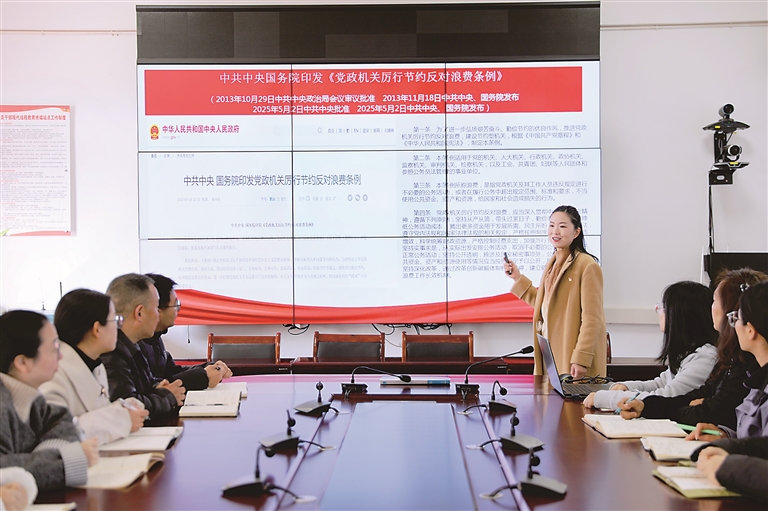
Group 1 - The core viewpoint emphasizes the importance of institutionalizing power to ensure strict governance within the Communist Party of China, as highlighted by Xi Jinping during the fifth plenary session of the 20th Central Commission for Discipline Inspection [1] - The construction of regulations and systems has been prioritized since the 18th National Congress, leading to unprecedented achievements in institutional development [1] - The need for effective enforcement of regulations is stressed, with a focus on making systems both comprehensive and practical, while ensuring equal adherence to rules without exceptions [1][4] Group 2 - The implementation of the Central Eight Regulations has effectively addressed issues of corruption and misconduct, marking a significant shift in party discipline and governance [2] - New regulations aimed at curbing extravagance and waste in party and government agencies are set to be enforced by 2025, promoting a culture of frugality [3] - The importance of leadership accountability in executing regulations is underscored, with a call for leaders to set an example and enhance transparency in governance [4]
人民日报评论员:更加科学有效地把权力关进制度笼子
Xin Hua She· 2026-01-13 16:41
Core Viewpoint - The article emphasizes the importance of institutionalizing power to ensure effective governance and discipline within the Communist Party of China, as highlighted by Xi Jinping's speech at the Fifth Plenary Session of the 20th Central Commission for Discipline Inspection [1]. Group 1: Institutional Framework - The establishment and revision of regulations have been unprecedented since the 18th National Congress, showcasing the Party's commitment to strengthening institutional frameworks [1]. - The focus is on making regulations more specific and actionable to enhance their effectiveness and ensure strict enforcement [1]. Group 2: Addressing Corruption and Misconduct - The implementation of the Central Eight Regulations has successfully addressed long-standing issues of corruption and misconduct, demonstrating the effectiveness of strict regulations [3]. - New regulations, such as the revised "Regulations on Strict Economy and Opposition to Waste in Party and Government Organs," aim to combat extravagance and promote a culture of frugality [4]. Group 3: Leadership and Execution - The success of institutional enforcement relies heavily on the commitment of leadership, particularly the "first person in charge," to model compliance and transparency [5]. - There is a call for increased awareness among party members regarding the importance of regulations as both a constraint and a protective measure [5]. Group 4: Broader Implications - The article suggests that other countries can learn from the Chinese Communist Party's experience in enhancing political discipline and governance through improved institutional frameworks [4]. - The commitment to institutional governance is seen as essential for achieving the goals of Chinese-style modernization [6].