副业刚需

Search documents
2025年,很多人说进入到了缺钱时代,这5个信号已经开始显现,早了解
Sou Hu Cai Jing· 2025-10-05 07:54
Core Insights - A pervasive sense of "money tightness" is emerging across various sectors of society, indicating a potential entry into an era characterized as the "money shortage era" by 2025 [1] Group 1: Consumption Trends - The consumption market is exhibiting a pronounced "K-shaped" structure, with one end seeing growth in budget-friendly options and the other maintaining stability in luxury goods and high-end experiences [3][5] - The middle tier of consumption, including affordable luxury brands and mid-range dining, is rapidly collapsing as consumers prioritize either essential goods or premium experiences [5] Group 2: Savings Behavior - A shift towards "defensive finance" is evident, with rising household savings rates despite lower interest rates, driven by uncertainty about future income [7] - The trend of "revenge spending" has transitioned to "revenge saving," reflecting a collective mindset focused on building financial security [7] Group 3: Cash Flow and Financial Security - Many individuals are becoming "invisible poor," where fixed expenses consume most of their income, leaving little for discretionary spending [8] - The importance of cash flow is heightened, with individuals becoming more cautious about non-essential expenditures due to the risk of unexpected financial burdens [8] Group 4: Asset Valuation and Investment - Traditional wealth creation avenues, such as real estate and stock markets, are losing effectiveness, with the real estate market facing long-term adjustments and liquidity issues [9][11] - The volatility in capital markets is making it increasingly difficult for ordinary individuals to achieve rapid wealth growth through investments, leading to a more conservative investment approach [11] Group 5: Employment and Income Diversification - The perception that having a single income source is risky is becoming widespread, prompting many to seek additional income streams through side jobs or freelance work [12] - The need for a "second income curve" is now a necessity for many, as job security diminishes across various sectors [12] Conclusion - The onset of the "money shortage era" is a result of global economic cycles, domestic structural adjustments, and individual financial choices, signaling a departure from previous wealth accumulation strategies [15] - Companies and individuals are encouraged to adapt by reshaping consumption habits, building financial cushions, managing debt prudently, and investing in personal skills to enhance competitiveness [13][14][15]


花45元假装上班,当代年轻人的“体面生存”实录
3 6 Ke· 2025-05-20 11:39
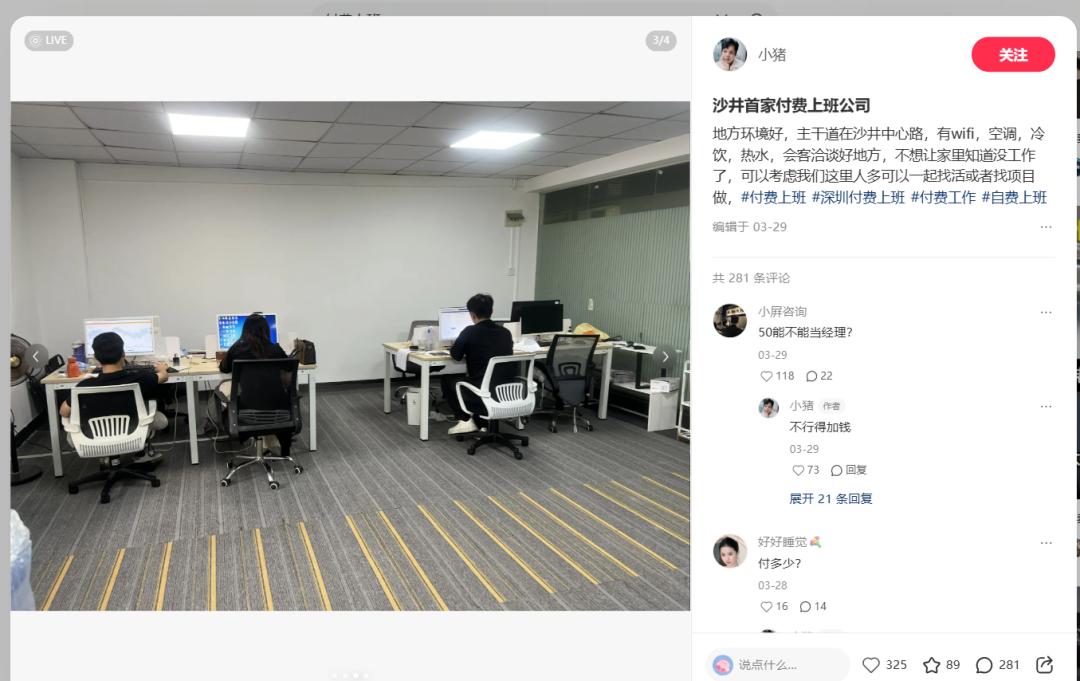
Core Insights - The phenomenon of "paid office" services reflects the deep-seated anxiety and structural changes in consumption behavior among contemporary youth during a period of social transformation [2][10][12] - The "paid office" market has evolved from a psychological comfort to a scalable consumer demand, indicating a shift in how young people cope with unemployment and identity crises [9][13][20] Group 1: Paid Office Services - The concept of "paid office" allows individuals to maintain a semblance of normalcy and social identity while unemployed, with costs ranging from 40 to 1000 yuan depending on the service duration [1][5][8] - The service has gained traction on platforms like Xiaohongshu and Xianyu, with users sharing experiences and referring to it as a "utopia for the unemployed" [5][8][18] - The pricing structure varies significantly between first-tier and second-tier cities, reflecting economic disparities and employment pressures [8][9] Group 2: Youth Anxiety and Consumption Behavior - Young people's anxiety has transformed from singular job-related concerns to a broader existential crisis, with many feeling pressured to maintain a facade of employment [10][12] - The average starting salary for 2025 graduates is reported at 2800 yuan, with a significant gap between expectations and reality, leading to heightened anxiety [10][12] - The rise of "emotional consumption" indicates a willingness to spend on services that provide psychological comfort, as seen in the increasing popularity of "healing economy" services [14][16][20] Group 3: Social Dynamics and Market Trends - The emergence of "paid office" services has led to new social dynamics, with online platforms becoming spaces for mutual support among the unemployed [18][20] - The trend of flexible employment and side jobs is on the rise, with participation rates in side jobs reaching 43.7% in early 2025 [20] - The market for career training and self-improvement courses has expanded, driven by the anxiety of young individuals seeking to enhance their employability [20]