消费K型分化

Search documents
证券市场周刊-第3期2026
2026-01-26 15:54
Summary of Key Points from the Conference Call Industry Overview - The conference call primarily discusses the **Chinese consumption market** and its dynamics as it approaches the 2026 Spring Festival, highlighting the potential for growth driven by economic recovery and policy incentives [3][10][12]. Core Insights and Arguments 1. **Economic Recovery and Consumer Confidence**: The Chinese economy is gradually recovering, with consumer data showing steady improvement. This is expected to create a favorable environment for the consumption sector, particularly during the upcoming Spring Festival [3][10][12]. 2. **Policy Incentives**: The implementation of consumption-boosting policies, such as the 2026 national subsidy for replacing old products, is anticipated to inject strong momentum into the consumption market [3][10][12]. 3. **K-shaped Consumption Recovery**: The consumption market is exhibiting a K-shaped recovery, characterized by robust demand for high-end products and a thriving low-cost segment. This reflects a significant shift in consumer preferences and spending behavior [3][10][12][67]. 4. **Diverse Consumption Scenarios**: The rise of new consumption scenarios, such as AI-driven retail and the silver economy, is expanding growth opportunities within the market. Traditional sectors like food and beverage, jewelry, and home appliances are also expected to benefit from this trend [3][10][12][64][67]. 5. **Emerging Brands and Market Dynamics**: Brands like **MIXUE Ice Cream** are gaining popularity due to their competitive pricing strategies, while high-end brands continue to see strong sales growth, indicating a bifurcation in consumer spending [3][10][12][64][67]. 6. **Luxury Market Resilience**: Luxury retail spaces, such as Beijing SKP, are experiencing growth despite overall market slowdowns, suggesting a sustained interest in high-end products [3][10][12][65][67]. 7. **Investment Opportunities**: Analysts emphasize the importance of identifying investment opportunities within the consumption sector, particularly in companies that demonstrate strong fundamentals and adaptability to changing consumer preferences [3][10][12][67][73][75]. Additional Important Content - **Consumer Behavior Changes**: There is a notable shift in consumer behavior, with a growing preference for high-quality, high-value products alongside budget-friendly options. This dual demand is reshaping the market landscape [3][10][12][67]. - **Market Performance Metrics**: The report highlights that the sales growth of luxury goods and budget-friendly products is outpacing traditional retail, indicating a significant transformation in consumer purchasing patterns [3][10][12][67]. - **Long-term Trends**: The discussion also touches on the long-term trends in the consumption market, suggesting that companies must innovate and adapt to remain competitive in a rapidly evolving landscape [3][10][12][75]. This summary encapsulates the key insights and arguments presented in the conference call, focusing on the dynamics of the Chinese consumption market and the implications for investment strategies.
宏观深度报告:“该省省、该花花”——中国消费的“K型分化”
Sou Hu Cai Jing· 2026-01-12 02:42
Core Insights - The report highlights a significant "K-shaped differentiation" in China's consumption market, driven by changes in income structure and demographic shifts, leading to a polarization between high-end quality consumption and high-cost performance consumption [1][5][12]. Group 1: Manifestations of Consumption "K-shaped Differentiation" - From the consumer perspective, "K-shaped differentiation" is evident in the choice of consumption scenarios, product selection, and service consumption. Traditional malls are losing appeal, while high-end luxury malls and low-cost platforms like Pinduoduo are gaining traction [1][14][17]. - Sales at Beijing SKP reached a record 26.5 billion yuan in 2023, with an annual compound growth rate of approximately 7.5% from 2019 to 2024, contrasting with negative growth in overall retail sales in Beijing [14][15]. - Pinduoduo has emerged as a significant player in the low-cost consumption scene, leveraging a subsidy model to offer high cost-performance products, appealing to consumers' desire for value during uncertain economic times [17][21]. - In terms of product choices, brands like Labubu are gaining popularity for their emotional value, while brands like Mixue Ice City are preferred for their cost-effectiveness [17][19]. - Service consumption shows a clear "K-shaped differentiation," with some consumers opting for luxury customized travel experiences, while others prefer budget-friendly travel options that maximize value [18][19]. Group 2: Reasons for Consumption "K-shaped Differentiation" - The demand side is influenced by generational changes, with Generation Z and younger seniors becoming the main consumer groups, shifting their focus from practicality to emotional value and cost-effectiveness [2][24][25]. - The macro policy shift towards "investing in people" has encouraged consumers to prioritize emotional value in their purchasing decisions, moving away from a sole focus on practical utility [28][29]. - On the supply side, increased competition in a saturated market has led retailers to adopt dual-track strategies, offering both high-end and low-cost products to meet diverse consumer needs [30][31]. Group 3: Theoretical Implications of Consumption "K-shaped Differentiation" - The "K-shaped differentiation" represents a fundamental shift in traditional consumption theory, where the focus has moved from a utilitarian perspective to a dual-value approach that emphasizes both emotional and practical value [2][32][36]. - The utility function in the "K-shaped differentiation" model suggests that consumers are willing to pay higher prices for products that provide significant emotional value, while also accepting lower emotional value if the practical utility and price are favorable [33][34]. - Retailers' supply curves have shifted from a traditional upward slope to a "U-shaped" curve, indicating that both high-end luxury and low-cost products are more profitable, while mid-range products face challenges due to price competition [34][35].


东吴证券晨会纪要2026-01-12-20260112
Soochow Securities· 2026-01-12 02:40
Macro Strategy - The report discusses the "K-shaped differentiation" in China's consumption market, highlighting the split between high-end quality consumption and high cost-performance consumption driven by changes in income structure and demographic shifts [6][8] - Consumers are increasingly valuing emotional and spiritual needs alongside practical value, leading to a shift in consumption behavior towards both high-value luxury and highly affordable options [6][8] Fixed Income - The report analyzes the current state of urban investment bonds in Fujian Province, indicating a high-pressure regulatory environment to maintain debt reduction achievements, with a continued "asset shortage" expected [2][12] - Fujian's economic performance is strong, with a GDP of 57,761 billion RMB in 2024 and a growth rate of 5.50%, ranking above the national average [12] - The province's local government debt is increasing, with a wide-ranging debt ratio of 40.35% and a total debt of 2,285.13 billion RMB, indicating a need for careful management of refinancing and liquidity [12][11] Industry Analysis - Gujing Gongjiu is positioned as a leading brand in the liquor industry, with a focus on maintaining stability during market adjustments and leveraging its strong brand and distribution channels to recover sales [4][13] - The company is expected to see a recovery in sales as consumer demand stabilizes, with projected revenues of 187.05 billion RMB in 2025, reflecting a decline of 20.7% year-on-year, but a positive growth forecast of 10.3% by 2027 [4][13] - Gujing Gongjiu's strategy emphasizes national expansion and a focus on mid-to-high-end products, with a strong competitive position in both local and regional markets [4][13] Company Specifics - Botai Che Lian is recognized as a leading provider of smart cockpit solutions, with a significant market presence and partnerships with major companies like Qualcomm and Huawei, enhancing its competitive edge [5] - The company anticipates rapid revenue growth driven by high-end domain control product orders, projecting revenues of 34.58 billion RMB in 2025, increasing to 78.39 billion RMB by 2027 [5] - Botai's strategic focus on integrating software, hardware, and cloud services positions it well within the rapidly growing smart cockpit market, with a projected market size of 1,290 billion RMB in 2024 [5]
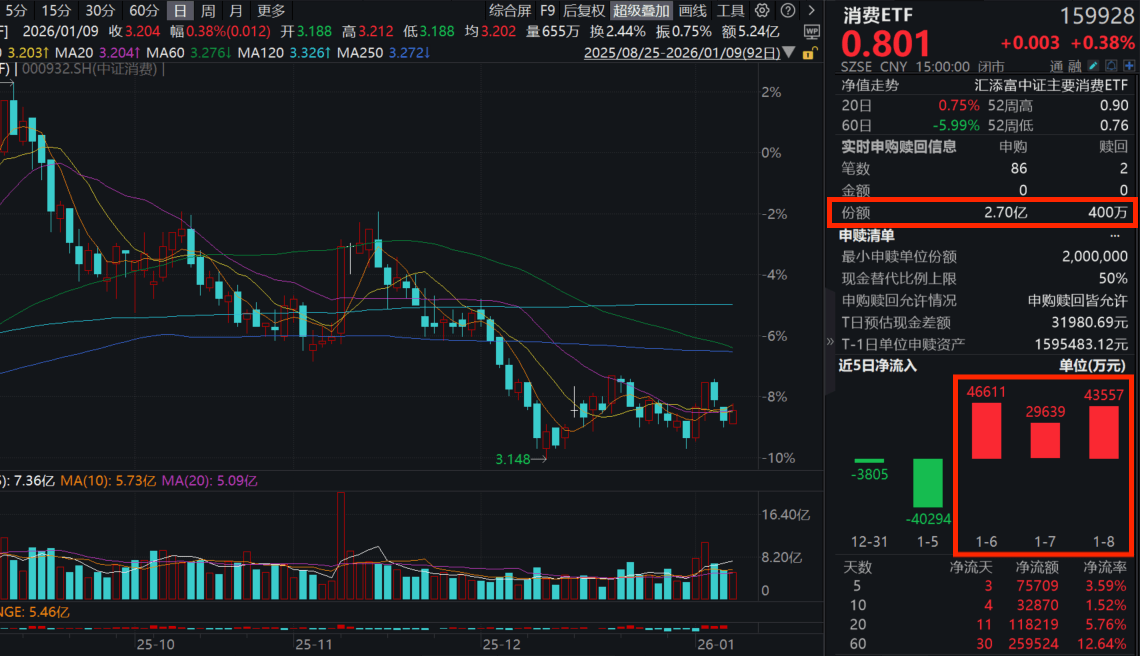
12月CPI环比由降转涨,核心CPI上涨1.2%!消费ETF(159928)再度飘红,连续第4日大举净流入超2.1亿元,累计揽金超14亿元!
Xin Lang Cai Jing· 2026-01-09 09:49
Core Viewpoint - The Chinese stock market shows positive momentum with the Shanghai Composite Index rising by 0.92% and surpassing the 4100-point mark, driven by favorable CPI data and significant inflows into consumer ETFs [1][3]. Economic Indicators - The National Bureau of Statistics reported that the Consumer Price Index (CPI) increased by 0.8% year-on-year in December, with a month-on-month rise of 0.2%. The core CPI, excluding food and energy, rose by 1.2% year-on-year [3][7]. - The Producer Price Index (PPI) saw a month-on-month increase of 0.2% but a year-on-year decline of 1.9%, indicating a mixed outlook for industrial pricing [3][6]. Market Performance - The Consumer ETF (159928) experienced a net inflow of 2.66 million units, accumulating over 14 billion yuan in total, with its latest scale exceeding 218 billion yuan, leading its peers in the same category [1][3]. - The valuation of the Consumer ETF's underlying index stands at a TTM P/E ratio of 19.29, which is in the 2.76% percentile over the past decade, indicating a favorable valuation compared to historical levels [3]. Sector Insights - The Hong Kong Stock Connect Consumer 50 ETF (159268) also saw a rise of 0.22%, with significant trading volume, highlighting investor interest in consumer stocks [5]. - The consumer sector is characterized by a "K-shaped" consumption pattern, where high-end and high-value products are favored by some consumers, while others seek high utility and low-cost options [10][11]. Investment Opportunities - The consumer ETF's underlying index is noted for its resilience across economic cycles, with top holdings including leading liquor brands and major agricultural companies, indicating strong fundamentals in the consumer sector [11].
中国消费的“K型分化”:“该省省、该花花”
Soochow Securities· 2026-01-08 12:55
Group 1: Key Insights on "K-Shaped Consumption" - China's consumption market is experiencing a "K-shaped differentiation," characterized by high-end quality consumption on one end and high cost-performance consumption on the other[1] - The shift in consumer behavior reflects a growing emphasis on emotional value alongside practical value, moving away from a purely utilitarian perspective[1] - High-end luxury consumption is seeing significant growth, with Beijing SKP achieving a record revenue of 26.5 billion yuan in 2023, reflecting a compound annual growth rate of approximately 7.5%[13] Group 2: Factors Driving "K-Shaped Differentiation" - The change in consumer ideology is driven by generational shifts and macro policies that increasingly focus on "investing in people" rather than just material goods[3] - The Z generation and younger elderly populations are becoming the main consumer force, prioritizing emotional satisfaction over mere functionality in their purchasing decisions[23] - Retailers are adapting to this differentiation by offering both high-end and low-cost products, as seen with brands like Xiaomi and BYD, which cater to both ends of the market[21] Group 3: Implications and Risks - The "K-shaped differentiation" is reshaping the underlying logic of China's consumption market, influencing regional economic growth and industrial structure adjustments[11] - Risks include potential delays in supportive policies for new consumption, exacerbated impacts from real estate adjustments, and slowing growth in household income affecting overall consumption[36]
第一创业晨会纪要-20251126
First Capital Securities· 2025-11-26 02:43
Macro Economic Group - The report indicates that the US PPI remained stable in September, with a month-on-month increase of 0.3%, matching expectations, while the core PPI rose by 0.1%, slightly below the expected 0.2% [5] - Retail sales in the US showed a disappointing performance in September, with a month-on-month increase of only 0.2%, below the expected 0.4%, indicating a weakening consumer spending momentum [5][6] - The report highlights a "K-shaped" recovery in consumer spending, with a decline in auto sales attributed to the expiration of electric vehicle tax credits, alongside a soft job market and low consumer confidence [6] Advanced Manufacturing Group - Goldman Sachs downgraded Ganfeng Lithium's H-share rating to "Sell," lowering the lithium price forecast for the second half of 2026 by 14% to $9,500 per ton due to weak downstream market feedback and slowing inventory replenishment [12] - The report predicts a 12% shortfall in global lithium capacity relative to demand in the second half of 2025, transitioning to a 10% surplus by the second half of 2026 [12] - The report remains optimistic about mid-term lithium demand and price stability, citing a projected 46% growth in energy storage battery demand in 2026 [12] Consumer Group - Bilibili reported Q3 total revenue of 7.69 billion yuan, a year-on-year increase of 5% and a quarter-on-quarter increase of 4.8%, with adjusted net profit soaring by 233% to 786 million yuan [14][15] - The company achieved a GAAP operating profit of 354 million yuan, a significant turnaround from a loss of 66.7 million yuan in the same period last year, driven by cost reduction and efficiency improvements [15] - Advertising revenue grew by 23% year-on-year to 2.57 billion yuan, becoming the core growth engine for the company, while gaming revenue declined by 17% to 1.51 billion yuan due to high base effects from the previous year [15]
2025年,很多人说进入到了缺钱时代,这5个信号已经开始显现,早了解
Sou Hu Cai Jing· 2025-10-05 07:54
Core Insights - A pervasive sense of "money tightness" is emerging across various sectors of society, indicating a potential entry into an era characterized as the "money shortage era" by 2025 [1] Group 1: Consumption Trends - The consumption market is exhibiting a pronounced "K-shaped" structure, with one end seeing growth in budget-friendly options and the other maintaining stability in luxury goods and high-end experiences [3][5] - The middle tier of consumption, including affordable luxury brands and mid-range dining, is rapidly collapsing as consumers prioritize either essential goods or premium experiences [5] Group 2: Savings Behavior - A shift towards "defensive finance" is evident, with rising household savings rates despite lower interest rates, driven by uncertainty about future income [7] - The trend of "revenge spending" has transitioned to "revenge saving," reflecting a collective mindset focused on building financial security [7] Group 3: Cash Flow and Financial Security - Many individuals are becoming "invisible poor," where fixed expenses consume most of their income, leaving little for discretionary spending [8] - The importance of cash flow is heightened, with individuals becoming more cautious about non-essential expenditures due to the risk of unexpected financial burdens [8] Group 4: Asset Valuation and Investment - Traditional wealth creation avenues, such as real estate and stock markets, are losing effectiveness, with the real estate market facing long-term adjustments and liquidity issues [9][11] - The volatility in capital markets is making it increasingly difficult for ordinary individuals to achieve rapid wealth growth through investments, leading to a more conservative investment approach [11] Group 5: Employment and Income Diversification - The perception that having a single income source is risky is becoming widespread, prompting many to seek additional income streams through side jobs or freelance work [12] - The need for a "second income curve" is now a necessity for many, as job security diminishes across various sectors [12] Conclusion - The onset of the "money shortage era" is a result of global economic cycles, domestic structural adjustments, and individual financial choices, signaling a departure from previous wealth accumulation strategies [15] - Companies and individuals are encouraged to adapt by reshaping consumption habits, building financial cushions, managing debt prudently, and investing in personal skills to enhance competitiveness [13][14][15]