功效研发

Search documents
美妆行业深度报告:国货崛起、模式分化与营销提效下的竞争新局
Shanghai Aijian Securities· 2025-12-30 09:07
Investment Rating - The report rates the beauty and personal care industry as "Outperform" compared to the market [1] Core Insights - The beauty industry is experiencing significant growth driven by domestic brands, with a shift towards online sales channels, particularly through platforms like Douyin [2][3] - Domestic brands are gaining market share, with 43% of consumers preferring domestic beauty brands over international ones by 2025 [2][3] - The industry is characterized by high sales expense ratios due to intense competition and the need for substantial marketing investments [2][3] Summary by Sections 1. Beauty Industry Overview - The beauty sector is primarily focused on skincare and makeup, with online sales accounting for over 70% of revenue [2] - Facial care is the core category within skincare, with domestic brands experiencing growth despite overall market challenges [2][3] - The current channel structure is dominated by online sales, which account for 79% of revenue, with platforms like Taobao and Douyin leading the way [2][3] 2. Market Growth and Domestic Brand Rise - The Chinese cosmetics market is expanding, with domestic brands driving this growth [2][3] - The market size is projected to grow from 934.6 billion yuan in 2024 to 1,200 billion yuan by 2029, with a CAGR of 6.6% [2][3] - Domestic brands are expected to surpass international brands in market share by 2025, with a projected share of 52.9% by 2029 [2][3] 3. Business Model Differentiation - The domestic beauty industry has developed three main business models: efficacy research, brand deepening, and a combination of agency operations with self-owned brands [2][3] - Companies are transitioning from reliance on agency models to creating their own brands to enhance profitability [2][3] 4. Industry Characteristics and Competition - High gross margins and sales expense ratios are common in the beauty industry, driven by the need for extensive marketing to build brand recognition [2][3] - Companies are employing multi-faceted marketing strategies to balance costs and growth [2][3] 5. Investment Recommendations - The report suggests focusing on companies that excel in efficacy research, brand deepening, and transitioning from agency operations to self-owned brands [2][3] - Specific companies to watch include Juzhibio in efficacy research and Proya and Maogeping in brand deepening [2][3]
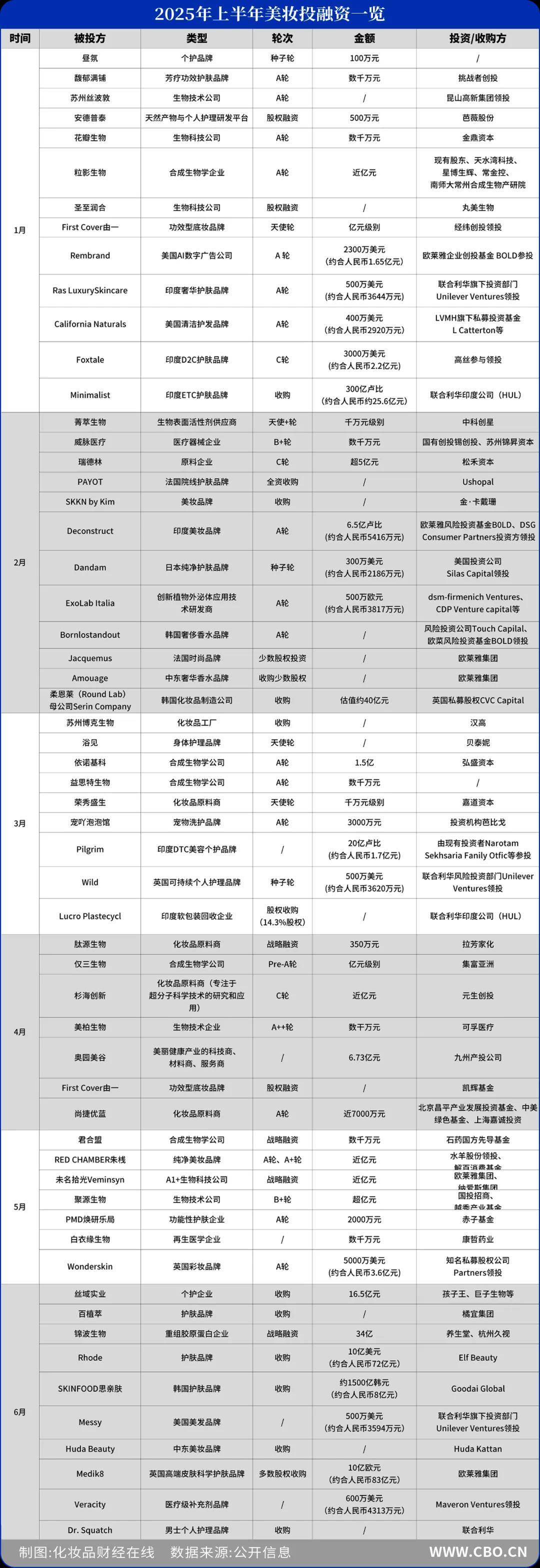
近60起,美妆投融资热潮来了!
Sou Hu Cai Jing· 2025-07-03 07:12
Core Insights - The beauty industry is experiencing significant activity in mergers and acquisitions, with notable transactions such as Unilever's acquisition of Dr. Squatch and the investment by Zhong Shanshan in Jinbo Biotechnology [1][12] - International giants like Unilever and L'Oréal are leading the charge in strategic mergers to enhance their brand portfolios and technological capabilities, particularly in emerging markets like India and the Middle East [1][10][12] - The trend of high-value transactions is evident, with 21 deals exceeding 100 million yuan and 6 deals over 1 billion yuan, highlighting the industry's robust investment landscape [1][12] Investment Trends - There were 58 beauty-related investment activities in the first half of the year, including 14 acquisitions, indicating a vibrant investment climate [1][12] - The focus on synthetic biology and biotechnology continues to attract capital, with companies in these sectors receiving significant funding [3][24] - The investment landscape is characterized by early-stage financing, with seed, angel, and A-round investments being predominant [12][24] Regional Focus - India, South Korea, and the Middle East are emerging as key markets for international capital, driven by their rapid growth and unique consumer preferences [12][13][17] - The Middle East beauty market is projected to grow significantly, with a current market size of $40 billion expected to exceed $60 billion by 2025 [15][17] - South Korea is becoming a major supplier of beauty products to the U.S. and Japan, with a market share of 22.2% in the U.S. [15] Company Strategies - Unilever is focusing on expanding its brand matrix in personal care and skincare, with recent acquisitions aimed at entering high-growth segments [8][10] - L'Oréal is investing in technology-driven companies and high-end brands, such as the acquisition of Medik8 for 1 billion euros, to strengthen its position in the skincare sector [10][12] - Domestic companies like Water Sheep and Betaini are actively participating in industry chain investments and acquisitions, indicating a trend towards ecosystem enhancement [12][24] Market Dynamics - The demand for functional and effective products is driving investment in brands that offer clear positioning and innovative solutions [24][26] - Emotional value and consumer experience are becoming critical factors in investment decisions, with brands that provide significant emotional engagement attracting capital [21][24] - The rise of niche markets and specific application scenarios is also influencing early-stage financing, as companies seek to address unique consumer needs [23][24]