
动力电池回收利用管理法治化

Search documents
动力电池回收新规将落地:堵住回收漏洞 全产业链闭环监管时代开启
Xin Lang Cai Jing· 2026-01-20 16:47
Core Viewpoint - The Ministry of Industry and Information Technology (MIIT) and five other departments have jointly issued the "Interim Measures for the Recycling and Comprehensive Utilization Management of Waste Power Batteries from New Energy Vehicles," which will take effect on April 1, 2026. This regulation aims to strengthen the management of power battery recycling and utilization through legal means, addressing the challenges posed by the increasing volume of retired batteries as the new energy vehicle industry rapidly develops [1][3]. Group 1 - The new regulation mandates a "vehicle-battery integration" approach, requiring that if a battery is missing during the recycling process, the vehicle will be deemed "missing." This aims to tackle the issue of retired batteries flowing into non-compliant channels [7][8]. - The regulation is expected to fill existing institutional gaps and centralize control over the end of the industry chain, thereby improving the market environment for compliant enterprises [3][9]. - Approximately 75% of retired power batteries currently flow into non-compliant channels, exacerbating environmental pollution and safety risks. The regulation aims to address this by enforcing stricter compliance measures [8][10]. Group 2 - A nationwide traceability information platform for power batteries will be established, generating a unique digital identity for each battery to monitor its lifecycle from production to recycling [9][10]. - The regulation specifies the extended producer responsibility for battery and vehicle manufacturers, requiring them to establish recovery service points and provide necessary information for battery recycling [10][11]. - Administrative penalties will be imposed for non-compliance with the recycling responsibilities, including fines and corrective orders, thereby enhancing accountability within the industry [10][11].

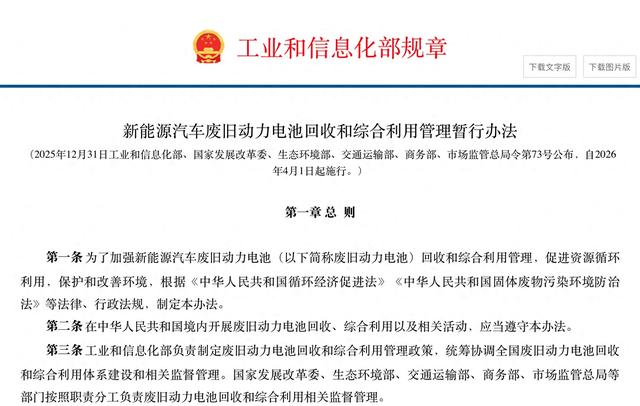
动力电池回收利用管理进一步完善 引导产业走向规范新阶段
Xin Lang Cai Jing· 2026-01-18 21:31
Core Viewpoint - The recent issuance of the "Interim Measures for the Management of Recycling and Comprehensive Utilization of Waste Power Batteries for New Energy Vehicles" marks a significant step towards legalizing the management of power battery recycling and utilization in China, emphasizing a "full-channel, full-chain, and full-lifecycle" approach [1][2]. Group 1: Policy Framework - The "Interim Measures" are a key implementation of the "Action Plan for Improving the Recycling and Utilization System of Power Batteries for New Energy Vehicles," which aims to accelerate the establishment of relevant regulations [2]. - The measures include a "vehicle-battery integrated scrapping" system to ensure that scrapped new energy vehicles come with their power batteries, preventing the loss of tracking for waste batteries [2][3]. Group 2: Responsibilities and Regulations - The measures clarify the responsibilities of battery manufacturers and new energy vehicle producers, mandating them to fulfill extended producer responsibility and enhance information sharing across the industry chain [1][3]. - Specific obligations are outlined for various stakeholders, including battery replacement service providers and vehicle dismantling enterprises, to ensure proper disposal and recycling of waste batteries [3][4]. Group 3: Industry Impact - The new regulations aim to standardize the market for battery disposal and recycling, addressing previous issues of low industry entry barriers that led to substandard practices [4]. - Enhanced regulatory measures will impose penalties for non-compliance, such as failing to report battery information or not fulfilling recycling responsibilities, thereby strengthening the enforcement of the new rules [4]. Group 4: Future Outlook - The industry is expected to move towards a more sustainable future under the guidance of these policies, with a projected increase in waste battery generation exceeding 1 million tons by 2030 [1]. - The establishment of a national information platform for tracking battery flows and the introduction of digital identification for batteries are anticipated to improve monitoring and management [2].