
新能源汽车废旧动力电池

Search documents
每日市场观察-20260324
Caida Securities· 2026-03-24 07:00
Market Performance - On March 23, the Shanghai Composite Index fell by 3.63%, the Shenzhen Component Index dropped by 3.76%, and the ChiNext Index decreased by 3.49%[3] - The trading volume on March 23 reached 2.45 trillion CNY, an increase of approximately 150 billion CNY compared to the previous trading day[1] Sector Analysis - All sectors except for oil and coal experienced declines, with agriculture, commerce, electronics, and textiles showing the largest drops[1] - Over half of the industries saw declines exceeding 4%, with the banking sector also experiencing significant losses[1] Market Sentiment - The market is experiencing heightened panic, influenced by escalating tensions in the Strait of Hormuz, which are affecting global energy markets and economic systems[1] - International oil prices have surpassed 100 USD per barrel, and European natural gas prices have significantly increased[1] Economic Impact - The conflict is causing a ripple effect, leading to rising prices in fertilizers and other agricultural products, which may further increase food production costs[1] - The Chinese government is focusing on developing a diverse clean energy system, including wind, solar, nuclear, and biomass energy during the 14th Five-Year Plan[5] Fund Flow - On March 23, the Shanghai Stock Exchange saw a net outflow of 14.944 billion CNY, while the Shenzhen Stock Exchange had a net inflow of 0.793 billion CNY[4] - The top three sectors for capital inflow were passenger vehicles, packaging and printing, and photovoltaic equipment, while the top outflow sectors included semiconductors, communication equipment, and components[4] Industry Developments - In the first two months of 2026, China's engineering machinery product exports reached 10.686 billion USD, marking a year-on-year increase of 33.4%[10] - The Ministry of Industry and Information Technology is conducting research on the recycling and utilization of used power batteries from new energy vehicles[9]
电池回收进入“硬监管时代”,车企、电池厂、拆解企业该做什么?| 退役电池研究室①
Xin Lang Cai Jing· 2026-02-05 05:51
Core Viewpoint - The new regulations for the recycling and comprehensive utilization of used power batteries in the electric vehicle industry mark a transition to a stringent regulatory phase, emphasizing compliance and accountability in battery recycling practices [1][4]. Group 1: Regulatory Framework - The Ministry of Industry and Information Technology issued the "Interim Measures for the Management of Recycling and Comprehensive Utilization of Used Power Batteries for New Energy Vehicles," which signifies the entry into a strong regulatory phase for battery recycling [1][4]. - The new regulations optimize the recycling management system by clarifying responsibilities at various stages, enhancing the battery traceability system throughout its lifecycle, and improving multi-departmental collaborative supervision mechanisms [1][4]. Group 2: Compliance and Accountability - The regulations introduce clear penalties and accountability for recycling violations, transitioning from principle-based advocacy to mandatory compliance requirements [2][4]. - The introduction of a battery identification system provides a basis for legally holding specific companies accountable, effectively reducing the flow of retired batteries into informal recycling channels [2][4]. Group 3: Lifecycle Management - The new regulations enhance the existing battery recycling traceability management system established in 2018, requiring a unified battery coding system for credible and traceable data throughout the battery's lifecycle [8]. - The system will allow different data access levels for government and enterprises, facilitating regulatory oversight and operational management optimization [8]. Group 4: Responsibility Allocation - The new regulations clarify the responsibilities of various stakeholders based on battery source types, assigning responsibilities to vehicle manufacturers, battery manufacturers, and comprehensive utilization enterprises [9]. - Vehicle manufacturers are required to establish recovery service points that match their sales volume and inform consumers about recycling procedures when batteries reach suggested retirement conditions [9][10]. Group 5: Recommendations for Stakeholders - Battery and vehicle manufacturers should implement dedicated management for waste batteries and ensure compliance with the unified information reporting system [10]. - Scrap vehicle dismantling enterprises are encouraged to collaborate with vehicle manufacturers to guide consumers in proper disposal practices [11]. - Consumers are advised to choose recognized service points for maintenance and disposal to avoid unqualified recycling channels [12]. - Other enterprises, such as maintenance and battery swap companies, must ensure proper storage and transfer of waste batteries to designated recovery service points [13].

我国加强新能源汽车废旧动力电池回收利用
Zhong Guo Zhi Liang Xin Wen Wang· 2026-01-29 06:23
Core Viewpoint - The Ministry of Industry and Information Technology and five other departments have jointly issued the "Interim Measures for the Recycling and Comprehensive Utilization of Waste Power Batteries from New Energy Vehicles," emphasizing a management approach that covers the entire lifecycle of batteries, requiring that scrapped vehicles must include their power batteries, which will have a digital identity [1] Group 1: Regulatory Framework - The new regulations aim to prevent the illegal recycling of waste power batteries by ensuring that scrapped vehicles are accompanied by their batteries, with specific provisions for non-replaceable battery models being developed separately [2] - The measures introduce new requirements for the comprehensive utilization of waste batteries, eliminating the concept of "second-use" batteries to ensure safety and compliance with quality standards [3] Group 2: Recycling and Utilization - The recycling of waste power batteries is crucial as they contain valuable metals like nickel, cobalt, manganese, and lithium, as well as hazardous substances that can harm the environment if not properly managed [1][3] - The recycling rates achieved by some companies have reached 99.6% for nickel, cobalt, and 96.5% for lithium, demonstrating significant economic, social, and ecological benefits [4] Group 3: Management Approach - The measures follow a "full-channel, full-chain, full-lifecycle" management strategy, which includes standardized management of battery production, vehicle scrapping, battery swapping operations, and maintenance [5][6] - A nationwide information platform will be established to track the lifecycle of power batteries, with each battery receiving a unique digital identity to facilitate monitoring and compliance [7]
观车 · 论势 || 动力电池报废新规开启产业新篇
Zhong Guo Qi Che Bao Wang· 2026-01-26 10:34
Core Viewpoint - The introduction of the "Interim Measures for the Recycling and Comprehensive Utilization of Waste Power Batteries for New Energy Vehicles" marks a significant regulatory shift aimed at establishing a comprehensive management framework for battery recycling, emphasizing lifecycle management and digital solutions to enhance the sustainability of the new energy vehicle industry [1][2]. Group 1: Regulatory Innovations - The "Vehicle-Battery Integrated Scrapping" system addresses industry pain points by mandating that scrapped vehicles must include their power batteries, preventing the illegal sale of batteries in black markets [1][2]. - The digital identity management system for power batteries introduces unique dynamic codes for each battery, enabling full-chain traceability and proactive regulatory measures, which can enhance consumer confidence and optimize resource allocation for companies [1][2]. - A comprehensive responsibility system and strict penalty mechanisms are established, holding all stakeholders accountable and imposing administrative penalties for non-compliance, with severe cases potentially leading to criminal liability [2][3]. Group 2: Challenges in Implementation - Market-level challenges include the need to address the knowledge gap and financial concerns of vehicle owners, particularly those in the ride-hailing and freight sectors, who may resist the new regulations due to perceived short-term financial losses [2][3]. - Small and medium-sized enterprises face significant compliance costs and technical adaptation challenges, which may lead to the elimination of potentially viable companies during industry consolidation [3][4]. - Regulatory challenges include regional disparities in enforcement capabilities and the need for improved data-sharing mechanisms among departments to effectively identify and address violations [3][5]. Group 3: Recommendations for Successful Implementation - The establishment of a market-based recycling pricing mechanism and incentives for compliant battery disposal can help balance interests and reduce the appeal of black market sales [4][5]. - Government support for small enterprises through subsidies, low-interest loans, and tax reductions can facilitate compliance and encourage collaboration among industry leaders to support smaller firms [4][5]. - Strengthening grassroots enforcement capabilities and enhancing inter-departmental collaboration are crucial for effective regulation, alongside the development of detailed technical standards for battery recycling and utilization [5].
我国工业绿色低碳发展成效显著
Yang Shi Wang· 2026-01-24 11:43
Group 1 - The core viewpoint of the articles highlights the continuous improvement of China's green manufacturing service system during the "14th Five-Year Plan" period, with the emergence of "waste-free parks," "waste-free enterprises," and green factories, accelerating the transformation and upgrading of production methods towards greenness [1][2] - By 2025, the comprehensive utilization of waste power batteries from new energy vehicles in China is expected to exceed 400,000 tons, with various sectors increasingly adopting "waste-to-resource" practices [1] - The latest data shows that during the "14th Five-Year Plan," the reuse rate of industrial water in large-scale industries in China exceeds 94%, and the comprehensive utilization rate of major industrial solid waste reaches 57% [1] Group 2 - The efficiency of resource utilization is continuously improving, with the energy structure of industrial use being optimized; by 2025, the use of renewable energy in green computing facilities in China is expected to exceed 70% [2] - As of now, China has cultivated over 8,000 national-level green factories and more than 600 green industrial parks [2] - During the "14th Five-Year Plan," the output value of green factories accounted for 22% of the total output value of the manufacturing industry, up from 9%, with a cumulative reduction of over 13.5% in energy consumption per unit of added value in large-scale industries [2]
记者观察|动力电池“终身码”:一场深刻的产业治理革命
Zhong Guo Jing Ying Bao· 2026-01-22 16:25
Core Viewpoint - The introduction of a "digital identity" for every power battery in China's new energy vehicle industry marks a significant institutional reform, transitioning the industry from chaotic growth to regulated maturity, with a projected market scale exceeding 100 billion yuan by 2030 [1][3]. Group 1: Industry Transformation - The new regulation will enforce a "vehicle-battery integrated scrapping" policy, fundamentally altering the operational landscape and ensuring stable raw material supply for compliant enterprises [1][2]. - The current stock of new energy vehicles in China has surpassed 40 million, leading to an impending wave of battery retirements, with annual retirements expected to exceed 1 million tons by 2030 [1]. Group 2: Lifecycle Management - The establishment of a tracking system for batteries will create a dynamic "life file," enhancing regulatory oversight and curbing illegal circulation while enabling new business models based on accurate data [2][3]. - The system will drive optimization across the industry chain, necessitating design considerations for recyclability, production traceability, and battery health monitoring [2]. Group 3: Competitive Landscape - Future competition will hinge on digital capabilities, with companies that effectively utilize traceability data to optimize recycling networks and accurately assess battery residual value gaining a competitive edge [2][3]. - Leading companies are already achieving breakthroughs in recycling technologies, allowing for efficient extraction and recycling of key metals, which will translate into tangible competitive advantages in a regulated market [2]. Group 4: Implementation Challenges - Successful execution of the digital identity system relies on the integrity of data, supported by IoT technology and clear responsibility mechanisms, alongside a well-functioning recovery network [3][4]. - Long-term sustainability in the market will depend on ensuring that compliant businesses achieve real economic benefits and that the costs of recycling are lower than those of raw material extraction [3][4].
动力电池回收迎来“全链条”强监管时代
Xin Lang Cai Jing· 2026-01-22 05:49
Core Viewpoint - The rapid growth of China's new energy vehicle industry has led to a surge in retired power batteries, prompting the need for standardized recycling and utilization practices, as highlighted by the recent issuance of the "Interim Measures for the Management of Recycling and Comprehensive Utilization of Waste Power Batteries for New Energy Vehicles" by six government departments, marking a new phase in regulatory management for battery recycling [1][2]. Group 1: Regulatory Framework - The new management measures significantly enhance legal constraints compared to previous frameworks, addressing the inadequacies of the 2018 traceability management regulations [2]. - A notable innovation is the establishment of a digital identity management system for power batteries, which will enable real-time monitoring and information tracing throughout the battery's lifecycle, from production to recycling [2][4]. - The measures impose clear responsibilities on all parties involved and outline administrative penalties for non-compliance with recycling obligations and improper handling of waste batteries [4]. Group 2: Industry Development - China has established a recycling network across 31 provinces, nurturing 148 key enterprises in comprehensive utilization, with recovery rates for lithium, cobalt, and nickel at internationally advanced levels [5]. - Nearly 30 national standards have been released, covering various aspects of recycling, and the market regulatory authority aims to accelerate the development and implementation of these standards to guide high-quality industry growth [5]. - The introduction of these measures is seen as a milestone in transitioning the battery recycling industry from chaotic growth to high-quality development, promoting collaboration across the supply chain and maximizing the residual value of retired batteries [5].
新能源车报废将实行“车电一体”制
Mei Ri Shang Bao· 2026-01-22 00:25
Core Viewpoint - The new regulations for the recycling and comprehensive utilization of used power batteries from new energy vehicles (NEVs) will take effect on April 1, 2026, addressing the urgent need for standardized recycling processes as the first batch of NEVs approaches retirement [1]. Group 1: Regulations on Non-Swap Battery Vehicles - For non-swap battery vehicles, the core requirement is that the power battery must be handed over together with the vehicle to a qualified recycling and dismantling organization upon retirement [2]. - By 2025, the total amount of retired power batteries in China is expected to reach 820,000 tons, and it is projected to exceed 1 million tons by 2030 [2]. - The new regulations include a "digital ID" for each battery, allowing for full lifecycle tracking from production to recycling, which aims to prevent illegal sales and ensure consumer protection [2]. Group 2: Clarifications for Battery Replacement and Recycling Channels - Vehicle owners are advised to keep records of battery replacements and recycling receipts to avoid complications during the vehicle retirement process [3]. - The regulations require battery manufacturers to establish recycling points in each province, while NEV manufacturers must cover recycling points down to the prefecture level, simplifying the recycling process for vehicle owners [3]. - Strict penalties are established for those who illegally repurpose used batteries for other applications, with fines ranging from 10,000 to 100,000 yuan for serious violations [3]. Group 3: Exemptions for Swap Battery Vehicles - Swap battery vehicles are exempt from the "vehicle-battery integration" requirement, recognizing the unique nature of the battery swap model [4]. - The decision to exempt swap vehicles is based on the growing prevalence of battery swap networks, such as those operated by NIO and CATL, which have established extensive infrastructure [4]. - The regulations will allow for different ownership models of batteries, whether purchased outright or rented, without requiring the battery to be returned with the vehicle upon retirement [4]. Group 4: Recycling Technology and Market Regulation - The recycling technology for used power batteries in China has matured, with some companies achieving recovery rates of 99.6% for nickel-cobalt-manganese and 96.5% for lithium [5]. - The implementation of the new regulations is expected to further reduce illegal recycling activities, leading to a more regulated and orderly recycling market [5]. - The overall lifecycle management system for NEVs will become more robust, enhancing environmental protection and public safety while improving the user experience for vehicle owners [6].

全链条管理废旧动力电池回收利用
Jing Ji Ri Bao· 2026-01-21 22:16
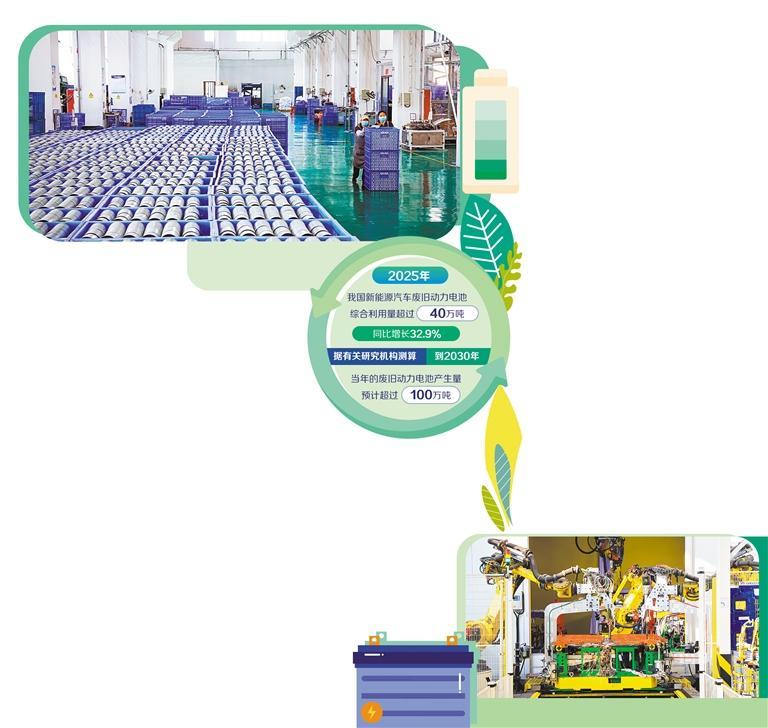
Core Viewpoint - The introduction of the "Interim Measures for the Recycling and Comprehensive Utilization of Used Power Batteries for New Energy Vehicles" marks a new phase in the standardized management of used power battery recycling in China, addressing the increasing volume of waste batteries due to the rapid development of the new energy vehicle industry [2][4]. Group 1: Regulatory Framework - The new management measures significantly enhance legal constraints and aim to resolve existing issues in the recycling process, such as unregulated sales and dismantling of used batteries [5][4]. - The previous regulations from 2018 will be abolished, and a digital identification system for power batteries will be established to monitor their lifecycle and ensure compliance [4][7]. Group 2: Industry Development - By 2025, the comprehensive utilization of used power batteries in China is expected to exceed 400,000 tons, reflecting a year-on-year growth of 32.9%, with leading companies achieving international standards in metal recovery rates [3]. - The management measures will require companies to adhere to new conditions for engaging in comprehensive utilization, focusing on compliance and environmental protection [7][8]. Group 3: Stakeholder Responsibilities - The recycling and utilization of used power batteries require collaboration among various stakeholders, including policy, market, technology, and standards [6]. - The government has established a recycling network across 31 provinces and has cultivated 148 leading enterprises in the comprehensive utilization sector [6]. Group 4: Public Participation - The measures emphasize the importance of public involvement in the recycling process, urging consumers to understand and comply with battery recycling guidelines when purchasing new energy vehicles [9]. - The call for collective responsibility highlights the need for consumers to ensure that used batteries are disposed of through regulated channels to prevent environmental hazards [9].
直击新能源汽车废电池黑产链:激光焊接+无证拼装
Mei Ri Jing Ji Xin Wen· 2026-01-21 12:57
Core Viewpoint - The article discusses the rising demand for "disassembled batteries" sourced from retired electric vehicle batteries, highlighting the regulatory challenges and market dynamics surrounding their use in electric bicycles and other applications [1][4][5]. Group 1: Market Dynamics - The demand for disassembled batteries is driven by their lower cost and higher performance compared to original batteries, appealing particularly to delivery riders and couriers [1][2]. - A disassembled battery can provide a range of up to 80 kilometers, significantly more than the original battery's 40 kilometers [1]. - The price of a disassembled battery is approximately 3,000 yuan, which is about 500 yuan cheaper than a new battery of the same specifications [2]. Group 2: Regulatory Environment - The Ministry of Industry and Information Technology has issued new regulations prohibiting the use of retired batteries in electric bicycles, effective from April 1, 2026 [1][5]. - The concept of "cascade utilization" for retired batteries has been eliminated, which previously allowed for their use in various applications [5]. - The new regulations emphasize the "vehicle-battery integration" requirement for the scrapping of electric vehicles, mandating that batteries must be included during the scrapping process [5]. Group 3: Industry Challenges - A significant portion of retired batteries, estimated at 80%, is reportedly missing from vehicles before they reach authorized recycling facilities, indicating a leakage into unregulated markets [4]. - The recycling capacity of legitimate battery recycling companies is underutilized, with estimates suggesting that only 25% of their capacity is currently being used [4]. - The rapid growth of the electric vehicle market has led to an urgent need for a robust battery recycling infrastructure to manage the increasing volume of retired batteries [6][9]. Group 4: Future Projections - The domestic battery recycling volume is projected to exceed 300,000 tons by 2024, with the number of retired lithium batteries expected to reach 981,600 tons by 2026 [7][8]. - The market for recycled materials from lithium batteries is anticipated to grow significantly, with sales expected to reach 856,100 tons by 2025 and 1,204,500 tons by 2026 [10].