动态更新机制

Search documents
新闻发稿如何借力GEO优化,实现AI时代的精准流量突围?
Xin Lang Cai Jing· 2026-02-04 05:06
Core Insights - The news release landscape is undergoing a fundamental transformation in the AI era, where users are adopting AI-generated answers directly instead of clicking on search results, making traditional exposure logic ineffective [1] - The goal of news releases has shifted from merely being published to being selected by AI for citation [5] Group 1: GEO's Impact on News Release Value Chain - GEO (Generative Engine Optimization) aims to position brand information as an authoritative source in AI responses, differing from traditional SEO which focuses on webpage ranking [3] - The GEO process consists of three stages: 1. Retrieval phase, where AI matches content based on semantic understanding rather than keyword stuffing [3] 2. Summary phase, where AI extracts key information from multiple articles to create structured answers, filtering out poorly supported or illogical content [4] 3. Generation phase, where AI synthesizes the final answer and automatically cites sources, providing authority to the referenced media and brands [4] Group 2: Practical Strategies for High Citation Rate GEO-Friendly Content - Content should be structured for easy understanding by AI, using a "conclusion first + bullet points" format, and employing Schema markup to enhance parsing efficiency [6] - Media selection should focus on high-authority sources tailored to different AI platforms, creating a "GEO media pool" for targeted distribution [6] - A dynamic updating mechanism is essential to maintain long-term visibility, requiring regular data updates and tracking AI citation status [7] - Geographic and situational targeting can enhance user engagement by delivering relevant content based on location and behavior [8] Group 3: One-Stop GEO Media Platform Recommendation - Super media platforms serve as efficient tools for enterprises to connect with various GEO media, significantly reducing channel expansion and management costs [10] - These platforms offer comprehensive GEO resource coverage, precise targeting capabilities, and full-process data visualization to optimize strategies [10] - The standardized process of super media platforms allows for bulk uploads and simultaneous multi-region distribution, minimizing manual operational costs [10] Group 4: Future Trends in GEO Optimization - The GEO optimization market in China is projected to exceed 10 billion by 2026, indicating a growing necessity for GEO capabilities in news release platforms [11] - Companies are encouraged to establish GEO optimization roles, adopt semantic analysis and structured writing skills, and implement AI content scoring systems to enhance trust and effectiveness [11]


产业地图应从好看变实用
Jing Ji Ri Bao· 2025-10-29 22:15
Core Insights - Tianjin has released its first city-level "Productivity Map," which comprehensively organizes and integrates the current industrial layout and planning development space, outlining the overall layout and regional characteristics of various industries [1] Group 1: Value and Functionality of the Productivity Map - The primary value of the productivity map lies in breaking down information barriers, providing a clear overview of regional resources and supporting government decision-making [1] - For enterprises, the map integrates key elements such as land, policies, and supporting resources, transforming investment from a "needle in a haystack" approach to a more efficient "targeted search" [1] - The map transcends traditional spatial representations, evolving into an intelligent decision-making platform that integrates multi-dimensional information related to industries, policies, and resources [1] Group 2: Challenges in Implementation - Despite its potential, the productivity map faces challenges such as inadequate data update mechanisms, leading to outdated information, and a focus on招商部门 (investment promotion departments) while neglecting the diverse needs of the industrial chain [1][2] Group 3: Pathways for Improvement - To make the productivity map truly intelligent, breakthroughs are needed in three dimensions: breaking down data barriers, establishing dynamic update mechanisms, and enhancing smart application capabilities [2][3] - A data-sharing mechanism involving government departments, enterprises, and research institutions is essential for comprehensive analysis and accurate judgment [2] - Implementing a dynamic update mechanism using big data technology will ensure the map reflects real-time industrial changes, enhancing its timeliness and accuracy [2] Group 4: Technological Integration and Practical Applications - The integration of artificial intelligence into the productivity map is crucial for developing scenario-based smart applications tailored to the needs of different stakeholders, such as government, enterprises, and investors [3] - Successful examples from other cities, such as Beijing's "three maps in one" initiative and Wuhan's enterprise data platform, highlight the importance of establishing a collaborative data supply chain between government and enterprises [3]
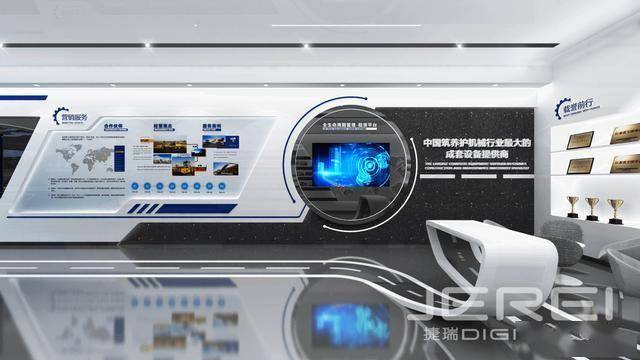
企业展厅——以空间叙事构建品牌价值场域
Sou Hu Cai Jing· 2025-08-28 08:47
Core Insights - The article emphasizes the transformation of corporate exhibition spaces from traditional display areas to core platforms for brand value expression, highlighting the importance of immersive experiences in conveying corporate strategy, culture, and technology [1] Group 1: Exhibition Hall Design - The design of corporate exhibition halls should prioritize user needs, with a focus on understanding the audience's profile, such as investors, partners, and general visitors [3] - A multi-layered narrative framework is essential for exhibition design, as demonstrated by a renewable energy company's exhibition that uses a storyline of "crisis awakening - technological breakthrough - ecological co-construction" [3] - The integration of technology should serve content expression, avoiding a cold, tech-heavy feel while enhancing product memory through interactive elements [3] Group 2: Spatial Layout Design - Spatial layout is a balance between audience movement and information density, with different layouts suited for varying narrative strengths [4] - The use of vertical space can enhance the perception of area, as seen in a project that utilized mirror ceilings and LED light strips to create a sense of expanded space [4] - Lighting design plays a crucial role in setting the emotional tone of the space, with different color temperatures used to evoke specific feelings in various exhibition areas [4] Group 3: Exhibition Hall Operation - A dynamic updating mechanism is recommended to maintain the vitality of the exhibition hall, combining fixed core exhibits with rotating auxiliary areas [5] - Data-driven operations can enhance space efficiency, utilizing tools like heat maps and eye-tracking to optimize visitor engagement [5] - The evolution of exhibition halls from "physical containers" to "ecological platforms" reflects a shift towards deeper brand-audience interactions, transforming visits into meaningful dialogues [5]