区域协同机制

Search documents
从“那时”到“这时”丨从“忧患河”到“幸福河”
He Nan Ri Bao· 2026-01-26 23:42
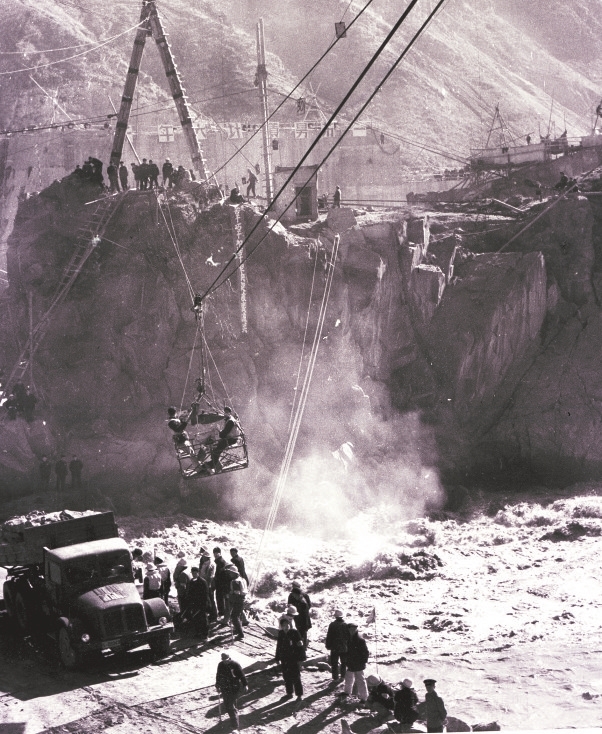
Core Insights - The article highlights the historical significance and modern transformation of the Sanmenxia Water Conservancy Project on the Yellow River, emphasizing its role in flood control, ecological protection, and smart water management [3][4]. Group 1: Historical Context - The Sanmenxia Water Conservancy Project, initiated in 1957, was the first large-scale water conservancy project built on the Yellow River in New China, constructed by thousands of workers under challenging conditions [3]. - The dam, measuring 713 meters in length and 106 meters in height, controls 91.5% of the Yellow River's watershed area, providing safety for 170 million people downstream [3]. Group 2: Ecological and Technological Advancements - Since 2009, the region has developed a 1,194-kilometer composite ecological corridor along the Yellow River, addressing soil erosion over an area of 6,779 square kilometers, with the river's water quality stabilizing at Class II [4]. - The Sanmenxia reservoir has created over 100 square kilometers of wetlands, increasing bird species from 175 to 315, attracting thousands of swans for wintering [4]. Group 3: Modern Water Management - The project has evolved from "engineering water management" to "ecological river protection," integrating safety, ecology, and intelligence into a modern water management system [4]. - The dam features 354 monitoring points forming a "nerve network," with robots conducting 24-hour inspections, achieving millimeter-level data precision [4]. - AI algorithms can forecast water conditions 72 hours in advance with over 95% accuracy, and during the 2025 water and sediment regulation period, the reservoir will provide 475 million cubic meters of water for sediment flushing [4]. Group 4: Future Recommendations - Suggestions for enhancing Yellow River protection include improving regional collaboration mechanisms, establishing cross-provincial compensation systems, and innovating cultural tourism linkages to promote the Yellow River's story globally [6].

为什么长三角是世界级城市群,而珠三角不是?
Sou Hu Cai Jing· 2025-10-09 01:28
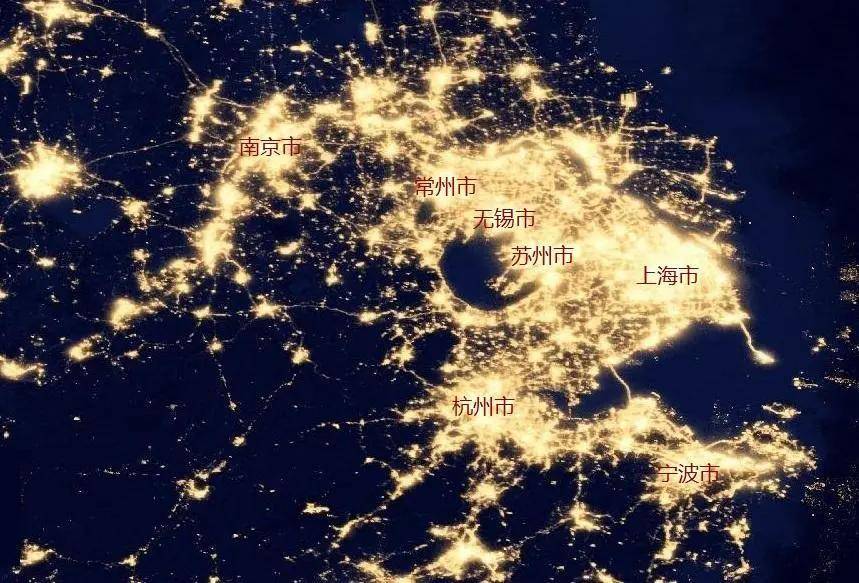
Economic Overview - The Yangtze River Delta (YRD) has a GDP approaching 30 trillion yuan in 2022, accounting for nearly one-quarter of the national total, surpassing the economic scale of Japan's Pacific coastal cities and comparable to New York metropolitan area [2] - In contrast, the Pearl River Delta (PRD) has a GDP of over 13 trillion yuan, which is approximately 45% of the YRD's total [2] Regional Development and Infrastructure - The YRD benefits from the Yangtze River basin as a vast hinterland, forming a "core-hinterland" gradient development pattern, with Shanghai as the leading city and Jiangsu, Zhejiang, and Anhui as supporting regions [2] - The PRD, while relying on the Pearl River, has limited hinterland expansion due to geographical barriers, primarily radiating its influence within South China [2] Industrial Structure - The YRD exhibits a dual-driven structure of "manufacturing powerhouse + innovation hub," with diverse industries including finance, shipping, and advanced manufacturing [3] - The YRD has established complete industrial chains in emerging sectors such as integrated circuits, biomedicine, and artificial intelligence, positioning itself as a national strategic technology force [3] - The PRD, known for its tech innovation in Shenzhen and advanced manufacturing in Dongguan, remains overly reliant on electronics manufacturing, making it vulnerable to global industry fluctuations [3][4] Collaborative Mechanisms - The integration of the YRD has become a national strategy, with mature collaborative mechanisms that break down administrative barriers, fostering cooperation among the three provinces and one city [3][4] - The YRD's cities are gradually forming a "quasi-same-city" development pattern through improved market systems and public service networks [4] Talent and Cultural Strength - The YRD boasts eight "Double First-Class" universities, facilitating a talent market that promotes free movement and efficient allocation of human resources [5] - The cultural heritage of the YRD, combined with its educational resources, enhances its soft power and sustainable development capabilities [5] - The PRD, while rich in Lingnan culture, lags in high-end talent reserves and cultural soft power compared to the YRD, impacting its long-term innovation capacity [5] Global Competitiveness - The YRD is emerging as a world-class urban agglomeration, characterized by economic scale, diverse industries, regional integration, talent attraction, and cultural depth [6] - The PRD, supported by the Guangdong-Hong Kong-Macao Greater Bay Area strategy, is accelerating its development in technology innovation and international openness, showcasing strong vitality in these areas [6] - Both urban clusters represent different models of regional economic development, with the YRD focusing on breadth and depth, while the PRD emphasizes speed and sharpness [6]