区域经济韧性

Search documents
青岛银行(002948):——2026年度经营展望:资产质量比利润高增更超预期
Changjiang Securities· 2026-02-04 08:42
Investment Rating - The report maintains a "Buy" rating for Qingdao Bank [9] Core Viewpoints - Qingdao Bank's performance in 2025 exceeded expectations, achieving over 20% profit growth for two consecutive years, with a strong outlook for 2026 [2][6] - The bank's asset quality has significantly surpassed expectations, indicating underestimated risk management capabilities [2] - The bank has effectively reduced its asset quality burden since 2019 and has centralized credit approval processes to unify risk preferences across branches [2] - Future credit cost rates are expected to improve further, with a projected provision coverage ratio exceeding 300% [2] - The bank's return on equity (ROE) is anticipated to continue rising, and its current valuation remains undervalued from a price-to-book (PB) and price-to-earnings (PE) perspective [2] Summary by Relevant Sections Performance Overview - Qingdao Bank's 2025 net profit growth reached 21.7%, with a significant quarterly increase of 47.8% in Q4 [12] - The bank's loan growth is projected to maintain double-digit rates, driven primarily by corporate lending [12] - The net interest margin is expected to face slight downward pressure, but overall interest income is forecasted to grow robustly [12] Asset Quality and Risk Management - The non-performing loan (NPL) ratio decreased significantly to 0.97% in Q4 2025, with a provision coverage ratio rising to 292% [12] - The bank's credit cost is estimated to be around 1% for 2025, with potential to decrease to 0.7% in the future [12] - Continuous provisioning for non-credit assets has contributed to profit growth, indicating strong risk management practices [12] Strategic Outlook - The bank's three-year strategic plan has been successfully executed, with a compound annual growth rate (CAGR) of 15.4% for total assets and 18.9% for profits from 2023 to 2025 [12] - The economic resilience of Shandong province, where the bank operates, is expected to support continued growth, with the province projected to surpass a GDP of 10 trillion yuan by 2025 [12] - Qingdao Bank's market share in Shandong is currently low at 2.3%, suggesting significant room for growth compared to other regional banks [12]
“博鳌亚洲论坛将创造更多合作机遇”——访沙特基础工业公司首席执行官阿尔-法季
Xin Hua She· 2025-11-30 23:13
Group 1 - The Boao Forum for Asia is an important platform for government, business, and academic leaders to create more cooperation opportunities and promote common development [1] - The Riyadh meeting of the Boao Forum will be held on December 26-27, 2025, in Saudi Arabia, with over 300 guests from more than 10 countries and regions discussing topics such as regional economic resilience, energy transition, and sustainable development [1] - The Riyadh meeting is seen as a significant opportunity to enhance cooperation among Asian countries and to showcase opportunities in Saudi Arabia, particularly in the petrochemical sector [1] Group 2 - The Saudi Basic Industries Corporation (SABIC) has been operating in the Chinese market for over 40 years and is one of the first large multinational companies to enter China [2] - SABIC emphasizes that its cooperation with China goes beyond mere trade, focusing on collaborative partnerships that involve knowledge exchange, technology sharing, joint innovation, and providing market solutions [2] - The company recognizes China's efforts to optimize the business environment and is committed to actively participating in China's economic development in the future [2]
博鳌亚洲论坛利雅得会议聚焦经济多元化与可持续发展
Xin Hua She· 2025-11-28 03:16
Group 1 - The Boao Forum for Asia Riyadh Conference 2025 opened in Riyadh, Saudi Arabia on November 27, focusing on the theme of "Transforming to Promote Regional Economic Diversification and Sustainable Development" [1] - The conference will host two sub-forums addressing topics such as regional economic resilience, energy transition, and sustainable development [1]
山东12家城商行中期业绩分析:稳健增长显现区域金融韧性
Guan Cha Zhe Wang· 2025-09-05 07:19
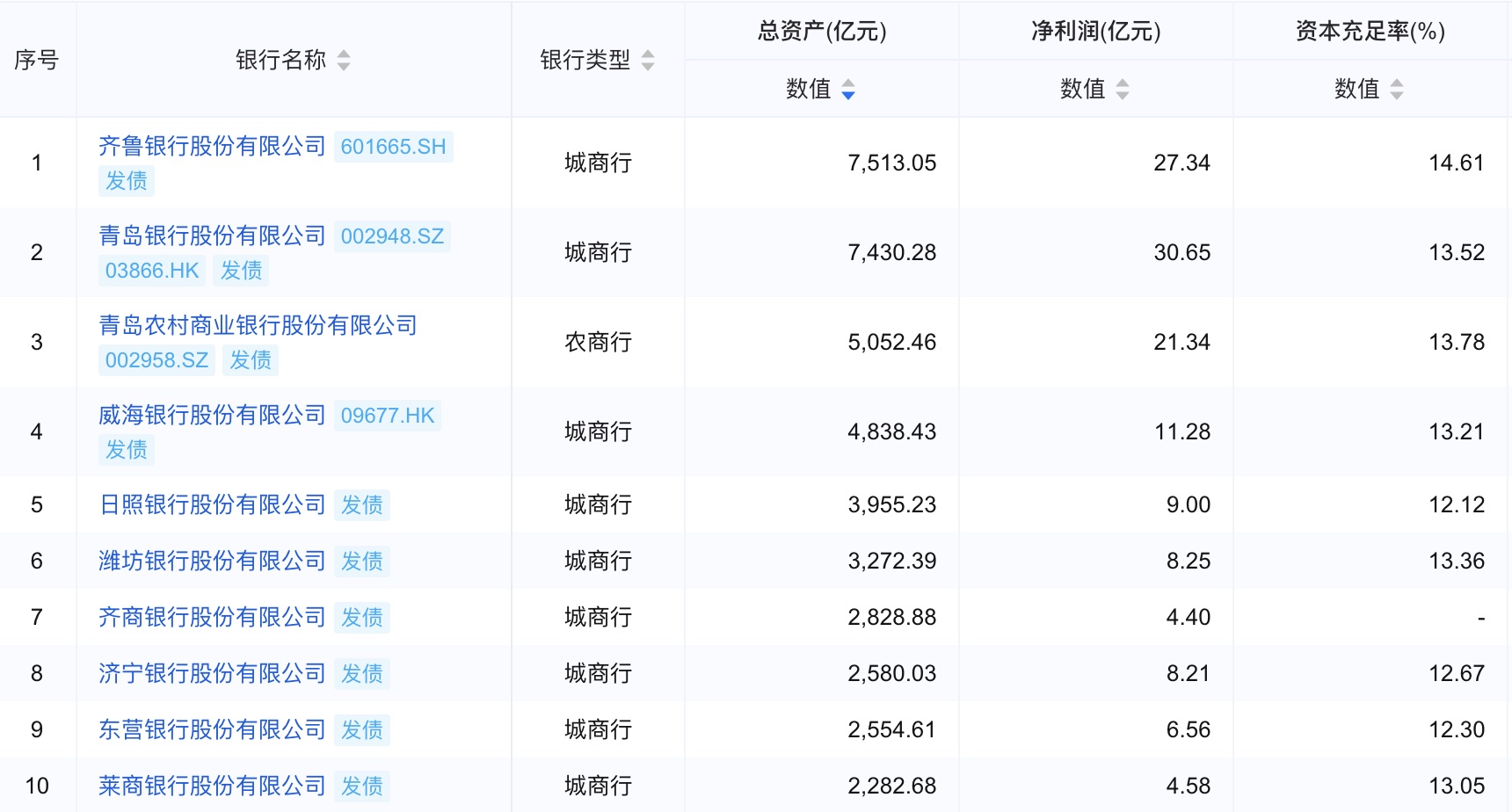
Core Insights - The article highlights the strong development momentum of local banks in Shandong, showcasing impressive performance in asset scale expansion, profitability improvement, and risk management amid regional economic resilience [1][4]. Group 1: Asset Scale and Competition - As of June 2025, Qilu Bank leads with total assets of 751.305 billion, followed closely by Qingdao Bank at 743.028 billion, establishing a "dual-hero" competitive landscape [2][3]. - Linyi Commercial Bank exhibited remarkable asset growth, increasing by 13.04% compared to the end of 2024, marking it as the fastest-growing bank [3]. Group 2: Profitability and Revenue Structure - Qingdao Bank reported revenue of 7.662 billion, ranking first, while Qilu Bank followed with 6.782 billion, reinforcing their revenue dominance [5]. - Yantai Bank showed the highest revenue growth at 17.35%, with Jining Bank and Tai'an Bank achieving 15.89% and 13.02% growth, respectively [5]. - Qingdao Bank's net profit reached 3.152 billion, maintaining its leading position, while Qilu Bank's net profit was 2.727 billion [5]. Group 3: Income Sources and Asset Quality - Interest income remains a crucial revenue source, with Yantai Bank's interest income surging by 28.85%, leading the growth [6]. - Investment income for Qingdao Bank soared to 1.509 billion, a 93.96% increase, becoming a significant driver of non-interest income growth [7]. - Most Shandong city commercial banks maintain a low non-performing loan ratio between 1%-2%, indicating stable asset quality [7]. Group 4: Regional Economic Support and Future Outlook - Shandong's GDP grew by 6.2% in the first half of 2025, surpassing the national average, indicating a stable economic environment that supports banking growth [8]. - The article notes a differentiated development pattern among banks, with Qilu and Qingdao banks leveraging scale and brand, while others like Jining and Weifang banks show rapid growth potential [9]. - Future challenges include deepening interest rate marketization and increasing regulatory demands, necessitating banks to optimize income structures and enhance digital service capabilities [9].